
- Release Year: 2003
- Platforms: Windows
- Publisher: Cornelsen Verlag GmbH & Co. oHG
- Genre: Adventure, Educational
- Perspective: Fixed / flip-screen
- Game Mode: Single-player
- Gameplay: Mini-games
- Setting: Fantasy
Description
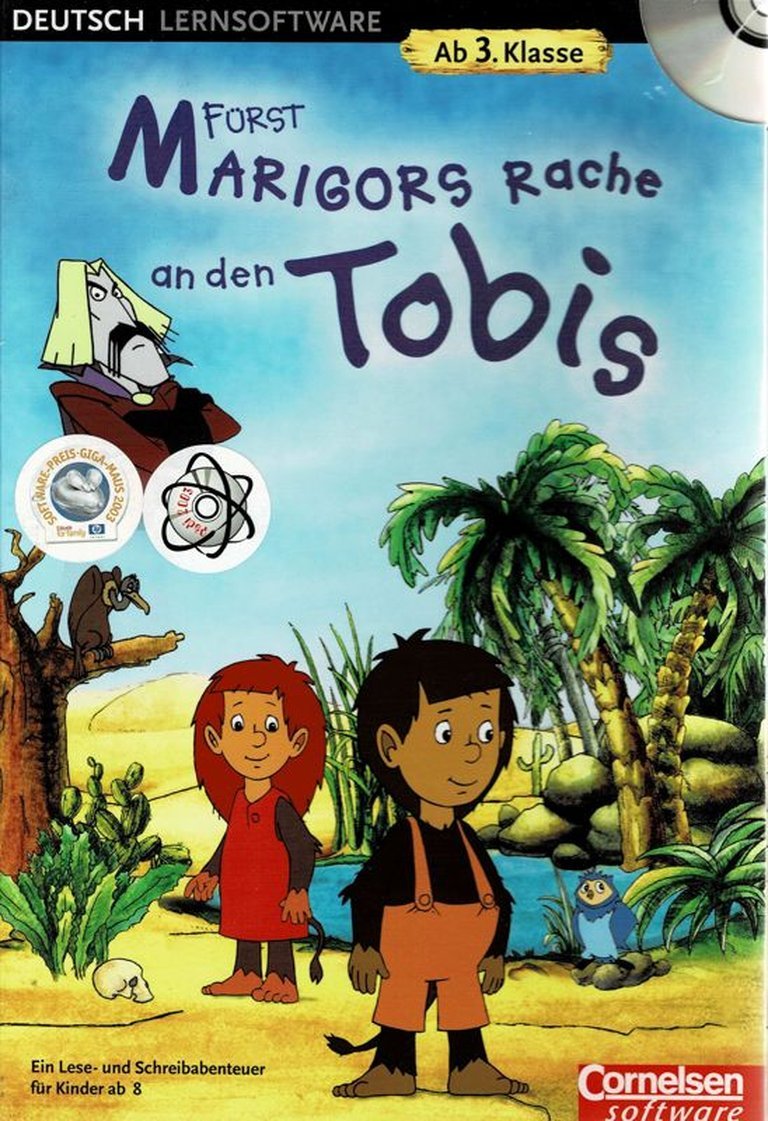
Fürst Marigors Rache an den Tobis is a 2003 educational adventure game for children aged eight and up, set in a fantasy world where the villainous Prince Marigor has conjured away all the colors. Protagonists Elo and Ela embark on a point-and-click quest to restore them, completing numerous minigames that test math, logic, reading, writing, and foreign language skills in a fixed/flip-screen environment.
Fürst Marigors Rache an den Tobis: Review
Introduction
In the colorful annals of early 2000s edutainment, few titles evoke the whimsical fusion of fantasy adventure and pedagogical rigor quite like Fürst Marigors Rache an den Tobis. Released in 2003 by the German educational powerhouse Cornelsen Verlag, this point-and-click adventure for children aged eight and up (roughly third grade and beyond) transforms the vengeful machinations of a color-stealing sorcerer into a gateway for mastering reading, writing, math, logic, and even elements of foreign languages and geography. As protagonists Elo and Ela (sometimes rendered as Ela and Alo in promotional materials) navigate a desaturated world to restore vibrancy, players unwittingly sharpen their skills through over 60 intricate puzzles and 100+ mini-games. This review posits that Fürst Marigors Rache stands as a pinnacle of German edutainment design—seamlessly blending narrative enchantment with curriculum-aligned challenges—cementing its status as an underappreciated artifact in video game history, deserving resurrection for modern audiences.
Development History & Context
Cornelsen Verlag GmbH & Co. oHG, a longstanding Berlin-based publisher specializing in schoolbooks and learning software, spearheaded the development of Fürst Marigors Rache an den Tobis as a direct sequel to the 1997 hit Fürst Marigor und die Tobis. While specific credits remain sparse (MobyGames lists none, urging community contributions), the project likely drew from the collaborative talents behind the original, including Hahn Interaktiv GmbH and Team-Konzept Informationstechnologien GmbH & Co. KG—studios versed in crafting child-friendly digital experiences.
The early 2000s marked the zenith of CD-ROM edutainment in Europe, particularly Germany, where government-backed digital literacy initiatives and a robust home PC market (fueled by affordable Windows 95/98/XP machines) created fertile ground. Technological constraints were pronounced: fixed 640×480 resolution, hand-drawn sprites in a fixed/flip-screen perspective, and reliance on DirectX-era middleware for smooth point-and-click interactions. No widescreen support or high-fidelity 3D—hallmarks of the impending console shift—meant developers leaned heavily on atmospheric 2D art and pre-rendered backgrounds to evoke immersion.
The gaming landscape was bifurcated: AAA titles like Half-Life 2 loomed on the horizon, but edutainment thrived in niches like Germany’s Lollipop or Tobi series. Cornelsen’s vision was unapologetically didactic yet entertaining, positioning the game as “Lernspaß” (learning fun). Released amid a wave of “Rache” (revenge)-themed titles (e.g., Die Rache der Moorhühner), it tapped into populist fantasy tropes while addressing post-PISA literacy gaps. Preservation efforts, like the imperfect ISO on Archive.org (noting 6% unrecoverable sectors), underscore its obscurity, with MobyGames entry dated February 2025—evidence of ongoing archival heroism.
Narrative & Thematic Deep Dive
At its core, Fürst Marigors Rache an den Tobis is a tale of retribution and restoration in the fantastical Tobiwelt (Tobi world). The antagonist, Fürst Marigor—a brooding sorcerer still seething from his defeat in the prior game—unleashes his “Rache” by banishing Elo and Ela to a monochrome wasteland and absconding with all colors. This act of magical vandalism desaturates the vibrant Tobiwald, plunging allies into grayscale despair. Our heroes, plucky Tobi-children with boundless grit, embark on a quest to outwit Marigor’s omnipresent eyes, traps, and minions, enlisting fellow children along the way.
Plot Structure and Pacing
The narrative unfolds as a linear yet branching point-and-click adventure, commencing in a barren, farbloser Wüste (colorless desert). Each solved puzzle incrementally repaints the environment— from dusty dunes to lush oases—mirroring player progress and reinforcing themes of perseverance. Key beats include evading pterodactyl-like guardians (echoed in Reddit anecdotes of demo “Game Overs”), decoding riddles from enigmatic elders, and infiltrating Marigor’s domain. Dialogue, delivered via simple text and voiceovers (German-exclusive), is concise yet flavorful: Marigor’s taunts drip with villainy (“his all-seeing eyes will prevent you!”), while Elo/Ela’s banter exudes childlike optimism.
Character Analysis
– Elo and Ela/Alo: Dual protagonists embodying curiosity and teamwork; their interchangeable naming across sources hints at localization fluidity. They serve as player avatars, fostering empathy through expressive sprites.
– Fürst Marigor: A compelling foil—petty yet omnipotent—whose revenge motif explores consequences of defeat, subtly teaching emotional regulation.
– Supporting Cast: Tobikinder allies introduce diversity, from logic-savvy locals to geography-spouting explorers, humanizing the fantasy.
Themes
Beneath the whimsy lie profound educational layers: color as metaphor for knowledge (restoring hues = skill mastery); logic vs. sorcery (brains over brawn); and cultural exploration (riddles on “fremde Erdteile” or foreign lands). It critiques rote learning—”not pauken (cramming), but high-entertainment Denksport (brain sport)”—promoting intrinsic motivation. Gender balance (female-led duo) and inclusivity prefigure modern standards, making it a progressive relic.
Gameplay Mechanics & Systems
Först Marigors Rache excels as a point-and-click adventure punctuated by mini-games, creating addictive loops of exploration, puzzle-solving, and reward.
Core Loops
Players navigate flip-screen scenes via mouse cursor, interacting with hotspots to trigger dialogue, inventory use, or challenges. Progress gates behind 60+ “knifflige” (tricky) Rätsel (puzzles), escalating from basic reading (word hunts) to advanced logic (Sternchenrätsel/star puzzles, Augenrätsel/eye riddles, Buenos oder Malos/good or bad judgments).
Mini-Games Breakdown
– Reading/Writing (Primary Focus): Over 100 exercises—text comprehension, spelling, sentence building—integrated as quest necessities (e.g., deciphering faded signs).
– Math/Logic: Pattern recognition, sequencing, basic arithmetic disguised as trap-disarmers.
– Foreign Language/Geography: Quizzes on “new words” and world regions, tying into exotic locales.
– Variety: Screenshots (from wilfriedmetze.de) reveal diversity—marble mazes, word searches—ensuring replayability.
Progression & UI
No traditional leveling; advancement is color-based, with a clean inventory and hint system for stuck players. UI is intuitive: large cursors, readable fonts, minimal clutter. Flaws include fixed resolution (black borders on modern displays, per PCGamingWiki fixes) and save issues on Vista+ (requiring permission tweaks). Innovation shines in adaptive difficulty—challenging for adults/teens—balancing education with entertainment.
Combat Absence
No direct combat; “battles” are intellectual, aligning with pacifist fantasy.
World-Building, Art & Sound
The Tobiwelt is a masterclass in economical world-building: a fantasy realm blending Tobiwald forests, deserts, and Marigor’s lairs, progressively revitalized. Atmosphere builds through desaturation—initial gray despair yields to rainbow triumph—amplifying emotional stakes.
Visual Direction
Hand-drawn 2D art in comic-book style (per PCGamingWiki on predecessor) features vibrant palettes post-restoration. Fixed screens flip seamlessly, with parallax scrolling for depth. Extras like pterodactyl perils add peril without violence.
Sound Design
Royalty-free audio (assumed) includes whimsical SFX, child-voiced dialogue, and ambient fantasy scores—evoking wonder. Separate volume for effects/speech enhances accessibility, contributing to “Lernspaß” immersion.
These elements coalesce into a cohesive sensory experience: visuals teach observation, sound reinforces phonics.
Reception & Legacy
Launch reception is a void—no MobyScore, Metacritic, or player reviews on MobyGames; “Be the first!” pleas persist. Commercially, it targeted schools/families via CD-ROM, likely succeeding modestly in Germany’s edutainment market (Cornelsen’s pedigree). No sales figures, but series continuity suggests viability.
Reputation evolved from forgotten to cult archival gem: PCGamingWiki docs fixes, Archive.org hosts ISOs, Reddit quests evoke nostalgia (e.g., desert demos). Influence? Subtle—pioneered integrated edutainment loops inspiring Carmen Sandiego successors or * Scribblenauts* puzzle-narratives. In German gaming, it bridges 90s Lollipop to modern apps, preserving literacy-through-play amid digital shifts. Its obscurity underscores edutainment’s ephemerality, yet preservation cements historical value.
Conclusion
Först Marigors Rache an den Tobis is a triumphant synthesis of adventure and academia—a 2003 time capsule where a color-thief’s spite births cognitive triumphs. From its vengeful lore and puzzle mastery to evocative art and untapped legacy, it transcends “kiddie software,” challenging adults while delighting youth. In video game history, it occupies a vital niche: proof that learning can enchant. Verdict: Essential for edutainment historians; 9/10 for its era—play the ISO, fix the saves, and reclaim the colors. A resurrection via Steam or GOG would honor its ingenuity.