
- Release Year: 1997
- Platforms: Macintosh, Windows 16-bit, Windows
- Publisher: Cognitive Technologies Corporation
- Developer: Cognitive Technologies Corporation
- Genre: Educational, logic, Math
- Perspective: 1st-person
- Game Mode: Single-player
- Gameplay: Arcade, Drills, Exploration
- Setting: Planet
Description
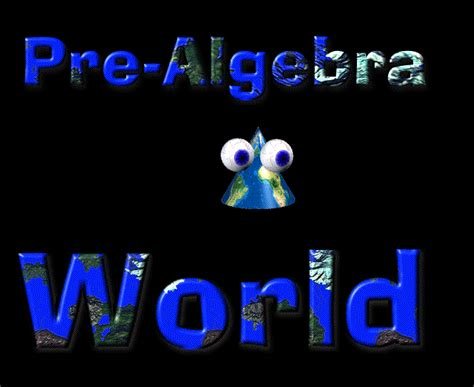
Pre-Algebra World: Number Sense is an edutainment game set on an explorable alien planet, where players, guided by the abstract creature Google, learn pre-algebra concepts through interactive multimedia activities. Covering place values and historic numeral systems, rounding and estimation, integer factorization, fractions, and an arcade of visual practice challenges, it builds foundational math skills beyond basic arithmetic to prepare for algebra.
Gameplay Videos
Pre-Algebra World: Number Sense Free Download
Pre-Algebra World: Number Sense Reviews & Reception
invisiblesandwichtm.wordpress.com : has some of the trippiest visuals of any video game, short of something like Rez.
Pre-Algebra World: Number Sense: Review
Introduction
Imagine landing on an alien planet where mathematics manifests as a psychedelic fever dream: veiny-eyed cone creatures whisper hints, sieves gasp in horror at your mistakes, and abstract landscapes pulse with pre-rendered colors that evoke both childhood wonder and subtle unease. Released in 1997, Pre-Algebra World: Number Sense is one such relic from the golden age of CD-ROM edutainment—a time when developers crammed every ounce of multimedia flair into educational software to captivate young minds. Developed and published by the now-defunct Cognitive Technologies Corporation, this obscure title has lingered in the shadows of more famous peers like Math Blaster Mystery: Pre-Algebra, surviving only through fan preservation efforts on sites like the Internet Archive. Its legacy is that of a bizarre artifact: a sincere attempt to make pre-algebra exciting that instead birthed something memorably surreal. My thesis is clear: Pre-Algebra World transcends its pedagogical roots to become a cult curiosity, exemplifying the unbridled creativity—and technical quirks—of 1990s multimedia edutainment, deserving rediscovery for its historical eccentricity rather than mechanical brilliance.
Development History & Context
Cognitive Technologies Corporation, a small Maryland-based outfit (possibly linked to educational initiatives, though details are scarce), poured its modest resources into Pre-Algebra World under the direction of Anne Lennan and Greg Bardwell, who doubled as producers. Andrea Curran and Greg Bardwell handled core development, with special thanks to Joan Slatniske and Patrick Sharp— a lean team of just five credited individuals, typical for boutique edutainment studios of the era. Their vision was ambitious: transform dry pre-algebra concepts into an interstellar adventure, leveraging CD-ROM’s vast storage for animations, sounds, and interactivity to bridge theory and practice. Likely built with Macromedia Director or Authorware (common tools for multimedia titles), the game targeted middle-schoolers on Windows (both 16-bit and 32-bit) and Macintosh, emphasizing keyboard/mouse input for broad accessibility.
The late 1990s marked the zenith of “multimedia mania,” where CD-ROMs promised “omg u can has a picture of somethin in ur text while a midi plays,” as one nostalgic blogger quipped. Edutainment boomed amid hype for Super VGA resolutions (640x480x256 colors), but lagged behind entertainment gaming’s 3D revolution—titles like GoldenEye 007, Final Fantasy VII, and Grand Theft Auto dominated headlines in 1997, showcasing polygons and cinematic flair. Educational software, however, prioritized compatibility over spectacle, aiming at school labs with modest hardware. Constraints like jerky animations (due to rudimentary scripting) and low-fi pre-renders reflected this: developers favored content density over polish, betting surreal visuals would mask limitations. In a landscape flooded with Math Blaster clones and Oregon Trail memes, Cognitive’s planet-hopping premise stood out, though commercial viability was niche—priced at $39.95 via the short-lived Mathrealm site, it vanished as the company dissolved, leaving no digital reissues.
Narrative & Thematic Deep Dive
Pre-Algebra World‘s “plot” is a whisper-thin pretext: players explore an abstract alien planet divided into five “worlds,” each a multimedia sandbox for math drills, guided by Google—an enigmatic cone-shaped entity with bulging, vein-laced eyes that materializes for hints. No grand hero’s journey here; you’re a silent astronaut-protagonist navigating surreal domains where numbers come alive. Dialogue is sparse and functional—Google’s advice is folksy and direct (“Try factoring out the smallest prime!”), delivered via text and voiceovers, evoking a patient but eerie tutor.
Thematically, the game personifies pre-algebra as cosmic discovery, framing math as universal truths unlocked through exploration. World 1 delves into place values and ancient numeral systems (Roman, Babylonian), portraying numbers as historical artifacts amid starry voids. World 2’s rounding and estimation evoke foggy nebulae, teaching approximation as a starry shortcut. Factorization in World 3 uses Eratosthenes’ sieve, which gasps at errors—a visceral reaction underscoring trial-and-error. Fractions in World 4 build on this, visualizing parts via manipulatives like slicing alien fruits. The finale, an “arcade,” remixes concepts into visual puzzles, emphasizing diagrams over abstraction.
Yet, underlying unease permeates: themes of isolation (solo planet-trekking), imperfection (fallible sieves, veiny guides), and the uncanny (jerking animations mimicking dream logic). Blogs like Invisible Sandwich™’s label it “edutainment meets drugs,” capturing how its LSD-like visuals—pulsing shapes, disproportionate eyes—clash with wholesome intent. Characters lack depth; Google is a Rorschach test of benevolence or horror. Ultimately, the narrative serves education, but its themes accidentally probe childhood’s weird underbelly, making math feel like forbidden knowledge.
Gameplay Mechanics & Systems
At its core, Pre-Algebra World loops through learn-practice-drill-review, unified by 1st-person planet navigation. From the main menu (a starry hub evoking early Shockwave interfaces), select worlds via mouse clicks. Each section opens theory via narrated slideshows, then interactive exercises: drag numbers into place-value charts, round meteors to nearest tens, factor grids with sieve tools, or partition fraction pies. Google pops up for hints, resetting on errors with gentle encouragement. The arcade caps it with mini-games like visual fraction matches or estimation races, procedurally tweaking problems for replayability.
Progression is linear yet self-paced—no levels, saves, or scores beyond implicit mastery (unlock arcade post-core worlds). UI is straightforward: prominent buttons, calculators, and handbooks for conversions (e.g., ounces to cups), but clunky—text-heavy overlays obscure visuals, mouse sensitivity lags on emulated hardware. Innovations shine in manipulatives: resize fraction bars dynamically, or “cross out” multiples in real-time sieves, fostering tactile understanding. Flaws abound, though: limited problem banks lead to repetition; animations stutter unnaturally (objects teleport-slide); no adaptive difficulty risks boring advanced users. Combat? Absent—pure logic drills. On vintage Windows 98 VMs (as tested on Archive.org ISOs), it runs smoothly at 30fps, but modern ports demand DOSBox/VMware tweaks. Overall, mechanics prioritize drills over “fun,” succeeding as tutor but faltering as game.
World-Building, Art & Sound
The “world” is a thematically segmented planet: abstract backdrops per topic—cosmic grids for places, misty clouds for estimates, metallic lattices for factors, organic blobs for fractions—crafted in pre-rendered 256-color glory. Screenshots reveal trippy palettes: neon purples, throbbing oranges, geometric horrors like the veiny Google or gasping sieve. Art direction revels in excess, aping Riven‘s mysticism on a budget; resolutions cap at 640×480, but density impresses—zoomable diagrams, rotatable models. Atmosphere? Surreally immersive, blending wonder (starfields) with dread (unblinking eyes), distracting yet mnemonic.
Sound design amplifies this: MIDI-esque tunes loop ambiently (ethereal chimes for exploration), punctuated by bubbly SFX—pops for correct answers, wheezes for wrongs. Voiceovers are clear, child-friendly narrations, with Google’s hints in a warm baritone. No orchestral sweeps like contemporaries, but multimedia synergy (syncopated animations to boings) creates hypnotic rhythm. These elements elevate drills from rote to ritualistic, imprinting concepts via sensory overload—though jank (lip-sync fails, abrupt loops) undercuts polish, contributing to its “nightmare fuel” charm.
Reception & Legacy
At launch, Pre-Algebra World flew under radars—no MobyScore, zero critic/player reviews on MobyGames, no sales charts. Edutainment’s niche doomed it commercially; Cognitive faded, Mathrealm died, leaving secondhand scraps ($2.48 on NeverDieMedia). Reputation evolved via preservation: GabeKagan (who Moby-added it in 2015) archived ISOs on Internet Archive, penned a LinkedIn ode to its “memorably bizarre” visuals, and dropped a 90-minute annotated longplay (YouTube/Steam, 2016). Blogs hail its trippiness—”short of Rez”—positioning it as 90s multimedia excess poster child.
Influence? Minimal—no direct sequels, unlike Math Blaster‘s empire. Yet, it epitomizes edutainment’s pivot from drills (Algebra Arcade, 1983) to immersive worlds, prefiguring gamified apps. In broader history, it’s a footnote amid 1997’s titans (Fallout, Gran Turismo), but fuels retro subcultures obsessing over “weird PC” like Phantasmagoria. Preservation underscores its place: not revolutionary, but a time capsule of unfiltered creativity.
Conclusion
Pre-Algebra World: Number Sense distills 1997 edutainment’s essence—sincere math pedagogy swathed in multimedia psychedelia, from Google’s haunting gaze to gasping sieves. Its small-team ambition shines in conceptual depth and interactivity, marred by tech quirks and repetition, yet its surreal art/sound forge unforgettable vibes. No landmark, but a vital obscurity: it reminds us edutainment birthed gaming’s weirdest experiments. Verdict: 8/10 for historical immersion—fire up a VM, brave the veins, and witness pre-algebra’s cosmic oddity. Essential for retro historians, nostalgic math whizzes, and seekers of digital fever dreams. Its place in history? A preserved glitch in the matrix of learning.