
- Release Year: 2010
- Platforms: Gloud, Macintosh, OnLive, PlayStation 3, Windows, Xbox 360
- Publisher: ak tronic Software & Services GmbH, Feral Interactive Ltd., Square Enix Limited, Warner Bros. Interactive Entertainment Inc., WB Games, Inc.
- Developer: Rocksteady Studios Ltd
- Genre: Action, Compilation
- Perspective: Behind view
- Game Mode: Single-player
- Gameplay: Metroidvania, Stealth
- Setting: Contemporary, Fantasy, North America
- Average Score: 86/100
Description
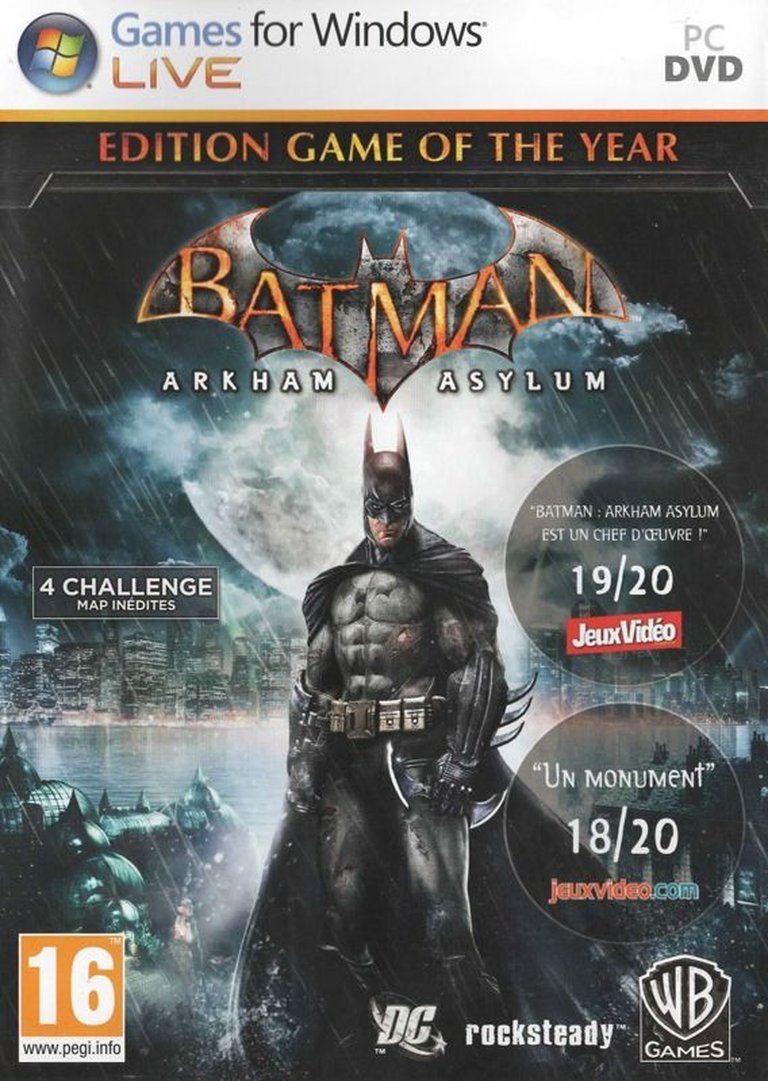
Batman: Arkham Asylum – Game of the Year Edition immerses players in the role of Batman as he battles to regain control of the iconic Arkham Asylum after the Joker orchestrates a massive riot, unleashing hordes of henchmen and villainous inmates in a gripping stealth-action adventure blending Metroidvania exploration, intense combat, and detective puzzles within the dark, gothic setting of Gotham City’s notorious psychiatric facility.
Gameplay Videos
Where to Buy Batman: Arkham Asylum – Game of the Year Edition
Batman: Arkham Asylum – Game of the Year Edition Cracks & Fixes
Batman: Arkham Asylum – Game of the Year Edition Reviews & Reception
ign.com : the best comic book game of all time.
Batman: Arkham Asylum – Game of the Year Edition: Review
Introduction
Imagine the Caped Crusader, shadowed cape billowing in the fog-shrouded night, delivering Gotham’s most notorious clown prince of crime back to the foreboding gates of Arkham Asylum—only for that very delivery to ignite a powder keg of madness, unleashing a horde of Batman’s deadliest foes upon the island’s crumbling corridors. This electrifying premise kicks off Batman: Arkham Asylum, a 2009 masterpiece from Rocksteady Studios that didn’t just redefine superhero video games; it etched itself into gaming history as a benchmark for narrative-driven action-adventures. The Game of the Year Edition, released in 2010 across platforms like Windows, Xbox 360, PlayStation 3, and later Mac and others, bundles the core experience with essential DLC challenge maps, including the Insane Night pack’s Nocturnal Hunter and Totally Insane, the Collector’s Edition’s Crime Alley, Scarecrow’s nightmare platforms, and PS3-exclusive Joker challenges. With optional 3D anaglyph support on consoles (via included glasses) and Nvidia 3D Vision/PhysX on PC, it elevates an already immersive title.
Arkham Asylum‘s legacy endures as the genesis of the Arkhamverse, spawning sequels like Arkham City and Arkham Knight, and influencing countless titles with its blend of brutal combat, predatory stealth, and detective intrigue. My thesis: This GOTY Edition isn’t merely a definitive Batman simulator—it’s a psychological thriller masquerading as a superhero epic, masterfully capturing the Dark Knight’s duality as both relentless vigilante and haunted detective, while pioneering gameplay loops that remain unmatched in fidelity to the source material.
Development History & Context
Rocksteady Studios, a relatively young UK-based developer founded in 2004, took a bold swing with Batman: Arkham Asylum, their second major title after the middling Urban Chaos: Riot Response. Published by Eidos Interactive (later Warner Bros. Interactive Entertainment) in North America and Warner Bros. globally, the game launched on September 15, 2009, for PS3 and Xbox 360, with PC following in March 2010. Powered by Unreal Engine 3, it navigated the era’s technological constraints—last-gen hardware pushing towards gritty realism amid the PS3/Xbox 360 lifecycle—by focusing on a contained, island-bound world rather than open-world sprawl, allowing meticulous polish on combat animations, lighting, and physics (PC-exclusive PhysX enhanced debris and cloth simulation).
The creative vision stemmed from writer Paul Dini (Batman: The Animated Series) and director Sefton Hill, who aimed to embody “what it’s like to be Batman.” Drawing loose inspiration from Grant Morrison’s 1989 graphic novel Arkham Asylum: A Serious House on Serious Earth, they crafted an original tale unbound by specific comic continuity, emphasizing Batman’s detective prowess (often sidelined in prior games) alongside brawling. Voice direction reunited animated series icons: Kevin Conroy as Batman, Mark Hamill as the Joker, and Arleen Sorkin as Harley Quinn, infusing authenticity.
The 2009 gaming landscape was ripe for reinvention. Superhero games languished—think Batman Begins (2005) or Spider-Man: Web of Shadows—plagued by shallow mechanics and poor adaptations. Amid shooters like Modern Warfare 2 and RPGs like Dragon Age: Origins, Arkham Asylum carved a niche by blending Resident Evil 4-style over-the-shoulder action with Metroid Prime-esque scanning, all on a persistent, explorable island. The GOTY Edition, arriving March 2010 (Windows first), responded to acclaim by compiling DLC absent from base retail, solidifying its status while teasing sequels via Easter eggs like hidden Arkham City blueprints.
Narrative & Thematic Deep Dive
Plot Synopsis: A Descent into Madness
The story unfolds over one chaotic night on Arkham Island. Batman (Conroy) escorts the Joker (Hamill) to the Intensive Treatment Center amid a suspicious Blackgate Prison fire that floods the asylum with his thugs. Joker escapes with Harley Quinn’s (Sorkin) aid, seizing control, freeing inmates like Victor Zsasz, Bane, Poison Ivy, Scarecrow, and Killer Croc, and holding Commissioner Gordon (Tom Kane) hostage. Batman navigates escalating threats: rescuing staff like Aaron Cash and Dr. Penelope Young, uncovering Young’s “Titan” serum (a Venom derivative), battling hallucinatory fear toxin sequences, and thwarting Joker’s army-building scheme.
Key arcs include the Medical Facility’s Patient X reveal (Titan-mutated Bane), sewers teeming with Croc, Ivy’s botanical takeover, and a rooftop finale where Batman resists Titan mutation to pummel the colossal Joker. Post-credits tease loose ends with a drifting Titan crate grabbed by Bane, Scarecrow, or Croc. Supporting cast shines: Quincy Sharp (Kane, revealed as “Spirit of Arkham”), Oracle (Kimberly Brooks), and Riddler (Wally Wingert) taunting via intercepted comms.
Themes: Fear, Vengeance, and the Thin Line of Sanity
At its core, Arkham Asylum is a character study of Batman’s psyche. Scarecrow’s toxin forces visions of his parents’ murder and a monstrous self, underscoring trauma-fueled vigilantism. Joker’s anarchy mirrors Batman’s repression—Hamill’s gleeful taunts (“You complete me!”) probe their codependence, echoing The Killing Joke. Themes of institutional failure permeate: Arkham’s decay symbolizes failed rehabilitation, with Sharp’s messianic delusions adding irony.
Dialogue crackles with wit—Joker’s party list banter, Harley’s slip-ups, Ivy’s eco-fury—elevated by stellar VO. Subtle lore (interview tapes, bios for Alfred, Penguin, etc.) weaves Batman mythos without overwhelming. GOTY extras like Scarecrow maps deepen horror elements, making it a thriller dissecting heroism’s cost.
Gameplay Mechanics & Systems
Core Loops: FreeFlow Combat and Invisible Predator
Arkham Asylum‘s genius lies in dual pillars: FreeFlow Combat and Predator stealth, forming seamless loops. Combat eschews button-mashing for rhythmic counters, strikes, and dodges—attack (square), counter (triangle), evade (circle), stun (L1)—building a combo multiplier for XP. Gadgets integrate fluidly: quick Batarang throws stun groups, Batclaw yanks foes. Upgrades (e.g., triple Batarang, remote-control variant) via XP tree encourage mastery, handling variants like knife-wielders (evade-stun) or Titan brutes (steer into walls).
Predator mode thrives in gargoyle-perched arenas: Detective Mode (hold L1) reveals enemies in red (armed), blue (neutral), with vantage points for silent takedowns (inverted from perches, ledge pulls, wall-smash). Explosive Gel traps weak walls or proximity-detonates, Sonic Batarangs manipulate suicide collars. Gun encounters demand pure stealth—no direct assaults.
Progression, Gadgets, and Riddler Challenges
XP unlocks 47 achievements/47 Steam feats, gadgets like Line Launcher (zip-lines), Cryptographic Sequencer (disable fields), Ultra Batclaw (multi-pull). Detective Vision scans forensics: fingerprints, pheromones, X-rays for puzzles (e.g., vapor trails).
Riddler’s 240 challenges—trophies, riddles, teeth, tapes, maps—demand backtracking post-gadget acquisition, fostering Metroidvania exploration. UI is intuitive: radial gadget menu, minimap with scan overlays. GOTY challenge maps test extremes (e.g., Joker’s chaotic combat remakes on PS3).
Flaws? Repetitive thug waves late-game, but innovations like fear multi-takedowns (double/y split) keep it fresh. Single-player focus shines—no co-op bloat.
World-Building, Art & Sound
Arkham Island feels oppressively alive: a gothic labyrinth of Intensive Treatment’s sterile cells, Medical Facility’s toxin haze, Botanical Gardens’ overgrown horror, and Caves’ dripping gloom. Free-roam post-story rewards 100% completion, unveiling bios and secrets. Visuals—moody shadows, rain-slicked exteriors, dynamic lighting—craft claustrophobia; Unreal Engine’s particle effects (spores, debris) immerse, enhanced by PC PhysX.
Art direction nails Batman’s world: detailed inmate cells, Joker’s smeared graffiti, Ivy’s titanic flora encroaching buildings. GOTY’s 3D adds depth to hallucinations.
Sound design elevates: Ron Fish and Nick Arundel’s score swells from tense stings to orchestral climaxes. VO is flawless—Conroy’s gravelly gravitas, Hamill’s manic cackle. Ambient madness (echoing laughs, dripping water, inmate screams) builds dread; FreeFlow’s visceral crunches satisfy.
Reception & Legacy
Launched to universal acclaim—Metacritic 91 (PC/PS3), 92 (Xbox 360); Steam “Overwhelmingly Positive” (96% from 27K+ English reviews, 55K total)—critics hailed it “breathtaking” (AceGamez 96/100), a “defining” action-adventure (MobyGames 88% critics). Players averaged 4.2/5 (55+ ratings). Sales topped millions, spawning GOTY bundling DLC for accessibility.
Awards flooded: BAFTA GOTY 2009, GamesRadar+, D.I.C.E., more. Reputation evolved from “Batman done right” to blueprint for superhero games (Spider-Man PS4/2018 echoes FreeFlow). Influenced Middle-earth: Shadow of Mordor‘s Nemesis, God of War 2018’s combat. Arkham series grossed billions; remasters like Return to Arkham (2016) and Switch Trilogy (2023) prove timelessness. Flaws (dated graphics pre-remaster) pale against innovation.
Conclusion
Batman: Arkham Asylum – Game of the Year Edition distills the Dark Knight to his essence: detective, predator, warrior. Its airtight narrative probes heroism’s shadows; gameplay loops—FreeFlow’s fluidity, Predator’s tension, Riddler’s compulsion—set enduring standards; atmosphere grips like few others. Exhaustive yet accessible, with GOTY extras perfecting the package, it claims an unassailable throne in video game history: the gold standard for licensed adaptations, a flawless fusion of comics fidelity and gameplay genius. If unplayed, rectify immediately—Batman demands it. Score: 10/10. Eternal GOTY.