
- Release Year: 2004
- Platforms: Macintosh, Windows
- Publisher: Viva Media, LLC
- Developer: SchoenerMedia KG
- Genre: Educational
- Perspective: 3rd-person (Other)
- Game Mode: Single-player
- Gameplay: Mini-games, Puzzle elements
- Average Score: 85/100
Description
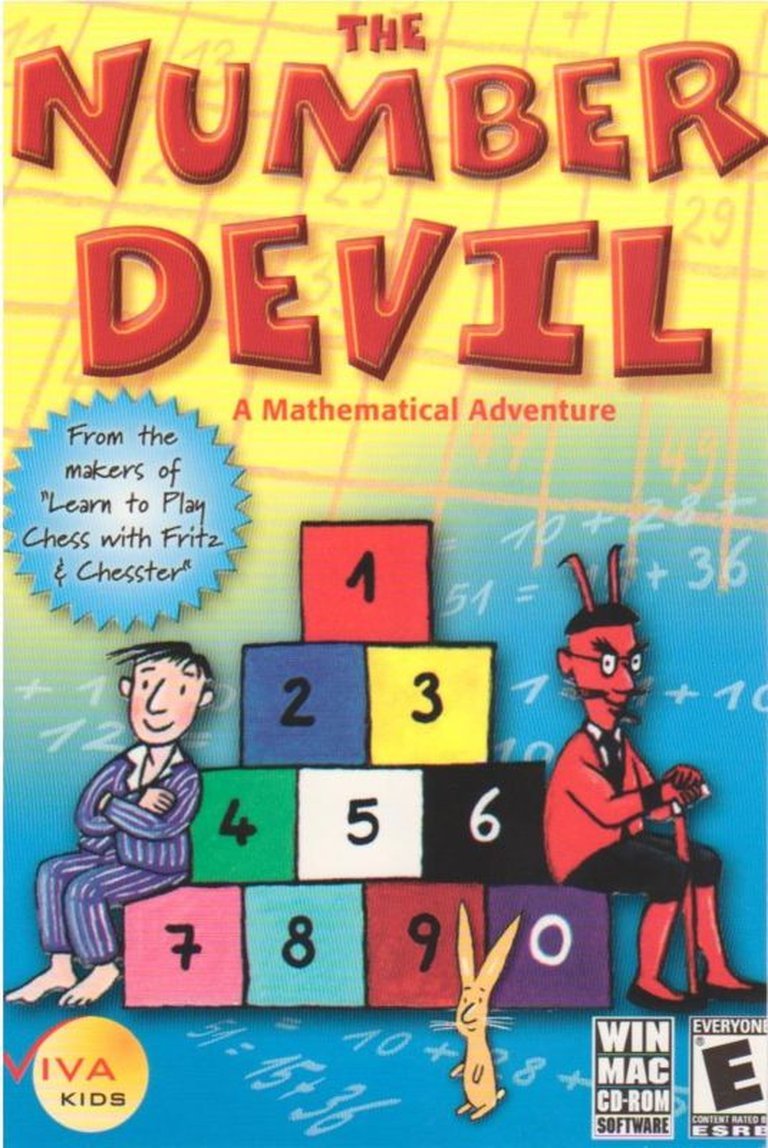
In The Number Devil: A Mathematical Adventure, a young boy named Robert, who hates math due to his boring teacher Mr. Bockel, begins dreaming of the whimsical Number Devil, who takes him on imaginative nightly tours of mathematical concepts over 10 nights, from the basics like zero to advanced topics such as the Golden Section, planes, and knots. Players participate by solving point-and-click puzzles, entering numbers on a blackboard, and playing reinforcing mini-games like Pac-Man mazes and Tetris-inspired challenges, with helpful features like a glossary and table of contents, all faithfully adapting the acclaimed children’s book by Hans Magnus Enzensberger.
The Number Devil: A Mathematical Adventure Reviews & Reception
commonsensemedia.org : Unique math title covers unconventional concepts.
edutainingkids.com : It’s all a dream—but a very educational one!
mobygames.com (84/100): Brings math concepts to life in funny and imaginative ways.
superkids.com (86/100): Intriguing program that takes an unusual approach to mathematics.
The Number Devil: A Mathematical Adventure: Review
Introduction
Imagine a world where math isn’t a drudgery of rote memorization under a tyrannical teacher, but a whimsical dreamscape populated by sly devils, hopping numbers, and rabbit-infested Fibonacci forests. The Number Devil: A Mathematical Adventure (2004) transforms this vision into an interactive edutainment experience, faithfully adapting Hans Magnus Enzensberger’s beloved 1997 children’s book into a point-and-click journey that demystifies mathematics for young minds. Born from a literary phenomenon that sold millions across Europe and introduced playful neologisms like “prima donnas” for primes and “rutabagas” for roots, the game arrived in an era when educational software sought to blend arcade fun with learning. Its legacy endures as a cult classic among math-phobic kids and nostalgic educators, proving that numbers can be as enchanting as fairy tales. Thesis: While The Number Devil excels as a narrative-driven gateway to sophisticated math concepts through innovative dream logic and replayable mini-games, its era-bound technical limitations and variable difficulty curve prevent it from transcending edutainment into timeless artistry—yet it remains a vital antidote to math anxiety in video game history.
Development History & Context
Studio and Creators’ Vision
Developed by the German studio SchoenerMedia KG and published by Viva Media, LLC for Windows and Macintosh in June 2004, The Number Devil was a direct digital extension of Enzensberger’s book, Der Zahlenteufel. Enzensberger, a poet and critic disillusioned with rigid school math curricula (inspired by his daughter Theresia’s struggles), envisioned math as playful folklore rather than dry abstraction. The game’s CD-ROM concept credits Enzensberger alongside Franz-Maria Sonner, Eva Kappel, and others, ensuring fidelity to the source: 12 dream nights (condensed to 10 plus a bonus) teaching concepts from zero to infinity. Illustrator Rotraut Susanne Berner’s vibrant, surreal art style was faithfully digitized by designers Robert Ott and Caya Maue, with animations by Wolfgang Schöner and Robert Schmid. Viva handled American localization, with translation by Michael Henry Heim (the book’s English translator) and editorial by Linda Weal and Nicole Kirkorian, adapting humorous terms while preserving cultural quirks.
Technological Constraints of the Era
Released on CD-ROM for systems like Windows 98/ME/XP (Pentium 233+, 64MB RAM) and Mac OS X 10.1 (G3+, 128MB RAM), the game epitomized early-2000s edutainment tech: fixed/flip-screen visuals, point-and-click interfaces via keyboard/mouse, and simple arrow-key mini-games. No 3D acceleration or online features—pure offline, single-player fare. Constraints like 800×600 resolution warnings (annoyingly persistent on modern displays) and basic sound (Thomas Wersche/Detlef Fischer, music by Felix Janosa) limited polish, but enabled dense interactivity: hyperlinked glossaries and seekable indices. Programming by SchoenerMedia focused on accessibility, with pop-up icons for navigation, volume, scores, help, and exit.
Gaming Landscape at Release
2004 marked edutainment’s twilight amid rising casual gaming (The Sims, browser Flash) and console dominance (Grand Theft Auto: San Andreas). Educational titles like Reader Rabbit or Viva’s own Fritz & Chesster chess series targeted parents/teachers seeking “fun learning.” The Number Devil stood out by bucking drill-heavy norms, embracing narrative immersion akin to Myst but for kids. It nominated for 2004 NAVGTR Best Family Game, reflecting optimism for “serious games.” Yet, it launched quietly amid blockbuster shadows, commercial success tied to the book’s European bestseller status (Spain, Germany, Netherlands, Italy, Japan).
Narrative & Thematic Deep Dive
Plot Summary and Structure
Mirroring the book, the story follows Robert, a math-hating boy tormented by teacher Mr. Bockel (later Mr. Boekel in some texts), whose “child abuse” lessons spawn nightmares. Enter the Number Devil (Teplotaxl), a red-horned, impish guide from Number Heaven, invading Robert’s dreams for 10 nights. Each “night” (chapter) unfolds as a surreal vignette:
- Night 1: Quantity guessing, introducing one and zero’s “sophistication.”
- Night 2: Forests of ones; hopping (exponents), negatives.
- Night 3: Prima donna (prime) caves; play-any-number prime checker.
- Night 4: Beach rutabagas (square roots).
- Night 5: Desert triangular numbers via coconuts.
- Night 6: Fibonacci (Bonacci) rabbits reproducing.
- Night 7: Pascal’s triangle patterns.
- Night 8: Classroom permutations and vroom (factorial) numbers.
- Night 9: Infinite series, unreasonable (irrational) numbers at the North Pole.
- Night 10: Proofs, Golden section, geometry (planes, knots, lines).
- Bonus Night 11: Invitation-only via high scores; imaginaries, Klein bottle, mathematicians like Bonacci (Fibonacci) and Professor Singer (Cantor).
Robert’s arc—from dread to enthusiasm—culminates in classroom triumph, echoing the book’s transformation.
Characters and Dialogue
Robert embodies the reluctant learner: whiny, speech-impeded (per SuperKids), but plucky. The Number Devil is charismatic dynamite—mouthy (“Wrong, pipsqueak! I’m the Devil, not Santa!”), edgy (Common Sense Media), yet endearing, sparring to provoke curiosity. Dialogue sparkles with puns: “What do you expect? Numbers aren’t toys!” Interactions let players choose: solve or watch Robert. Mrs. Wilson (mom) notes his changed sleep habits.
Underlying Themes
Math as Magic vs. Fact: Enzensberger critiques pedantic teaching, portraying math as dreamlike discovery—magical (rabbit patterns) yet provable. Critics like Ball/Bass (AMS) faulted this for mysticism, but it combats anxiety effectively. Curiosity Over Drills: Playful terms humanize abstraction; infinity as “endless hotel.” Transformation: Robert’s journey mirrors real growth, from hellish class to Number Heaven. Themes resonate beyond kids, appealing to adults (Paulos: “charming fairy tale”; Gardner: “entertaining”).
Gameplay Mechanics & Systems
Core Loops and Progression
Primarily point-and-click observation/listening, punctuated by interactive problems (mouse/keyboard entry) and chapter-ending mini-games. Progression is linear (10 nights), unlocked sequentially; high scores unlock Night 11. Scoreboard tracks mastery; no branching, but revisit via Table of Contents (night summaries with hyperlinks) or Seek (index jumps).
Mini-Games and Puzzles
Reinforcement shines here—varied, arcade-inspired:
– Quantity Guessing: Quick-peek bunnies/bugs/coins (Edutaining Kids favorite).
– Pac-Man Maze: Prime-chasing.
– Tetris-Inspired: Pattern-building.
– Road Rally/Sled Race (“Sleigh Ride in Owl’s Wood”): Arrow-key navigation.
– Roman Numeral Puzzle.
Innovative: Open-ended prime tester; permutation racetrack (4-color cubes). Flaws: Uneven controls (Common Sense: some difficult); no deep progression (scores reset?).
UI and Innovations/Flaws
Intuitive bottom bar: back/forward, volume, scoreboard, help, exit, Glossary (humorous term decoder), Table of Contents/Seek (review goldmines). Strengths: Non-linear review aids deepens learning. Weaknesses: Edgy feedback frustrates; variable pacing (talky lessons bore speedrunners); no save mid-night; dated resolution nag.
World-Building, Art & Sound
Setting and Atmosphere
Dreamscapes evolve surrealistically: oversized worlds, one-tree forests, prime caves, rabbit meadows, white Pascal rooms, polar infinities, heavenly mathematician parades. Fluid transitions via flips/screens evoke book pages turning, fostering wonder—math as living playground.
Visual Direction
Berner-inspired 2D art: Whimsical, colorful—furry calculators, coconut pyramids, hopping visuals. Fixed perspectives suit edutainment; animations lively (devil’s gestures). Atmosphere: Playful menace (devilish grins) tempers scariness (ESRB Everyone).
Sound Design
Felix Janosa’s music whimsically underscores dreams; Sound Ideas effects punctuate (whooshes, chimes). Voice acting: Devil’s sly baritone, Robert’s impediment adds charm (or annoyance). Martina Boette-Sonner’s direction keeps it immersive, though basic by 2004 standards—no VO overload.
Elements synergize: Visuals illustrate (rabbit Fibonacci), sound reinforces (hop “boings”), crafting hypnotic “edutainment trance.”
Reception & Legacy
Critical and Commercial Reception
Critics averaged 84% (MobyGames): Edutaining Kids (91%): “Original math tricks.” GiN (80%): “Funny teacher sim for grades 5-7 strugglers.” SuperKids (80%): Kid appeal despite Robert’s voice. Common Sense (10+): “Unique, edgy dynamic; uneven difficulty.” Players: 4.9/5 (sparse). Commercial: Modest—tied to book sales; eBay relics ~$7. No blockbuster, but Viva’s edutainment staple.
Evolving Reputation and Influence
Post-launch, praised for anti-anxiety impact (blogs like Musings of a Math Teacher used in classes). Legacy: Precursor to Number World Adventure (2017); inspired math-gamification (Prodigy, DragonBox). Niche influence on serious games (Serious Game Classification: arcade/puzzle-math). Book’s aura elevates it—Wikipedia notes audiobook/sequels. Today: Abandonware appeal; preserves 2004 edutainment ethos amid app saturation.
Conclusion
The Number Devil: A Mathematical Adventure masterfully distills Enzensberger’s dream-poetry into interactive pedagogy, its narrative charm, clever UI tools, and addictive mini-games forging an unforgettable math odyssey. Yet, clunky tech, tonal edginess, and pacing hiccups cap its genius. Verdict: An essential historical artifact—8.5/10—for educators and retro enthusiasts, securing its place as a pioneering bridge between literature, learning, and lighthearted gaming. In a genre often dismissed as “edutainment drudge,” it devilishly proves numbers can delight, deserving rediscovery in classrooms worldwide.