
- Release Year: 2002
- Platforms: Windows
- Publisher: 1C Company, Infogrames Entertainment SA
- Developer: collision-studios GmbH
- Genre: Strategy, Tactics
- Perspective: Top-down
- Game Mode: Single-player
- Gameplay: Real-time tactics, Turn-based strategy
- Setting: Historical events, Napoleonic Wars
- Average Score: 54/100
Description
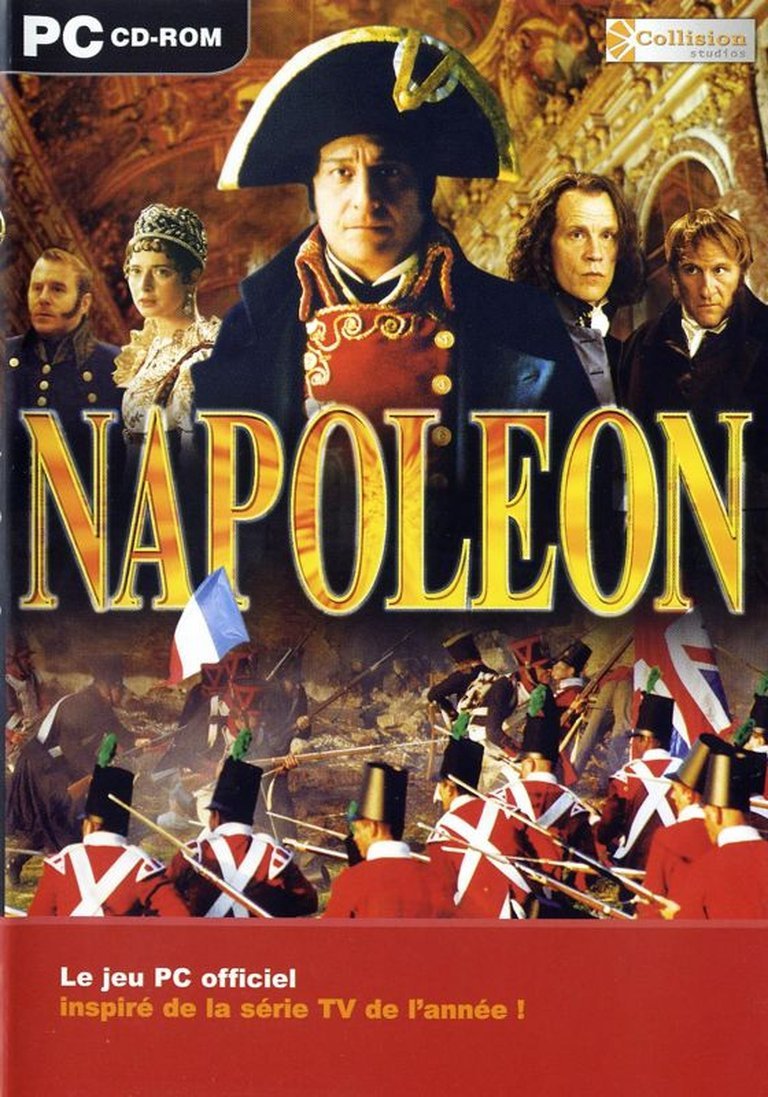
Napoleon is a licensed strategy and tactics game based on a European TV movie series, where players embody Napoleon Bonaparte to recreate his most important battles during the Napoleonic Wars. The gameplay splits into a Risk-like strategic mode for moving troops across a European map and real-time tactical combats controlling infantry, cavalry, and artillery units in limited formations, accompanied by about 45 minutes of movie footage.
Gameplay Videos
Where to Buy Napoleon
PC
Napoleon Reviews & Reception
mobygames.com (29/100): not great, but not terrible and fine as a casual games
Napoleon: Review
Introduction
In the annals of video game history, tie-in titles often evoke a mix of curiosity and caution—vehicles more for marketing synergy than gaming innovation. Napoleon (2002, Windows), developed by the modest German studio collision-studios GmbH and published by Infogrames Entertainment SA (with a Russian release by 1C Company), exemplifies this duality. Released amid a burgeoning era of real-time strategy (RTS) giants like Cossacks: European Wars and the shadow of Total War, it ties directly to a European TV miniseries on Napoleon Bonaparte, interweaving about 45 minutes of live-action footage into its campaigns. As a professional game journalist and historian, I approach Napoleon not as a masterpiece of Napoleonic simulation but as a curious artifact: a budget-conscious hybrid of turn-based grand strategy and real-time tactics that prioritizes cinematic flair over mechanical depth. My thesis is clear—while its licensed authenticity and aggressive AI offer fleeting charms for casual history buffs and miniseries fans, Napoleon ultimately crumbles under shallow gameplay, technical woes, and a failure to honor the tactical genius it purports to recreate, cementing its place as a footnote in early-2000s strategy gaming.
Development History & Context
Collision-studios GmbH, a small Hamburg-based outfit known for unremarkable titles like Augustus: Im Auftrag des Kaisers and Shadow Harvest: Phantom Ops, helmed Napoleon with a lean team of just 15 credited individuals. Producer Stefan Layer from Infogrames Deutschland oversaw the project, while lead programmer Wolfgang H. Alwin Fandrych and coder Marco Nowara handled the core engine. Graphics and level design fell to a collective of six artists—Tobias Höfle, Dennis Brünig, Oliver Specht, Thomas Böhmelt, Ansgar Frattner, and Beate Twardoch—emphasizing isometric visuals suited to the era’s hardware constraints. Joachim Ottmer composed the score, with Hanz Marathon Music on sound design and Weltenschmiede managing localization (primarily German, with a Russian variant as Наполеон).
Launched in late 2002 on CD-ROM for Windows PCs (requiring modest specs like a Pentium III 500MHz, 128MB RAM, and 16MB graphics card), Napoleon emerged in a landscape dominated by sophisticated RTS and turn-based strategy hybrids. The early 2000s saw Age of Empires II expansions, Rise of Nations, and SSI’s Close Combat series elevating historical wargaming with detailed unit rosters, morale systems, and terrain exploitation. Yet Napoleon was hamstrung by its tie-in nature: a promotional vehicle for the 2002 ZDF/BetaFilm miniseries, ahead of its January 2003 European premiere. Special thanks to Oliver Bachert (BetaFilm) and Michael Wetzel (Infogrames Deutschland) underscore this synergy. Technological limits—no 3D acceleration demands, mouse-only input—reflected a post-Command & Conquer era where isometric views thrived (Warcraft III was peaking), but collision-studios’ vision was unambitious: a Risk-lite map feeding into skirmish-scale battles. In an industry chasing epic scopes, this micro-budget production (evident in its single-player focus and lack of multiplayer) prioritized TV footage integration over innovation, dooming it to obscurity amid flashier contemporaries.
Narrative & Thematic Deep Dive
Napoléon‘s narrative leans heavily on its licensed miniseries, framing Bonaparte as the central protagonist in a linear recreation of his pivotal campaigns. Absent overt plot exposition—the game eschews voiced dialogue or branching stories—its “narrative” unfolds via interstitial cutscenes: exclusive clips totaling 45 minutes, bridging battles like Austerlitz or Waterloo. These evoke the era’s grandeur, with actors portraying Napoleon amid revolutionary fervor and imperial ambition, but serve more as promotional vignettes than cohesive storytelling. The campaign mode strings together historical recreations, from Italian Campaign skirmishes to the Russian retreat, punctuated by footage that ties player victories to scripted drama.
Thematically, Napoleon grapples with destiny versus strategy, embodying Bonaparte’s maxim—”It is the success that makes great men”—yet undermines it through determinism. Players command generic forces without personal agency in grand events; cutscenes impose historical inevitability, reducing Napoleon to a spectator in his own legend. Characters are faceless—no marshals like Ney or Davout appear meaningfully; units are mere infantry, cavalry, and artillery blobs differentiated only by national colors (French blue vs. Austrian white). Dialogue is sparse, limited to tactical prompts (“A seemingly hopeless battle. Show what you can do!”). Underlying motifs of European conquest mirror the miniseries’ focus on hubris and legacy, but the game’s shallowness betrays this: no moral ambiguity, no supply lines crumbling in Russia, just abstracted triumphs. Player reviews note the clips’ “appropriate atmosphere,” enhancing immersion for miniseries fans, yet critics like PC Games lambasted them as preludes to a “cliché-flooded TV series.” Ultimately, the narrative is a thin veneer—historical events as backdrop, not driver—prioritizing spectacle over the tactical brilliance that defined the Corsican.
Gameplay Mechanics & Systems
At its core, Napoleon bifurcates into turn-based grand strategy and real-time tactics, with three modes: a narrative campaign (historical battles), a Risk-inspired Europe conquest, and progressive standalone skirmishes.
Grand Strategy Layer: The Europe map is a pure Risk clone—move armies across territories, amass reinforcements, declare attacks. No diplomacy, economy, or logistics; options are binary: advance or assault. Critics derided its “board game charm” (Computer Bild Spiele), with occasional crashes plaguing saves.
Tactical Battles: Triggered attacks zoom to isometric, real-time fields where you command handfuls of infantry (melee/ranged), cavalry (flanking charges), and cannons (area bombardment). Controls are mouse-driven: select, move/attack, toggle two formations (line for firepower, square for defense). UI is rudimentary—a cluttered HUD with unit panels, minimap, and formation toggles—but responsiveness falters: units ignore orders, pathfinding glitches (troops “float” over water or bottleneck bridges, per PC Games). No morale, experience, or upgrades; nations’ units are mechanically identical, save colors. Skirmishes scale difficulty organically—early bouts are trivial, but later demand aggression as AI ramps up (GameStar called early Austerlitz a “frechheit,” or cheeky misrepresentation).
Innovations are nil; flaws abound—strohdumm (hay-dumb) AI (Game Captain), seicht (shallow) depth, no multiplayer. Progression is linear, completable in an evening for veterans. Player Mitchell N (2020 MobyGames review) praised escalating challenge and “sufficiently aggressive” AI, likening it to a “poor man’s Cossacks 2,” but conceded skirmish-scale (“handful of units”). Loops are repetitive: position artillery, flank with horse, grind infantry. Verdict: functional for casuals, infuriating for tacticians.
World-Building, Art & Sound
Set amid Napoleonic Wars (1803–1812), Napoleon‘s Europe spans customizable battlefields per nation—forests, plains, rivers—but maps are tiny skirmishes, not grand fields like Borodino. Atmosphere hinges on miniseries clips: grainy live-action evoking fog-of-war drama, with period uniforms and cannon smoke. Isometric visuals, rendered by the art team, are serviceable 2002 fare—detailed sprites animate fluidly (marching, firing), but low-res textures and sparse effects (wind-simulated bullets per some specs, though unverified) feel dated. Colors distinguish factions effectively, yet repetition breeds boredom.
Sound design amplifies mood: Joachim Ottmer’s score channels revolutionary marches (drums, horns), immersive for era enthusiasts. SFX—musket volleys, cannon booms, cavalry hooves—are punchy, though sparse. No voiceover; prompts are text-only. Miniseries footage adds cinematic gravitas, “grandiosen Ausschnitte” (GameStar), blending real actors with pixelated troops. Collectively, these forge a nostalgic haze—historical verisimilitude via license—but tiny scales and graphical maulness (Game Captain) undermine epic scope, suiting casual dips over prolonged immersion.
Reception & Legacy
Launch reception was dismal: MobyScore 4.6/10 (#26,647 of 27K), critics averaged 29% from seven German/French outlets. Computer Bild Spiele (58%) deemed it “befriedigende” for newbies/miniseries fans; GameStar (48%) mocked Austerlitz’s simplicity vs. C64’s North & South; PC Games (33%) roasted AI/pathfinding; harsher scores (PC Action 17%, Gamesmania.de 15%) branded it “Schrott” (junk), “Abzocke” (rip-off). Jeuxvideo.com (5%) called it an “affront aux amateurs d’Histoire.” Players averaged 2.2/5; Mitchell N’s 2020 retrospective: “not great, but… fine as casual,” worth “a few dollars” for AI challenge/miniseries tie-in.
Commercially, obscurity—no sales data, but low collection (3–4 owners on MobyGames). Legacy? Negligible influence; overshadowed by Empire: Total War (2009), Napoleon: Total War (2010). It nods to movie tie-in pitfalls (cf. GoldenEye 007 success vs. generic flops), prefiguring Assassin’s Creed historical blends but lacking depth. As preservation artifact, it endures via abandonware, evoking 2002’s strategy boom—flawed, forgotten, yet evocatively Napoleonic.
Conclusion
Napoléon (2002) is a relic of tie-in excess: cinematic hooks and historical sheen mask vapid mechanics, buggy execution, and untapped potential. Its Risk-RTS hybrid offers mild thrills—aggressive AI, escalating skirmishes—for miniseries aficionados or casual strategists, but repels with shallowness, crashes, and dated controls. In video game history, it resides as a cautionary curio: ambitious in license, anemic in design, warranting a playthrough for context but no pantheon spot. Verdict: 3/10—a tactical trifle, best at bargain-bin prices, eclipsed by era’s titans yet whispering of Bonaparte’s fleeting glory.