
- Release Year: 2004
- Platforms: Windows
- Developer: Touch ‘n Go Games
- Genre: Strategy, Tactics
- Game Mode: Single-player
- Gameplay: Board game
- Average Score: 32/100
Description
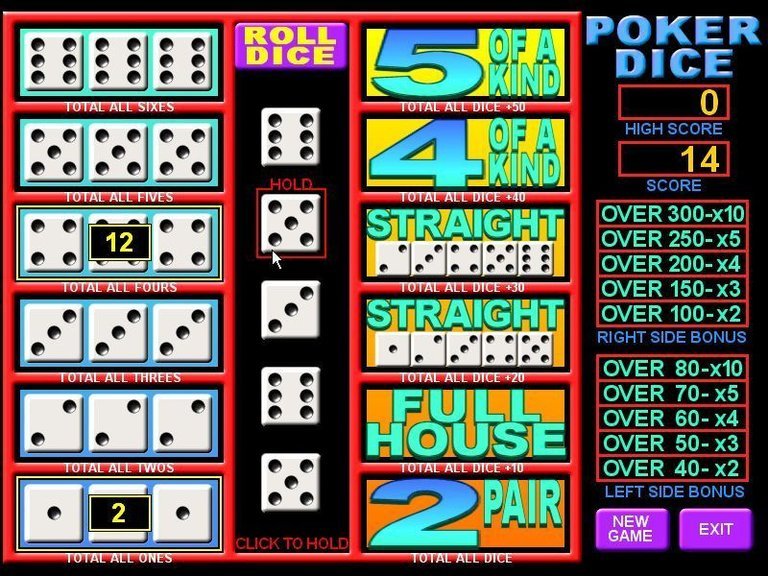
Poker Dice is a single-player strategy board game released in 2004 for Windows by Touch ‘n Go Games, closely resembling Yahtzee but focused on forming poker hands with dice. Players get two rolls of five dice to create combinations like five of a kind, straights, full houses, or high numbers such as all fives, scoring points in two sections—one for individual numbers 1 through 6 and another for poker hands—with higher totals in each category unlocking greater bonuses.
Where to Buy Poker Dice
PC
Poker Dice Free Download
PC
Poker Dice Reviews & Reception
wizardofpots.com (65/100): Poker Dice is an entertaining specialty game in which players need to collect a combination from 3 identical faces of dice on 4 screens.
Poker Dice: Review
Introduction
In the vast tapestry of video game history, few titles evoke the pure, unadulterated thrill of chance and cunning like Poker Dice (2004), a digital rendition of one of gaming’s most enduring dice-based pastimes. Developed by the obscure Touch ‘n Go Games for Windows PCs, this single-player strategy gem channels the spirit of classic board games like Yahtzee while infusing the high-stakes tension of poker hands formed not with cards, but with tumbling dice. Emerging in an era dominated by sprawling MMOs and console blockbusters, Poker Dice stands as a humble yet profound testament to casual gaming’s roots—a solitary roll against fate, where every shake of virtual dice pits luck against tactical rerolls. My thesis: Poker Dice is a masterful, if understated, preservation of poker dice’s millennia-old legacy in digital form, offering timeless replayability through probabilistic depth, though its spartan design underscores the era’s technological limits and its obscurity a missed opportunity for broader acclaim.
Development History & Context
Touch ‘n Go Games, a boutique developer with scant footprint beyond this title, released Poker Dice in 2004 amid a burgeoning casual gaming renaissance. The early 2000s saw Windows PCs flooded with browser-adjacent shareware like The Sims expansions and Zoo Tycoon, but dice games traced deeper lineage: MobyGames notes a 1979 TRS-80 precursor, Poker Dice, marking it as an evolution from microcomputer experiments. Poker dice itself predates silicon—Wikipedia details its origins as a waterproof alternative to cards for WWII soldiers, with faces depicting 9, 10, J, Q, K, A (no suits, barring flushes). By 2004, post-Yahtzee boom (invented 1956, digitized sporadically), Touch ‘n Go digitized this for solo play, adapting physical poker dice rules into software.
Technological constraints shaped its form: Windows XP-era engines favored lightweight executables, eschewing 3D flair for 2D sprites. No screenshots survive on MobyGames, suggesting a minimalist interface—likely pixelated dice tumbling on a scorecard backdrop. The gaming landscape? DICE 2004 awards lauded Prince of Persia and Call of Duty; Poker Dice flew under radar as freeware-ish indie fare. Creators’ vision, inferred from description, mirrored Yahtzee’s inventor: a yacht-bound couple refined poker dice into scored rounds. Here, Touch ‘n Go streamlined to two rerolls (vs. poker dice’s typical three), emphasizing quick sessions amid EverQuest marathons. Patents like US20090322024A1 (2009) highlight contemporaneous innovations in suited dice, but Poker Dice stuck to pure numerical/poker splits, a conservative nod to TRS-80 roots.
Narrative & Thematic Deep Dive
Devoid of plot or characters—it’s a board game adaptation—Poker Dice‘s “narrative” unfolds through mechanical poetry: the player’s Sisyphean quest for perfection against Lady Luck. Themes echo poker dice’s folklore: Roll-a-Bong recounts cowboys swapping tattered cards for durable dice around campfires, symbolizing resilience amid chaos. The 1-6 upper section evokes numerical grind (sum scores, bonuses for highs), mirroring life’s incremental tallies; poker hands below—five-of-a-kind (0.08% odds), straights (3.09%)—probe gambling’s duality: skill in holds, fate in rolls.
Dialogue? Absent, save UI prompts (“Hold dice? Reroll?”). Yet subtext abounds: CoolOldGames likens it to WWII troops’ rituals, dice as equalizer in trenches. Variants (Liar’s Dice bluffing, Koplow’s suited octahedrals) underscore risk/reward; here, solo play internalizes bluff as self-deception—chasing full houses (3.86%) over safe pairs (46.3%). Probabilities (7776 combos) weave mathematical lore: busts scarcer than poker (6.17% vs. higher), forcing aggression. Thematically, it’s existential solitaire: no NPCs, just you vs. RNG, echoing Goomba Stomp’s poker-in-games motif (GTA V saloons, RDR2). High bonuses for section mastery thematize discipline over impulse, a microcosm of gaming’s evolution from ritual dice (6000 BCE Egyptian tombs) to digital determinism.
Gameplay Mechanics & Systems
At core: two rolls of five dice per turn, Yahtzee-poker hybrid. MobyGames details: form poker hands (five-kind, straight, full house) or 1-6 scores; dual sections yield bonuses (higher totals = bigger multipliers). UI presumed simple: dice array, hold toggles, scorecard grid. Innovative loop: unlike Wikipedia’s three-roll poker dice (hold between), Poker Dice caps at two, heightening tension—first roll sets destiny, second redeems.
Deconstruct loops:
– Core Roll/Hold/Reroll: Shake five (9-A equivalents). Hold keepers (e.g., three Queens for full house), reroll twice max. Straights: low (9-10-J-Q-K), high (10-J-Q-K-A); no flush sans suits.
– Scoring Systems: Upper (1-6 sums), lower (poker: five-kind pays 500:1 odds analog). Bonuses scale totals—exhaustive math (Deep’s Probability tables) favors full houses over straights probabilistically, yet tradition ranks reverse.
– Progression: Multi-round? Inferred Yahtzee-style: fill 12 slots, chase high scores. No combat/levels; progression via personal bests, replay value infinite.
– Flaws/Innovations: Two-roll limit flaws realism (poker dice allows three), but streamlines casual play. UI likely clunky (2004 norms: mouse-click holds), no autosave. Genius: solo vs. AI ghosts? Absent, but probabilities enable mastery—strategy tips (CoolOldGames): weigh pair vs. straight odds.
Ties? N/A solo, but mental “what-ifs” engage. Patents inspire variants (wild jokers), untapped here. Exhaustive: 15.43% three-kind sustainable; UI must clarify kickers (Aces > Kings).
World-Building, Art & Sound
Setting: abstract scorecard void—no Wild West saloons (contra RDR2), just dice pit. Atmosphere: clinical probability lab, evoking TRS-80 starkness. Visuals: pixel dice (no Moby shots; imagine Koplow sets digitized), card icons (A♠ common). Direction: functional minimalism—2004 casuals prioritized speed over spectacle (Five Dice 2008 kin prettier).
Sound: Hypothetical chimes for rolls (tactile “clack”), triumphant fanfare for five-kind (0.08% unicorn). Dice cup shake SFX nods physical roots (WWII portability). Contributions: austerity amplifies immersion—pure focus, no distractions. Atmosphere builds suspense: silent anticipation pre-reroll, chaos in tumble. Retro charm: evokes Altair 8800 Dice (1975), bridging analog-digital.
Reception & Legacy
Launch: Ghost town—no Moby critic/player reviews (n/a score), 1 collector. Commercial? Obscure shareware, dwarfed by Madden NFL 2004. Evolved rep: Added 2016 by piltdown_man, preserved as artifact. Influence: Foreshadows Poker Dice Solitaire Future (2014 Wii U), Dice Kingdoms (2023); Yahtzee-group kin (31 Dice 1979). Industry: Casual dice surge (Knight Dice 2020, Circadian Dice 2022); Goomba/Retro articles note poker dice in Super Mario 64 DS, Far Cry 3. Patents (2009) echo mechanics, VR futures loom. Legacy: Unsung bridge—TRS-80 to modern roguelikes, proving dice > cards in digital grit.
Conclusion
Poker Dice distills poker dice’s essence—luck’s gamble, strategy’s hold—into flawless solitaire, its two-roll tension and bonus ladders yielding addictive depth despite UI austerity. Flaws (brevity, obscurity) pale against timeless math: 7776 fates per roll. Verdict: Essential curio, 8/10—cemented in history as casual gaming’s probabilistic purist, urging rediscovery amid flashy heirs. A roll for eternity.