
- Release Year: 2004
- Platforms: GameCube, PlayStation 2, Wii, Windows
- Publisher: Akella, Bigben Interactive GmbH, Bigben Interactive S.A., Neko Entertainment SARL
- Developer: Neko Entertainment SARL
- Genre: Action
- Perspective: 3rd-person
- Game Mode: Co-op, Single-player
- Gameplay: Platform
- Setting: Fantasy
- Average Score: 60/100
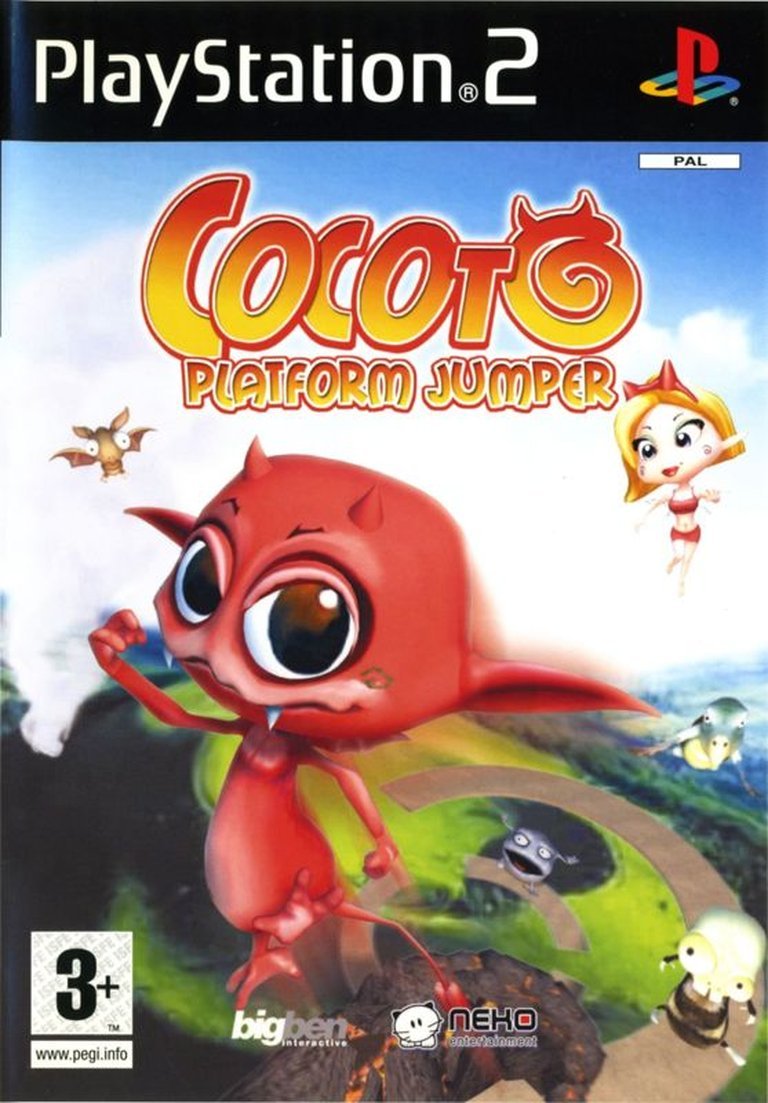
Description
In Cocoto: Platform Jumper, players control the demon Cocoto in a fantasy setting, embarking on a quest to save a secret of magma and his demonic friends by navigating circular 3D platforms viewed from an isometric angle, battling 30 unique enemies and 5 bosses across 40 levels in 5 diverse worlds, using special abilities to build temporary platforms and fight foes.
Gameplay Videos
Cocoto: Platform Jumper Free Download
Cocoto: Platform Jumper Reviews & Reception
metacritic.com (59/100): Platform Jumper doesn’t bring anything remotely new to the table, nor use the Wii’s controller to the fullest, but it does provide a fun platformer for the younger crowd to get started with, and the rest of us to enjoy for a few hours.
nintendolife.com : an enjoyable platform romp.
cubed3.com : Neko have injected a good bit of variety into what you interact with and see.
Cocoto: Platform Jumper Cheats & Codes
GBA (Europe) (En,Fr,De,Es,It) – Action Replay Max
Input codes using Action Replay Max device or GBA emulator (mGBA or VisualBoy Advance).
| Code | Effect |
|---|---|
| 407B3157 4F57FF7D C3B010F5 6DB0ED0E |
Jump higher |
| BC8E99E4 250F5180 65DA389A 09D8882C |
Untouchable |
| 9F90C8D4 51385F1D 65DA389A 09D8882C |
Timer stopped |
| D12A02C5 6946DE55 B6450111 C65005BC |
Jump Higher (Alternative Version) |
GBA – Stage Passwords
Enter one of the following passwords to access the stage shown.
| Code | Effect |
|---|---|
| TTAPAERD-141 | Stage 1.02 Abyss |
| TOAPTFTD-141 | Stage 1.03 Abyss |
| TOOPCCEN-148 | Stage 1.04 Abyss |
| TTILPFEF-169 | Stage 2.01 Volcano |
| TTOLEDEN-162 | Stage 2.02 Volcano |
| TOOLIDFN-177 | Stage 2.03 Volcano |
| TOOLCFCN-178 | Stage 2.04 Volcano |
GameCube (Europe) (En,Fr,De,Es,It) – Gecko
| Code | Effect |
|---|---|
| 04062DEC 38000000 04068024 38000000 04064B50 38000000 0406B1E8 38000000 040676C8 38000000 |
1HitKill all bosses |
| 0403EED4 4800000C 0403EEE0 38000064 |
Always invulnerable |
| 0403FD6C 60000000 04042A1C 60000000 |
Jump and walk in midair |
| 04040650 60000000 | Stay alive even without golden apples |
| 0407CE6C 60000000 04088BE8 60000000 |
Take gems anywhere |
Cocoto: Platform Jumper: Review
Introduction
In the annals of early 2000s platformers, few titles evoke the quirky charm of budget European development quite like Cocoto: Platform Jumper, a 2004 PS2 and GameCube release that spiraled its way into obscurity before resurfacing on WiiWare. Picture a pint-sized red imp named Cocoto, hurling magma arches like rainbow bridges from Rainbow Islands, scrambling up circular towers in a fantasy realm threatened by a lightning god—it’s a nostalgic nod to classics like Nebulus and Taito’s arcade heyday, wrapped in a family-friendly demonic package. As a game historian, I’ve pored over prototypes, credits, and reviews to uncover its story: a low-budget labor of love from French studio Neko Entertainment, designed for “simple and easy” accessibility. This review argues that Cocoto: Platform Jumper endures not as a masterpiece, but as a competent artifact of mid-tier platforming—flawed yet fun, perfectly suited for young players or retro enthusiasts seeking unpretentious vertical climbs amid the PS2 era’s blockbuster giants.
Development History & Context
Neko Entertainment SARL, a small French developer founded in the late 1990s, birthed Cocoto: Platform Jumper amid the cutthroat sixth-generation console wars. Led by project leader Laurent Lichnewsky, game and level designer Alexis Lévêque, technical director Frédéric Zimmer, and artistic director Sotheara Khem, the team of around 33 credited individuals (including programmers like Stéphane Mutel and Patrice Belmonte) crafted a title explicitly inspired by Nebulus (1987’s tower-climbing puzzle-platformer) and Rainbow Islands: The Story of Bubble Bobble 2. Their vision, as revealed in Nintendo Life interviews, was a “simple and easy” game for all ages—parents playing with kids—prioritizing balanced difficulty through weeks of level fine-tuning.
Technological constraints shaped its isometric 3D-on-2D-plane design: PS2 and GameCube hardware allowed circular, spiraling platforms without full open-world ambition, using CD-ROM media and split-screen multiplayer. Early prototypes (e.g., October 2003 alpha, lost; November 18, 2003 alpha, preserved via Hidden Palace) expose iteration: “Hell” evolved into “Volcano,” Atlantis featured desert-like cacti leftovers from Charlie’s Angels (PS2), and UI included power meters later axed. Cheat menus (R1 + Square + Start) and unused assets like Cerber boss music hint at scrapped content. Published by Bigben Interactive in PAL regions (PS2: July 9, 2004; GC: Dec 10, 2004), it hit Windows (2006), GBA (2007, 2D due to limits), and WiiWare (2009, 700 points, minimal Wii Remote shakes added—no new modes despite considerations).
The 2004 landscape was dominated by Super Mario 64 DS, Jak II, and Rayman 3, leaving budget fare like Cocoto to scrape by. Neko’s Cocoto IP (spawned here, spawning Kart Racer, Funfair) targeted Europe’s casual market, PEGI 3-rated for broad appeal amid rising family gaming post-Nintendogs.
Narrative & Thematic Deep Dive
Cocoto: Platform Jumper‘s story is a whimsical fairy tale of infernal guardianship, unfolding via sparse cutscenes and Fairy’s gibberish narration (evoking Cousin Itt). In the Abyss’s depths, Cocoto and imp friends Shiny, Baggy, and Neuro safeguard a “secret of magma” cauldron—their power source. Zaron, the Zeus-like “God of lightning” ruling Heaven, covets it, dispatching minions to kidnap the friends. Cocoto, aided by the ethereal Fairy (checkpoint guide), traverses five worlds—Abyss, Volcano (ex-Hell), Atlantis, Jungle, Heaven—to rescue them, culminating in boss confrontations symbolizing Zaron’s corrupted realms.
Characters are archetypal yet endearing: Cocoto, the heroic red demon-imp with pitchfork and arches; kidnapped trio as motivators (Neuro/Baggy retextures in prototypes); Fairy as expository sidekick; enemies like ghouls, tortoises, monkeys, angels (30 varieties). Dialogue is minimal—French prototype tutorials (“Utilise fstick gauche pour bouger,” “Crée une arche avec L”) emphasize mechanics over lore. Themes probe power’s allure (magma vs. lightning), friendship’s redemptive force, and infernal innocence—demons as protectors subvert hellish tropes, blending fantasy whimsy with moral simplicity for kids. Zaron embodies hubris, bosses (e.g., gorilla-like) his proxies. It’s no Shadow of the Colossus, but the plot hooks via progression: each rescue advances emotional stakes, reinforcing accessibility.
Gameplay Mechanics & Systems
At its core, Cocoto loops around vertical ascension: climb spiraling towers before timers expire (rising water/lava on failure), collecting golden apples (Sonic rings: shield from one-hit deaths, 10=life). Key innovation: magma arches (B button from solid ground), mimicking Rainbow Islands rainbows—build bridges, boost jumps, collapse on foes for double points. Pitchfork (Z-trigger) snipes flyers; spin attack (Wii shake) is melee panic button. Double-jump (A) and springs/moving platforms aid navigation. Upgrades (speedier/longer arches) from items; checkpoints (Fairy) persist enemy clears post-death.
Progression ties to scores: enemies slain, diamonds, spare time yield bonuses; high kills unlock world bonus stages (time-attack gems/lives). 40 levels (25 main + bonuses) across 5 worlds ramp difficulty—normal for casuals, hard amps foes/timer. Bosses demand pattern mastery (e.g., exploiting weaknesses). Multiplayer shines: 2P battle (5 HP, power-ups); 4P race (knock-offs, rising water). UI is clean (health, timer, apple counter) but dated—no widescreen. Flaws: stiff/jerky controls (detached jumps, no enemy respawns frustrate retries); repetitive climbs; GBA’s 2D downgrade. Strengths: tight loops, multiplayer longevity, hard mode’s sadistic challenge evoke “unforgiving early platformers.”
| Mechanic | Strengths | Flaws |
|---|---|---|
| Arches | Versatile (platforming/combat) | Ground-only spawn, crumbles easily |
| Combat | Varied (projectile/melee/collapse) | Spin ineffective; bosses repetitive |
| Progression | Score bonuses, lives | No continues; apple scarcity |
| Multiplayer | Fun, chaotic races | Split-screen limits depth |
Innovative yet flawed, it prioritizes pick-up-and-play purity.
World-Building, Art & Sound
Five worlds build a cohesive fantasy ascent from demonic depths to celestial tyranny: Abyss (dark spires), Volcano (lava flows, heat particles), Atlantis (aquatic ruins, beta worms/spiders), Jungle (totem foes, drab greens), Heaven (angelic contrasts). Spiraling towers foster vertigo-inducing immersion, hazards thematic (fire platforms, ice slips). Atmosphere blends cartoony menace—bloom, particles, parallax skies (beta volcano variants)—with PS2-era muddied textures/reuse, holding up via style over polish.
Art direction (Sotheara Khem, Marie N’Guyen) charms: Cocoto’s Gollum-esque imp, varied 30-enemy roster (glasses monkeys!). Sound by Raphaël Gesqua suits whimsy—bouncy tracks (unused Cerber boss theme), bloopy SFX, repetitive grunts/Fairy babble. No voice acting beyond gibberish enhances accessibility, though loops grate. Collectively, they craft cozy chaos: visuals evoke Rayman, audio a playful underscore, elevating budget roots to atmospheric vertical odysseys.
Reception & Legacy
Launch reception was middling: MobyGames 61% critics (8 reviews), Wii Metacritic 59/100 (“mixed”). PS2/GC scored 60% (Jeuxvideo.com: “accessible aux plus jeunes”); WiiWare varied—Nintendo Life/Cubed3/HonestGamers 70% (“competent, retro-relevant, solid for 700 points”), IGN 60% (“fairly fun, stiff controls”), GameSpot 40% (“awkward, stilted”). Praised: kid/parent appeal, multiplayer, challenge; panned: generic title/mechanics, controls, repetition. Commercial: obscure PAL budget title, WiiWare revival for bargain hunters (300 blocks).
Legacy endures modestly: Cocoto series flagship (22 overlapping credits with Kart Racer), influencing Neko’s casual output (Funfair, Fishing Master). No direct successors, but echoes in WiiWare platformers (Cocoto Surprise); prototypes fuel preservation (Hidden Palace). Cult status for retro fans—challenging hard mode, Rainbow Islands homage—positions it as a “forgotten adventure” (HonestGamers), emblematic of Europe’s unsung mid-tier amid AAA dominance. No industry shaker, but a survivor in digital reissues.
Conclusion
Cocoto: Platform Jumper synthesizes retro inspiration into a serviceable platformer: magma arches innovate mildly, worlds charm despite repetition, multiplayer extends play—all for accessibility amid PS2’s giants. Flaws like controls and shallowness cap it at competent, not classic. Yet, for its era, it carves a niche as family-friendly vertical climber, prototype revelations enriching its historiography. Verdict: 7/10—a quirky gem in video game history’s budget bin, ideal for nostalgic dives or kid intros, but outshone by peers. Seek the WiiWare port; its 700-point value immortalizes Neko’s impish spirit.