
- Release Year: 1997
- Platforms: DOS, Windows 16-bit, Windows
- Publisher: Serges Medien GmbH
- Genre: Compilation
- Game Mode: Single-player
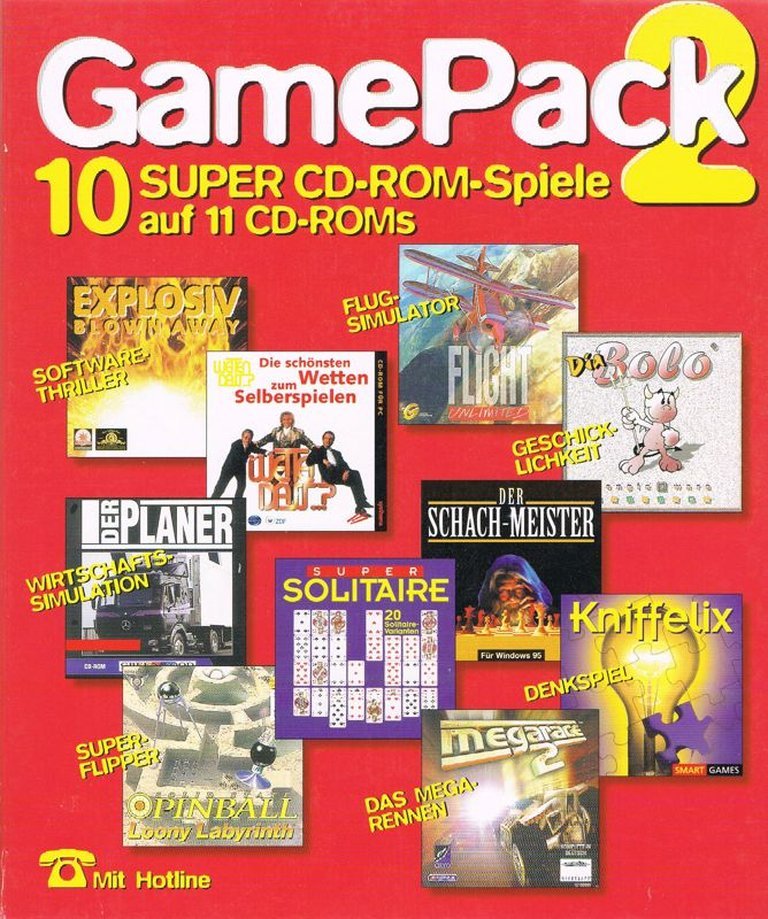
Description
GamePack 2 is a 1997 commercial compilation for Windows, DOS, and Windows 16-bit platforms, published by Serges Medien GmbH, bundling 10 diverse PC games including the high-speed futuristic racer MegaRace 2, realistic flight simulator Flight Unlimited, maze puzzle Loony Labyrinth, strategy title Der Planer, card games like Super Solitaire and Kniffelix, chess game Schach-Meister, action-packed Explosiv: Blown Away, Dia Bolo, and the interactive betting game Wetten Dass..?: Die schönsten Wetten zum Selberspielen.
GamePack 2 Free Download
GamePack 2 Reviews & Reception
retro-replay.com : GamePack 2 delivers an impressively varied suite of ten titles, ensuring there’s something for virtually every type of player.
GamePack 2: Review
Introduction
In the golden age of CD-ROM bloatware, when publishers crammed as many games as possible onto a single shiny disc to lure budget-conscious gamers, GamePack 2 emerged as a quintessential artifact of late-1990s PC gaming excess. Released in 1997 by the German outfit Serges Medien GmbH for Windows, DOS, and Windows 16-bit systems, this compilation bundles ten diverse titles—ranging from pulse-pounding racers to cerebral card games—into one affordable package. It’s a time capsule of an era when gaming was democratized through value-packed collections, bridging arcade thrills and casual puzzles amid the transition from 16-bit sprites to early 3D polygons. My thesis: GamePack 2 may lack the polish of marquee releases, but its eclectic mix exemplifies the unsung heroism of compilation packs, delivering unmatched variety and replayability that cements its place as a retro treasure for historians and nostalgia seekers alike.
Development History & Context
Serges Medien GmbH, a modest German publisher specializing in budget software, assembled GamePack 2 in 1997 as a follow-up to earlier efforts like the 1994 GamePack CD: 40 VGA Games and contemporaries such as Funsoft’s Gamepack (1997). This was peak CD-ROM era: hardware like 2X CD drives and Pentium processors enabled massive collections on single discs, capitalizing on falling manufacturing costs and a booming European PC market hungry for localized content. Technological constraints were evident—games targeted VGA/SVGA resolutions, Sound Blaster-compatible audio, and keyboard/mouse inputs—reflecting a landscape dominated by Windows 95’s rise and DOS holdouts.
The vision was pragmatic rather than revolutionary: curate proven mid-90s hits for mass appeal. Standouts like MegaRace 2 (1996, from Nazca New Zealand/Total Eclipse) brought futuristic racing flair, while Flight Unlimited (1995, Looking Glass Studios) showcased ambitious flight simulation amid an industry grappling with 3D acceleration’s infancy. Casual fare like Super Solitaire (1997) and Schach-Meister catered to Germany’s strong board-game culture, with titles like Wetten Dass..? Die schönsten Wetten zum Selberspielen (1996) tying into popular TV betting shows. A 1998 variant tweaked the lineup (adding Lode Runner On-Line and Teamchef), underscoring iterative repackaging common in budget publishing. Amid 1997’s boom-bust cycles—noted in GDC retrospectives like Michael Dornbrook’s “Surviving the Bloodbath”—compilations like this thrived by offering safe, diverse entertainment without blockbuster risks, mirroring the era’s shift toward accessible, family-friendly PC gaming.
Narrative & Thematic Deep Dive
As a compilation, GamePack 2 eschews a unified plot, instead weaving thematic threads through its ten standalone tales of human endeavor, chance, and chaos. Overarching motifs revolve around mastery over uncertainty: from strategic planning in Der Planer (1994), a resource-management sim evoking real-world logistics puzzles, to the high-stakes gambles of Wetten Dass..?, which recreates TV-inspired betting challenges with escalating wagers that probe risk and reward.
Individual narratives shine brightest. MegaRace 2 thrusts players into a dystopian future of televised death races hosted by the bombastic Lance Boyle, thematizing spectacle-driven violence and corporate exploitation in a cyberpunk arena. Flight Unlimited offers a more contemplative arc, piloting small aircraft through photorealistic skies, symbolizing freedom amid procedural weather systems that underscore nature’s unpredictability. Puzzle-driven entries like Dia Bolo (1997) and Loony Labyrinth (1995) explore isolation and ingenuity—Dia Bolo‘s abstract marble-rolling evokes existential mazes, while Loony Labyrinth infuses whimsy with cartoonish physics defying logic.
Explosiv: Blown Away delivers explosive vignettes of demolition derbies, theming destruction as cathartic art. Card and board games (Kniffelix, Schach-Meister, Super Solitaire) draw from timeless folklore: chess as intellectual warfare, Yahtzee-like dice rolls as fate’s whimsy. Dialogue is sparse—mostly menus and taunts—but Wetten Dass..? mimics game-show banter, adding cultural specificity. Collectively, these micro-narratives champion escapism, blending German precision (Der Planer, Schach-Meister) with arcade absurdity, reflecting 90s optimism in an analog-to-digital world.
Gameplay Mechanics & Systems
GamePack 2‘s strength lies in its kaleidoscopic core loops, spanning genres with intuitive UI tailored to era hardware. Racing and action dominate via MegaRace 2, a top-down futuristic racer with power-ups, nitro boosts, and weaponized cars; tracks demand memorization and twitch reflexes, flawed by collision glitches but redeemed by addictive multiplayer splitscreen. Explosiv: Blown Away iterates on bomb-defusal puzzles, chaining chain reactions in physics-based arenas—innovative proximity fuses add tension, though repetitive levels expose progression padding.
Simulation shines in Flight Unlimited, pioneering real-time weather and detailed cockpits for authentic bush-pilot missions; progression unlocks aircraft via skill checks, with forgiving autopilot for casuals. Der Planer employs grid-based scheduling, optimizing routes and resources in a proto-tycoon loop—flawed by clunky pathfinding but deeply satisfying for optimization nerds.
Puzzles and casuals form the backbone: Loony Labyrinth mashes pinball momentum with maze navigation, tilting screens for physics puzzles; Dia Bolo refines Sokoban-style block-pushing with momentum. Kniffelix digitizes Yahtzee with combo scoring, Super Solitaire variants offer endless redraws. Schach-Meister (likely Chessmaster 5000) boasts AI scaling from novice to grandmaster, with tutorial overlays. Wetten Dass..? gamifies TV bets via minigames (e.g., bottle-balancing), scoring via risk multipliers.
UI is utilitarian—point-and-click menus, keyboard shortcuts—with no unified launcher flaws beyond occasional DOS/WIN16 compatibility hiccups. Innovative systems like MegaRace 2‘s track editor and Flight Unlimited‘s free-flight mode boost longevity, though absent save states mar portability.
World-Building, Art & Sound
The compilation’s worlds are fragmented vignettes, yet cohesively evoke 90s PC eclecticism. MegaRace 2‘s neon-lit cyber-tracks pulse with dystopian billboards and holographic crowds, polygonal models aging gracefully into abstract futurism. Flight Unlimited stuns with vast terrains—procedural landscapes and volumetric clouds pioneering immersion on VESA SVGA. Loony Labyrinth‘s warped mazes blend 2D sprites with 3D-like tilt effects, crafting disorienting cartoons; Dia Bolo‘s minimalist voids amplify isolation via stark contrasts.
Casuals like Schach-Meister and Super Solitaire use photorealistic card renders against wood-paneled UIs, grounding abstraction in tactile realism. Explosiv: Blown Away‘s explosive dioramas burst with particle debris, while Der Planer‘s isometric factories hum with bureaucratic banality. Wetten Dass..? recreates studio sets faithfully, TV motifs enhancing cultural verisimilitude.
Sound design leverages General MIDI and Sound Blaster: MegaRace 2‘s thumping electronica and engine roars propel races; Flight Unlimited‘s wind howls and radio chatter build solitude. Solitaire chimes and chess beeps are crisp, Loony Labyrinth‘s boings cartoonish. No voice acting beyond menus, but ambient loops (e.g., carnival tunes in implied minigames) foster atmosphere. Collectively, these elements craft a patchwork sensory nostalgia, prioritizing function over flash to enhance diverse experiences.
Reception & Legacy
Launched commercially on CD-ROM amid 1997’s deluge of compilations, GamePack 2 flew under radar—no MobyScore, zero critic reviews on MobyGames or Metacritic, collected by just two tracked players. Its obscurity stems from budget branding; German focus limited Western buzz, echoing Gamepack predecessors. Commercial success likely modest, buoyed by Serges’ regional distribution, but no sales data survives.
Reputation evolved via retro databases: Kotaku and Steam listings highlight its roster, while Retro Replay praises variety. Influence permeates budget packs (Gamepack #1, 1999), prefiguring Steam bundles. Titles like MegaRace 2 inspired racers (Re-Volt), Flight Unlimited fed sim lineage (Microsoft Flight Simulator). As a genre sampler, it democratized access, influencing modern Humble Bundles. Obscurity belies impact—preserving mid-90s obscurities like Kniffelix for historians, amid GDC-noted industry cycles.
Conclusion
GamePack 2 distills 1997 PC gaming’s chaotic bounty into ten flavorful bites: blistering races, soaring sims, cerebral puzzles, and cozy casuals, all on one disc. Flaws—dated UI, variable polish—pale against its value proposition, a testament to compilations’ role in broadening access. In video game history, it occupies a vital niche: unsung curator of the era’s diversity, outshining flashier peers through sheer eclecticism. Verdict: Essential retro acquisition (8.5/10)—dust off DOSBox, pop the CD, and revel in budget brilliance that time forgot but enthusiasts reclaim.