
- Release Year: 1995
- Platforms: Windows 16-bit, Windows
- Publisher: Bethesda Softworks LLC
- Developer: Bethesda Softworks LLC
- Genre: Sports
- Perspective: Behind view
- Game Mode: Hotseat, Single-player
- Gameplay: Aiming, Power control, Spin control
- Average Score: 80/100
Description
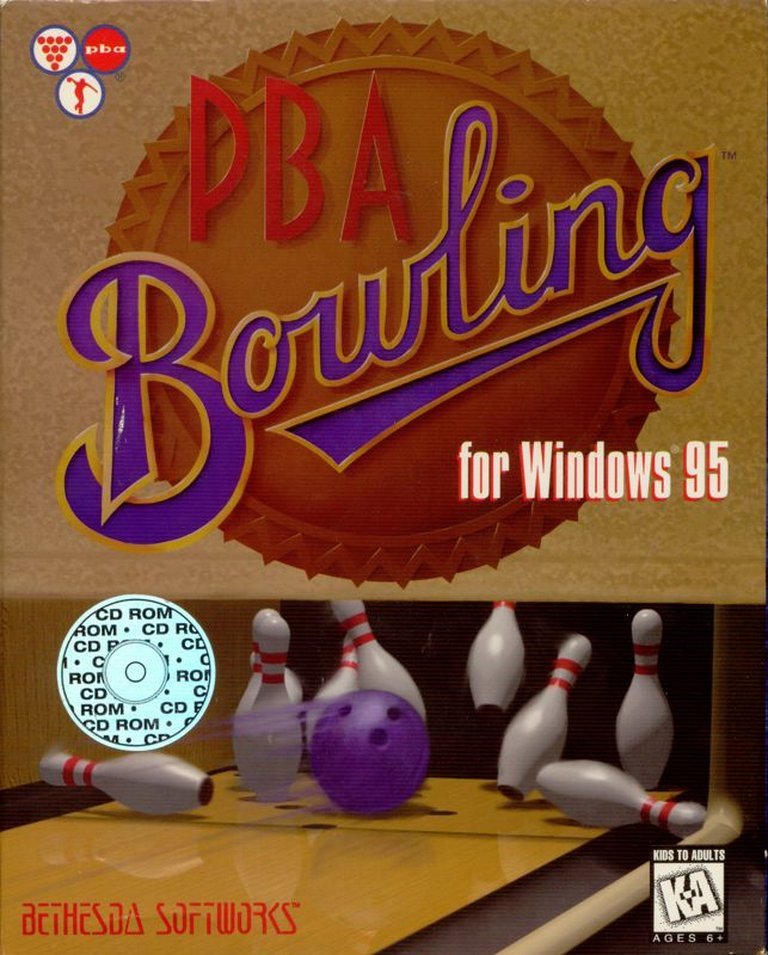
PBA Bowling, released in 1995 for Windows, is the first PC title officially sanctioned by the Professional Bowlers Association, offering a realistic bowling simulation with modes including individual, practice, team, and league play. Players select from fully digitized male or female bowlers, customize handedness, clothing colors, and skill levels from beginner to pro, then use precise controls for aiming, power, and spin on a detailed approach view, complete with close-up ball strikes on pins, supporting up to four players.
Gameplay Videos
PBA Bowling Free Download
PBA Bowling Patches & Updates
PBA Bowling: Review
Introduction
Imagine the thunderous crash of pins scattering like startled birds, the oily gleam of a well-maintained lane under fluorescent lights, and the electric tension of a tenth-frame spare—bowling, America’s everyman sport, distilled into pixels on a mid-90s PC screen. Released in 1995 by Bethesda Softworks, PBA Bowling marked the first PC title officially sanctioned by the Professional Bowlers Association (PBA), bringing the lane’s ritualistic drama to Windows desktops just as the OS was exploding in popularity. As a pioneer in licensed sports simulations, it promised to elevate bowling from arcade novelty to serious sim, complete with digitized pros and realistic physics. Yet, for all its technical ambition, PBA Bowling endures as a curious artifact: a game that nails the mechanics for die-hards but gutters on broader engagement, cementing its legacy as Bethesda’s modest swing in the sports genre before their RPG empire took shape. This review argues that while PBA Bowling innovated in customization and interface for its era, its static execution and niche appeal relegate it to a footnote in gaming history—admirable for authenticity, but ultimately a strikeout for mass entertainment.
Development History & Context
Bethesda Softworks, then a scrappy Maryland-based studio navigating the post-Wolfenstein 3D boom and pre-Elder Scrolls ascent, tackled PBA Bowling as a departure from their action-adventure roots. Led by Executive Producer Christopher Weaver (credited as CS Weaver), the project united producers Craig Walton and Bruce Nesmith—names synonymous with Bethesda’s early hits like Daggerfall—alongside game designers Brent Erickson and Walton himself, who moonlighted as lead programmer. A supporting cast included programmers Julian Lefay and Morten Mørup, artist Michael Matthews, and sound designer Andy Warr, with technical art by Bart Rydalch and manual writing by Walton and Peggy Meile. Notably, the game leveraged Bethesda’s in-house XnGine 3D engine, a tool also powering contemporaries like SkyNET and The Terminator: Future Shock, hinting at shared tech across their portfolio.
Collaboration extended to MediaTech West for development muscle, while PBA Hall of Famer Walter Ray Williams Jr.—a 15-time titlist and two-time Player of the Year—served as technical advisor, his likeness gracing the box art alongside the official PBA logo. This licensing was a coup, authenticating the sim amid a gaming landscape craving realism. Released November 15, 1995, for Windows 3.x and 95 (requiring a 486-33 CPU, 4MB RAM, and SVGA), it arrived during the Windows 95 revolution, where CD-ROMs and multimedia exploded—think Myst‘s dominance and sports sims like EA’s Madden NFL. Bowling games existed (e.g., 1980’s Intellivision PBA Bowling), but PC lacked a pro-tier entry. Constraints like 256-color SVGA and no hardware acceleration forced clever workarounds: fully digitized bowler animations from performers like Sergio Alexander and Gina Chamberlain, full-motion video clips, and a multi-window UI to simulate depth without full 3D lanes. Virgin Interactive handled international distribution, but Bethesda’s vision was clear: capture bowling’s “Friday night at the lanes” vibe, per box blurbs, in an era when sports titles prioritized simulation over spectacle.
Narrative & Thematic Deep Dive
PBA Bowling eschews traditional storytelling for the episodic rhythm of sports simulation, a deliberate choice reflecting 90s sim design where “narrative” emerges from procedural competition rather than scripted drama. No overwrought plot or voiced protagonists here—just the implicit lore of PBA culture: the grind of league nights, the pressure of tournament frames, and the camaraderie (or rivalry) of team play. Players embody customizable avatars—digitized male or female bowlers, named and tweaked for handedness, attire colors, ball weight, skill (beginner/intermediate/pro), and lane oil patterns—stepping into roles as virtual pros chasing perfect games.
Thematically, it romanticizes bowling’s blue-collar ethos: accessibility for all, yet mastery demanding precision and mental fortitude. Themes of persistence shine in practice mode’s spare training under eight lane conditions, mirroring real bowler’s oil-pattern battles. League and team creation fosters social simulation—painstaking editor setup for up to four players per squad evokes bowling alley bureaucracy, underscoring community bonds. Dialogue is sparse: automated scorecards and post-strike FMV clips (briefmark-sized, per critics) deliver triumphant cheers or groans, with digitized sound effects amplifying emotional beats like gutter-ball agony. Walter Ray Williams Jr.’s endorsement weaves authenticity, positioning players as heirs to legends.
Yet, this “narrative” falters in depth—no career arcs, rivalries, or escalating stakes beyond high scores. Themes of isolation creep in: solo play feels hollow without the promised “hallenatmosphäre” (hall atmosphere), as German reviewers lamented, reducing bowling’s social soul to mechanical reps. In extreme detail, the game’s procedural “plot” loops through 10 frames, building tension via splits and strikes, but lacks voiceover commentary or bowler banter to humanize avatars. It’s a thematic gutter: bowling as ritualistic meditation, not epic saga, rewarding purists while alienating those craving character-driven immersion.
Gameplay Mechanics & Systems
At its core, PBA Bowling revolves around a meticulous throw loop: select mode (individual, practice, team, league), customize bowler, then execute via a innovative four-window UI—the main approach view, spin/power gauge, aiming arrows, and pin-impact close-up. Behind-view perspective puts you on the approach, positioning anywhere on the lane before fine-tuning aim (arrow grid), power (meter fill), and spin (curve dial). Ball rolls with realistic physics—hook, skid, or straight—culminating in a slow-motion pin scatter, auto-scoring tallied in a persistent window. Up to four hot-seat players rotate, with skill levels gating difficulty: pros demand pixel-perfect lines under varied oil patterns.
Innovations abound: lane condition selection and ball weight tweaks add strategic depth, simulating PBA pros’ gear obsession. Practice hones spares under eight conditions, while league mode’s editor—though “nervig” (tedious), per PC Joker—builds persistent rosters. UI shines for era standards: intuitive sliders avoid clunky menus, echoing golf sims’ precision.
Flaws mar the loop: excessive ease yields high-200s games quickly, per GameSpot, sapping challenge—straight shots dominate, spin underperforms. Animations feel “ärmlichen” (miserable), ball graphics glitchy, lacking crash-and-explosion thrill. No network play limits multiplayer to locals, and static pacing induces “ober gähn” (yawning), as Power Play quipped. Progression is absent—no unlocks, stats tracking rudimentary. On 486 rigs, it chugs; modern ports (e.g., Abandonware) black out windows sans patches. Verdict: Faithful sim loop, flawed by accessibility overkill and absent dynamism.
World-Building, Art & Sound
The “world” is a sterile bowling alley abstraction: generic lanes with oil gradients, no lounges or crowds, evoking isolation over immersion. Atmosphere hinges on procedural lanes—oily sheen, pin reset clatter—but lacks dynamic weather, crowds, or venue variety, undermining “lieblingsbahn” (favorite alley) promise.
Visuals leverage XnGine for digitized bowlers (eight animators’ mocap) in SVGA 256-colors: fluid approaches, but pin collisions devolve into “anti-gravity” floats, robbing explosiveness. FMV strikes dazzle briefly, yet postage-stamp scale disappoints. UI windows multitask elegantly, framing action cinematically.
Sound excels: rolling thunder, pin explosions “amazing” (Video Games & CE), digitized effects capture essence—from approach footfalls to gutter splashes. No soundtrack avoids cliché, letting SFX breathe, though critics missed music for motivation. Collectively, elements forge a focused sim vibe: authentic for laneside tension, but barren for spectacle, prioritizing function over flair.
Reception & Legacy
Launch reception split sharply: MobyGames aggregates 55% critic average (8 reviews), 6.1/10 overall, ranking #8,239 on Windows. Highs: Electric Games (88%) lauded golf-like UI, graphics/sound, team play; PC Player (DK) (72%) conceded fun for fanatics; CNET urged “Try It” for pressure simulation. Lows dominated: PC Games (DE) (31%) slammed sloppy presentation; PC Action (DE) (35%) static gameplay; Power Play (46%) called it yawn-inducing sans friends. GameSpot’s 6.2/10 encapsulated: heaven for bowlers, lacking for normies. PC Gamer (70%) praised sim fidelity but solo fatigue.
Commercially “moderately successful” (PC Data), it boosted Bethesda to #46 publisher in 1996; PR chief Pete Hines later dubbed it the best-selling bowling game ever. Legacy endures modestly: spawned PBA Tour Bowling 2 (2000), influenced PBA licensees (PBA Pro Bowling 2021/2023), but no industry quake—bowling sims boomed later (Brunswick Pro). Bethesda alumni (e.g., Walton on 31 titles, Erickson on 29) carried forward sim rigor to RPGs. Reputation evolved to cult curiosity on Abandonware/Archive.org, nostalgia for Windows 95 era, but dismissed as niche relic amid golf/flipper sim floods.
Conclusion
PBA Bowling stands as Bethesda’s earnest 1995 foray into sports sims: pioneering PBA licensing, customizable depth, and windowed precision amid Windows 95’s dawn, bolstered by talents like Weaver, Nesmith, and Williams Jr. Its mechanics faithfully recreate bowling’s tactile ritual, art/sound evoke lane authenticity, yet narrative voids, easy loops, and visual stutters hobble replayability, yielding mixed reviews and niche sales. In video game history, it’s no Madden milestone—a competent underdog that hooked enthusiasts but split on the approach, paving PBA sequels while foreshadowing Bethesda’s sim-to-epic pivot. Verdict: 6.5/10—Recommended for retro sports fans or 90s PC completists; a spare worth picking up, but no perfect game. Fire up a demo (if patches cooperate) and roll for yourself.