
- Release Year: 2009
- Platforms: Nintendo DS, Windows
- Publisher: ak tronic Software & Services GmbH, Game Factory Interactive Ltd., Mindscape SA, MumboJumbo, LLC, rondomedia Marketing & Vertriebs GmbH, Russobit-M
- Developer: MumboJumbo, LLC
- Genre: Adventure
- Perspective: 1st-person
- Game Mode: Single-player
- Gameplay: Hidden object, Puzzle elements
- Setting: Horror
- Average Score: 68/100
Description
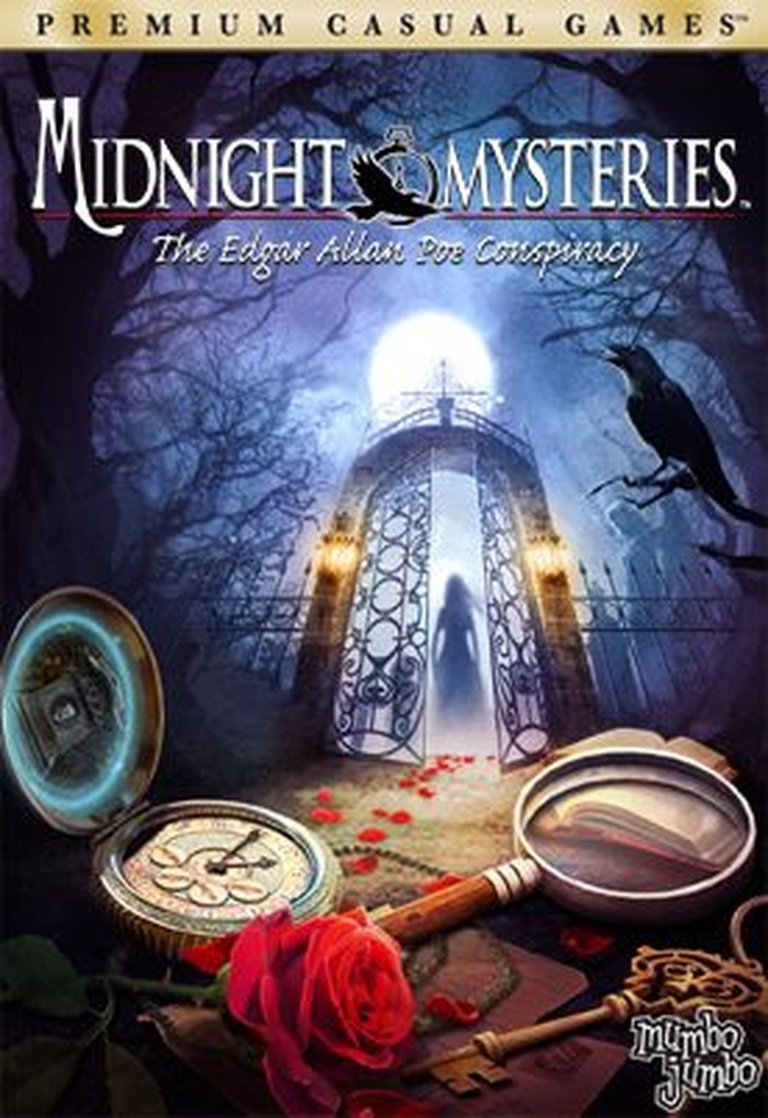
In Midnight Mysteries: The Edgar Allan Poe Conspiracy, a reclusive writer is visited by the ghost of Edgar Allan Poe, who enlists their help to unravel the mystery surrounding his untimely death. Using a magical pocket watch to travel through time, players explore atmospheric locations inspired by Poe’s works, solving hidden object puzzles, collecting clues, and tackling intricate challenges in this horror-tinged adventure game.
Gameplay Videos
Midnight Mysteries: The Edgar Allan Poe Conspiracy Guides & Walkthroughs
Midnight Mysteries: The Edgar Allan Poe Conspiracy Reviews & Reception
metacritic.com (55/100): The variety in gameplay that helped prevent Samantha Swift from being a total disappointment is definitely back in full force for Midnight Mysteries, tweaked to make the adventure far more enjoyable.
omnimysterynews.com : The screens are beautifully rendered and have “movement”, branches swaying and the like. The scenes are atmospheric, something you’d expect to visualize in a Poe story.
Midnight Mysteries: The Edgar Allan Poe Conspiracy: Review
Introduction
In the dim glow of a flickering lantern, as ravens perch ominously and shadows whisper secrets from the grave, Midnight Mysteries: The Edgar Allan Poe Conspiracy beckons players into a spectral investigation that marries the macabre allure of 19th-century literature with the clickable intrigue of casual gaming. Released in 2009 as the inaugural chapter of MumboJumbo’s Midnight Mysteries series, this hidden object adventure (HOG) casts players as a reclusive mystery writer haunted—literally—by Edgar Allan Poe’s restless ghost, tasking them with unraveling the enduring enigma of the author’s 1849 death using a time-traveling pocket watch. Amid a surge of literary-themed casual games, it stands as a poignant tribute to Poe’s bicentennial, blending gothic horror with puzzle-solving. My thesis: While its brevity and technical rough edges prevent it from ascending to genre masterpieces like Mystery Case Files, Midnight Mysteries excels as an atmospheric gateway to Poe’s world, delivering clever nods to his canon that elevate standard HOG fare into a hauntingly literate experience worthy of rediscovery in the age of remastered casual classics.
Development History & Context
MumboJumbo, LLC—a Denver-based studio founded in 2001 and best known for casual puzzle titles like Chainz and the Samantha Swift series—developed and self-published Midnight Mysteries amid the 2009 explosion of shareware HOGs distributed via portals like Big Fish Games and WildTangent. Led by game design lead John Newcomer (credited on 50+ titles) and original concept creators including Kelly Hamilton, Matthew Lichtenwalter, and a team of Russian collaborators like Ilya Plyusnin and Sergey Krushch (hidden object engine programmer), the project drew from the studio’s prior work on artifact-hunting adventures. Art director Kirill Korneev oversaw visuals, with animations by Hamilton, Chuck Lee, and others, reflecting a mix of American and Eastern European talent.
The era’s technological constraints shaped its first-person, point-and-click design: built for Windows (Pentium 3 1GHz, 256MB RAM) using keyboard/mouse input, it eschewed 3D complexity for 2D scenes optimized for CD-ROM/download distribution. Released July 2009 (Windows) and ported to Nintendo DS in 2010 by publishers like Mindscape SA and ak tronic, it navigated a casual market dominated by Big Fish’s trial model—$6.99 full unlock post-hour demo. The 2009 landscape was ripe for literary tie-ins: HOGs like Agatha Christie: Peril at End House and The Lost Cases of Sherlock Holmes proliferated, fueled by post-crash demand for affordable, bite-sized escapism. Timed for Poe’s 200th birth anniversary, MumboJumbo’s vision was ambitious—to weave The Raven, The Gold Bug, The Mystery of Marie Roget, and The Purloined Letter into a conspiracy thriller—yet constrained by shareware budgets, resulting in a compact 2-3 hour runtime across six chapters. Bugs (e.g., unselectable items) and historical liberties (presuming Poe’s murder) hint at rushed polish, but its engine innovations laid groundwork for sequels like Salem Witch Trials.
Narrative & Thematic Deep Dive
At its core, Midnight Mysteries reimagines Poe’s mysterious Baltimore demise—found delirious in ill-fitting clothes, dying days later—as a grand conspiracy solvable in 24 ghost-guided hours. Players embody an unnamed, gender-neutral writer whose career revival hinges on this spectral summons. Poe’s apparition provides the magical chronometer, enabling jaunts through his oeuvre: graveyards evoking “The Premature Burial,” bug-infested collections nodding to The Gold Bug, and shadowy studies channeling The Tell-Tale Heart. Suspects emerge—Poe’s publisher, fiancée’s brothers, a wealthy storeowner—interviewed via cutscenes, with clues pieced from witnesses like doctors and Dupin (Poe’s detective archetype).
Dialogue is sparse but flavorful, delivered in narrated cutscenes with Poe’s brooding baritone urging haste (“Who killed Edgar? And why hide the truth?”). Themes pulse with Poe’s obsessions: mortality’s veil (The Raven‘s endless “nevermore”), guilt’s heartbeat, cryptographic riddles (The Gold Bug, The Purloined Letter), and conspiracy’s paranoia. Time travel amplifies irony—players avert Poe’s fate by exposing “cooping” (election fraud voter-stuffing) or rivals—yet critiques arise for ahistorical flair, presuming murder over alcoholism/edema theories, as GameRadio noted. Characters lack depth: Poe is a brooding mentor, ghosts ethereal guides, suspects caricatured (jealous brothers, scheming publisher). Still, thematic cohesion shines—riddles like “unlucky number” (13) or “wise bird” (owl) embed Poe’s riddling style, transforming HOG lists into literary puzzles. The 160-year “cold case” motif, with 30 ghosts aiding, culminates in revelation, rewarding Poe fans while intriguing casuals with gothic intrigue.
Gameplay Mechanics & Systems
Midnight Mysteries thrives on a polished HOG loop: scour cluttered 1st-person scenes for list items (e.g., “skull,” “candle,” riddles like “portable steps” for ladder), with blue-highlighted entries demanding inventory tools (drag-drop corkscrew to uncork maps). A brown inventory bag holds keepers; ravens grant extra hints, while a raven-lamp button silhouettes/flies to targets—unlimited post-regen, though random clicks spawn a penalty cat. Glowing cursor gears trigger mini-puzzles: symbol locks (gravestone rubbings), tile-counting mazes (floor keys via directional clues), river-crossing logic (ferry boatman/sailors/boys/Dupin without invalid pairings), shape-matching (insect collections, card-suit locks), jigsaws, spot-the-difference, sliding blocks, and color-chain formations.
No combat or progression trees—advancement is linear, chapter-gated by puzzles, with no skill trees but replay via randomized lists (mitigated by fixed object spots). UI is intuitive: bottom list, side inventory, skip cutscenes. Innovations include contextual integration (objects blend seamlessly, some obscured) and adventure hybrids (e.g., scrub statues, bury-dig sand). Flaws abound: short length (2+ hours sans hints), pixel-hunting frustrations (multiple “bottles”/”newspapers”), occasional bugs (stuck bananas, vanishing scrolls), simplistic puzzles (auto-solve options), and DS port’s touch controls amplifying imprecision. Yet variety—HOG punctuated by 20+ minis—staves off monotony, per GameZebo, making it addictive for casual sessions.
World-Building, Art & Sound
The game’s 19th-century tableau—Poe’s Baltimore haunts, foggy graveyards, cluttered studies, rippling rivers—immerses via allusions: raven flocks (The Raven), beating hearts, buried secrets. Time-travel fluidly shifts eras/scenes, fostering conspiracy’s scope. Art direction blends hand-painted gothic realism (swaying branches, animated leaves/water) with clipart inconsistencies (noted in reviews), shadowy palettes evoking Poe’s melancholy. DS visuals hold but lose nuance.
Sound design amplifies dread: eerie piano/strings underscore mystery, ambient creaks/raven caws/heartbeat throbs sync with actions, Poe’s voiced narration chilling. No full soundtrack noted, but effects (hissing cat, gear grinds) enhance tactility, dimming lights/speakers advised for immersion. Collectively, they craft a cohesive, literary atmosphere—flawed visually, but aurally Poe-esque—elevating HOG clutter to haunting dioramas.
Reception & Legacy
Critically middling (MobyGames 64% from four reviews: GameZebo/GameRadio 70%, Nintendo Life 60% DS, Jeuxvideo 55%), it praised variety/atmosphere (“satiate HOG fans,” GameZebo) but dinged brevity, inaccuracies, puzzles (“waste of time,” Nintendo Life; “simplification abusive,” Jeuxvideo). Players averaged 3.6/5 (six ratings), collected by 42+ on MobyGames. Commercially shareware success via Big Fish/WildTangent, eBay resales $7-17, spawned nine sequels (Ghostwriting 2015 finale) and parallels like ERS Game Studio’s Dark Tales Poe series (The Black Cat, 2010+).
Reputation evolved from “rough debut” (bugs/short) to cult casual gem, influencing lit-HOGs (Women’s Murder Club). No industry shaker, but preserved Poe in gaming, cited academically (MobyGames’ 1,000+ citations), Steam App 32140 availability sustains it amid HOG revival (e.g., Hidden Through Time).
Conclusion
Midnight Mysteries: The Edgar Allan Poe Conspiracy distills Poe’s shadowy genius into clickable pulp, its HOG-puzzle fusion and thematic depth shining despite brevity, bugs, and inconsistencies. A flawed pioneer in literary casuals, it carves a niche for horror-infused adventures, proving even spectral yarns endure. Verdict: Essential for HOG historians and Poe devotees—7.5/10, recommended with lights low, a solid B-tier classic cementing MumboJumbo’s legacy in video game history’s shadowy annals.