
- Release Year: 2017
- Platforms: Windows
- Publisher: VT Publishing
- Developer: Crankies Smartworks
- Genre: Educational
- Perspective: Fixed / flip-screen
- Game Mode: Single-player
- Gameplay: Game show, quiz, trivia
Description
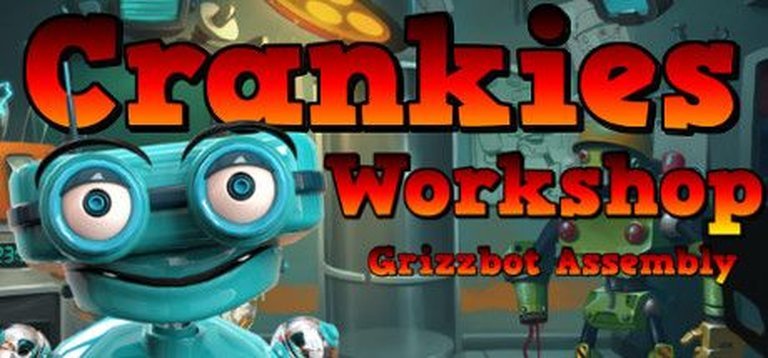
Crankies Workshop: Grizzbot Assembly is an educational trivia game set in a colorful and friendly workshop where players help the inventor Crankie assemble Grizzbots by answering true or false questions from knowledge machines. Featuring 30 levels with 10 questions each, correct and speedy answers advance the robot assembly process, earning dollar values and ranks from 1 to 3 to track progress and challenge players to beat their high scores across 300 challenging questions.
Crankies Workshop: Grizzbot Assembly: Review
Introduction
Imagine a whimsical workshop where robots spring to life not through sparks and welds, but through the raw power of true-or-false trivia—welcome to Crankies Workshop: Grizzbot Assembly, a 2017 Steam curio that embodies the wild, unfiltered indie scene of its era. Released amid a deluge of bite-sized educational titles, this game from developer Crankies Smartworks and publisher VT Publishing carves a niche as a hyper-simple quiz assembler, blending game-show vibes with robotic fantasy. Its legacy? An obscure gem in the Crankies Workshop series, infamous among achievement hunters for doling out 5,000 “Achievement King” badges in mere minutes, yet largely forgotten elsewhere. My thesis: While its colorful charm and free content update capture the joy of quick-fire learning, Grizzbot Assembly ultimately falters as a repetitive trivia slog, cementing its place as a testament to Steam’s golden age of shovelware experimentation rather than enduring innovation.
Development History & Context
Crankies Smartworks, a diminutive indie outfit, unleashed Grizzbot Assembly on September 12, 2017 (with some records noting the 14th), exclusively for Windows via Steam (App ID 705420). Published by VT Publishing—a prolific curator of low-budget titles—this was one entry in a rapid-fire series including Zazzbot, Lerpbot, Whirlbot, Bozzbot, Freebot Assembly, and even a sequel Grizzbot Assembly 2. Built on the Unity engine, the game reflects the era’s technological democratization: Unity’s accessibility allowed small teams to flood Steam with fixed-screen, keyboard-and-mouse trivia experiences, unconstrained by AAA budgets or hardware demands (minimum specs: 2.0 GHz CPU, 500 MB RAM, DirectX 9 GPU).
The 2017 gaming landscape was Steam’s indie Wild West—post-Among Us precursors, amid trivia revivals like You Don’t Know Jack reboots and Buzz! echoes, but dominated by asset-flip experiments. VT Publishing’s community posts highlight responsiveness: a free October 2017 update tripled content from 10 to 30 levels, responding to player feedback amid coupon trades and bug reports. No major patches beyond this, and the game’s removal from the Steam store by November 26, 2019, underscores its commercial ephemerality. Creators envisioned a “friendly atmosphere” for casual education, but Unity’s quirks (e.g., achievement bugs granting 100% completion pre-launch) exposed the pitfalls of rushed deployment in a market prioritizing quantity over polish.
Narrative & Thematic Deep Dive
At its core, Grizzbot Assembly spins a delightfully straightforward yarn: Crankie, the eponymous workshop tinkerer, faces a massive Grizzbot order but lacks the “knowledge” to fuel his assembly line. Enter the player, quizzed by sentient “knowledge machines” on true-or-false facts—each correct answer advances a robot’s construction, from skeletal frames to fully operational behemoths. Dialogue is sparse but endearing: Crankie “shows you the ropes” in a tutorial, then cheerily rates your bots with 1-3 stars based on total value, urging replays to “beat previous scores.”
Thematically, it’s a paean to knowledge as mechanical magic—trivia isn’t mere diversion but literal creation fuel, echoing educational forebears like Oregon Trail‘s factoids or Carmen Sandiego‘s globetrotting quizzes. Grizzbots symbolize industrious progress, their assembly mirroring real-world factories (nodding to games like The Assembly, a related MobyGames title). Subtle motifs of progression abound: slow answers yield low-dollar stages, fast ones premium parts, fostering a gamified learning loop. Characters lack depth—Crankie is a folksy everyman, bots anonymous—but the narrative excels in motivation, turning 300 questions into a heroic assembly quest. Flaws emerge in repetition: no branching plots or character arcs, just escalating trivia across 30 levels. Yet, this minimalism amplifies its charm, positioning knowledge as joyful labor in a post-truth 2017 world.
Plot Breakdown
- Tutorial (Level 0): Crankie introduces the crisis; 10 demo questions hook players.
- Levels 1-30: Each robot requires 10 progressive stages (questions), culminating in valuation.
- Post-Level Feedback: Crankie’s ranks (1-3) track mastery, with high scores unlocking implicit bragging rights—no explicit unlocks, but replay value drives narrative closure.
Character Analysis
| Character | Role | Traits | Thematic Contribution |
|---|---|---|---|
| Crankie | Host/Mentor | Friendly, encouraging, rating system enforcer | Embodies workshop spirit; humanizes trivia grind |
| Knowledge Machines | Quizzers | Impersonal fact-dispensers | Symbolize pure intellect fueling creation |
| Grizzbots | Products | Silent, evolving constructs | Represent player achievement; vary per level for visual progression |
Themes culminate in empowerment: mastering trivia “builds” success, a rare positive spin on edutainment.
Gameplay Mechanics & Systems
The core loop is elegantly reductive: answer true/false queries to assemble Grizzbots, with speed dictating dollar values per stage (10 per level, 300 total). Correct answers advance the fixed/flip-screen assembly—visual parts snap on amid clanks—while errors halt progress, demanding restarts. No lives or penalties beyond score dips; it’s forgiving for education.
Key Systems Deconstructed:
– Quiz Mechanics: 300 “challenging” true/false questions (topics unspecified, but general knowledge implied). Speed-scaling rewards snap judgments: quick hits maximize value, slow ones minimize.
– Progression & Scoring: Per-level totals yield Crankie’s 1-3 ranks. No meta-progression (e.g., upgrades), but leaderboards via personal bests encourage replays. 30 levels gate content linearly.
– UI/UX: Unity-driven, mouse/keyboard only. Simple: question screen → answer buttons → assembly animation → score. PCGamingWiki notes config in Steam’s compatdata/705420/pfx, but no remapping/VSync tweaks needed for 60+ FPS.
– Innovations/Flaws: Innovative tie-in of trivia to tangible building; flaws include repetition (identical loops), no difficulty ramps, and achievement bugs (5,000 “Achievement King” pops instantly, auto-completing for 100% in 1m median time per completionist.me).
Combat/Actions? None—pure quiz, no action/strategy despite Steam tags. Progression feels strategic via speed optimization.
| Loop Element | Strengths | Weaknesses |
|---|---|---|
| Question-Answering | Instant feedback, educational bite | Repetitive; bugs trivialize mastery |
| Assembly Viewing | Satisfying visuals/sounds | Fixed-screen limits immersion |
| Scoring/Ranks | Motivates replays | Shallow; no global leaderboards |
Overall, a tight 1-2 hour burst (18h avg. playtime skewed by farmers), ideal for trivia addicts but exhausting for depth-seekers.
World-Building, Art & Sound
The workshop is a vibrant, fixed-screen diorama: colorful backdrops of gears, conveyor belts, and half-built Grizzbots evoke a kid-friendly factory (think Wall-E meets Sesame Street). Unity art shines in simplicity—bright palettes, smooth animations as parts assemble with satisfying snaps. Flip-screen transitions (level-to-level) maintain focus, contributing to a “friendly atmosphere” that disarms players.
Atmosphere builds immersion: questions overlay the scene, assembly punctuates wins, fostering flow. Sound design (royalty-free per PCGamingWiki) likely features bouncy chiptunes, clanging SFX, and Crankie’s upbeat voiceovers—evident in Steam screenshots’ whimsical UI. These elements elevate the mundane: trivia feels like play, not work. Limitations? No HDR/widescreen native support, basic 500 MB VRAM needs, but they enhance pick-up-and-play coziness, making 30 levels a comfy marathon.
Reception & Legacy
Launch reception: Silent void—no MobyGames/Metacritic scores, zero critic/player reviews. Steam whispers of bugs (“100% achievements pre-start,” per forums) and coupon trades dominate; VT’s update post thanks “the community,” implying modest uptake (2,356 owners, 891 completers via completionist.me; ~0K active per PlayTracker). 5/100 Steam score reflects frustration, yet 93% avg. completion (100% median) marks it a hunter’s paradise—5,000 achievements for “Achievement King” spam, unlocked in 1m bursts.
Commercially, a blip: $4.99 price, store delisting 2019 signals flop, but series endurance (7+ titles) shows VT’s grind. Influence? Niche: pioneered achievement-farming trivia (echoed in Pixel Puzzles), edutainment amid Quiz revivals. Evolved rep: Cult status for plats (891 finishers), free update lauded. Industry ripple minimal—Unity shovelware archetype—but preserves 2017 Steam as trivia experimentation hub.
Conclusion
Crankies Workshop: Grizzbot Assembly distills trivia to its essence: quick questions fueling robotic whimsy, buoyed by free expansions and infectious cheer. Yet repetition, bugs, and sparsity hobble depth, rendering it a fleeting novelty. In video game history, it claims a footnote as Steam’s ultimate completionist bait—a quirky series cog exemplifying indie’s bold (if buggy) educational push. Verdict: 6/10—charming diversion for quiz fans and hunters, but no assembly-line masterpiece. Dust it off for a nostalgic 1m plat, then shelve amid the workshop clutter.