
- Release Year: 1996
- Platforms: Windows
- Developer: P.S. Neeley
- Genre: Strategy, Tactics
- Perspective: Top-down
- Game Mode: Single-player
- Gameplay: Board game
- Setting: Futuristic, Sci-fi
Description
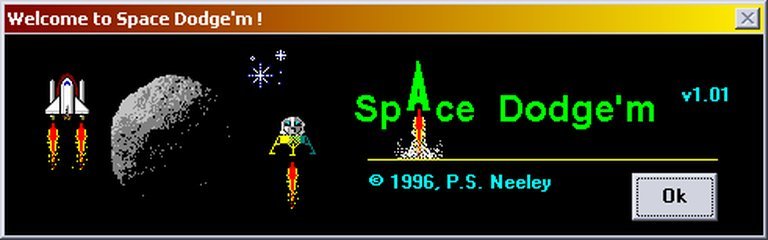
Space Dodge’m is a shareware sci-fi adaptation of the 1972 abstract board game Dodgem, set on a space station hurtling toward a catastrophic asteroid collision. Players take turns moving their shuttles or landers across a customizable square grid (3×3 to 8×8) toward evacuation pads—strictly forward (up or right) or sideways—while dodging occupied squares and strategically blocking opponents, all under a shrinking time limit before doom arrives.
Space Dodge’m Free Download
Space Dodge’m: Review
Introduction
In the vast cosmos of 1990s shareware gaming, where ambitious epics jostled with minimalist masterpieces on floppy disks and early downloads, Space Dodge’m emerges as a quiet revelation—a digital resurrection of a 1972 mathematical curiosity that transforms pedestrian board-game logic into a pulse-pounding race against cosmic doom. Developed as a solo passion project, this unassuming Windows title adapts Colin Vout’s abstract Dodgem into a sci-fi thriller set aboard a doomed space station, challenging players to evacuate their fleet amid an encroaching asteroid. Its legacy lies not in blockbuster sales or cultural memes, but in embodying the shareware era’s ethos: profound depth from the simplest rules. This review argues that Space Dodge’m is a cornerstone of combinatorial game design, proving that elegance in constraints can outshine graphical excess, and deserves rediscovery as a timeless tactic puzzle in video game history.
Development History & Context
Space Dodge’m was crafted in 1996 by P.S. Neeley, a prolific shareware auteur credited on over 10 titles, operating as a one-person studio in the democratized wild west of PC gaming. Released exclusively for Windows (with compatibility noted for Windows 3.x and 95), it leveraged Visual Basic 3.0—requiring the VBRUN300.DLL runtime—reflecting the era’s shift from DOS command-line hacks to graphical interfaces. Neeley’s vision was preservationist yet innovative: resurrecting Vout’s Dodgem, first popularized in print and BASIC listings like David Ahl’s 1979 More BASIC Computer Games, by infusing it with a narrative hook and time pressure absent in the original.
The mid-90s gaming landscape was transformative. Windows 95 had just launched, catalyzing a shareware explosion via portals like CNET and AOL downloads, where titles like Doom (id Software) and SimCity 2000 proved indies could rival publishers. Strategy games thrived amid Civilization and Command & Conquer, but board-game hybrids were niche, echoing chess variants or Quirks & Quarks. Technological constraints—modest RAM, no 3D acceleration—favored Neeley’s top-down, sprite-based design, prioritizing algorithmic AI over visuals. As shareware, it invited free trials with registration nudges, aligning with the model’s “try before buy” philosophy. Neeley’s homepage hosted downloads, underscoring personal distribution in a pre-Steam world. This context positions Space Dodge’m as a bridge between academic math games and commercial strategy, born from hobbyist ingenuity amid Windows’ ascent.
Narrative & Thematic Deep Dive
Space Dodge’m eschews verbose storytelling for implicit drama, its “plot” unfolding via premise alone: two rival factions—yours with shuttles (evacuating upward) or landers (rightward)—scramble to launch from a space station barreling toward an unstoppable asteroid. No cutscenes, characters, or dialogue exist; the narrative is mechanical, conveyed through a shrinking timer visualized as an expanding asteroid shadow. This minimalism amplifies themes of urgency and inevitability, mirroring real-time strategy without real-time chaos—every turn ticks the doomsday clock, forcing imperfect choices.
Thematically, it explores interdependence in opposition: players “dodge” foes not through combat, but positioning, evoking Cold War mutually assured destruction or evolutionary arms races. Vout’s original Dodgem win-condition (immobilizing the opponent) is subverted here—no stalemate via blockade; illegal moves prevent endless loops, emphasizing progress over paralysis. Sci-fi trappings—shuttles/landers as tokens, station grids as corridors—add flavor without bloat, theming resource scarcity (limited moves) and strategic sacrifice (abandon a piece to save the fleet?). Deeper still, it probes mathematical futility: no perfect strategy exists beyond 3×3 boards, where first-player wins demand precision; larger grids spawn chaos, symbolizing life’s unpredictable blockades. Absent voiced protagonists, the “dialogue” is the board’s silent taunts—your lander hemmed in, opponent’s shuttle slipping free—crafting emergent tragedy from rules alone.
Gameplay Mechanics & Systems
At its core, Space Dodge’m distills turn-based tactics to primal elegance: a square grid (3×3 to 8×8, customizable) hosts fleets of tokens (typically 3-5 per side, scaling with size). Players alternate moving one piece to an adjacent empty square—forward (toward pads), sideways, but never backward or occupied. Victory demands evacuating all your pieces off-board before the opponent, under an asteroid timer that accelerates visually and mechanically.
Core Loop and Blocking Dynamics
The loop is devilishly addictive: assess board state, predict foe responses, maneuver to block while advancing. Blocking shines in mid-game “traffic jams”—dodge sideways to clog lanes, forcing detours. The no-immobilize rule (a key tweak) bans moves leaving opponents move-less, curbing exploits and promoting fluidity. Time limit injects panic: asteroid “grows” per second (real-time overlay on turns), ending games prematurely—larger boards/timers suit AI skirmishes, tiny ones demand blitzkrieg.
Progression and Customization
No traditional leveling; “progression” is mastery via replays. Options abound:
– Board size: 3×3 (soluble, first-player win) to 8×8 (chaotic, unsolved).
– Timer: Adjustable doom-clock for casual/epic sessions.
– AI difficulty: Scalable opponent, from novice (predictable paths) to expert (ruthless blockers).
– Piece sets: Shuttles (vertical goal) vs. landers (horizontal), altering flow.
Combat and UI
No direct combat—pure positional warfare. Mouse-driven UI is spartan: click-to-move, hover previews legality. Flaws emerge in larger boards (clunky scrolling?) and solo-only play (no hotseat/multiplayer noted). Innovations like real-time timer hybridize turn-based purity, flaws like VB-era lag on modern systems (emulate via DOSBox/Archive.org). Yet, depth endures: combinatorial explosion rivals Go, where feints (side-step to bait) yield 10^50+ positions.
| Mechanic | Strengths | Weaknesses |
|---|---|---|
| Movement Rules | Elegant blocking, no draws | Steep learning curve for parity |
| Timer | Heightens tension | Can frustrate cautious play |
| AI Scaling | Replayable challenge | Lacks human unpredictability |
| Customization | Accessibility for all skill | Limited variety (no variants) |
World-Building, Art & Sound
The “world” is a stark space station grid—metallic corridors etched in top-down pixels, evacuation pads glowing at edges, asteroid looming as a pixelated harbinger. Visual direction prioritizes clarity: distinct shuttle/lander sprites (sleek vectors?), color-coded fleets (blue/red?), minimalism evoking Asteroids lineage. Atmosphere builds via escalation—board feels claustrophobic as pieces clump, timer’s encroachment casting doom.
Art is functional retro: Windows 3.x-era sprites, no animations beyond moves/evacuations. Sound design, toggleable, enhances immersion—sparse SFX (clunks for moves, whooshes for launches, ominous rumbles for asteroid) punctuate turns; music likely chiptune loops, underscoring tension without distraction. These elements forge psychological pressure: visuals declutter strategy, audio timers subconscious dread, creating a lean sci-fi vibe where emptiness amplifies stakes. On CRTs, it popped; modern emulations preserve the vibe, contributing to an experience greater than parts—pure, unadorned tactics in void.
Reception & Legacy
Launch reception was ghostly: no critic reviews on MobyGames/Metacritic, one player rates 3.6/5 (anecdotal praise for depth?). Shareware obscurity doomed visibility amid 1996 giants (Quake, Resident Evil), collecting dust with 3 Moby owners. Commercially, free downloads via Neeley’s site/Archive.org sustained it, but no sales data exists.
Reputation evolved positively in niche circles—abandonware sites (MyAbandonware) hail it 5/5; trivia spotlights its math pedigree (unsolved strategies). Influence permeates subtly: prefigures indie board-games (Slay the Spire‘s positional decks), combinatorial apps (Euclidea), and Into the Breach‘s turn-based foresight. As Dodgem digitizer, it preserves Vout’s legacy (cf. Gardner’s Time Travel and Other Mathematical Bewilderments), inspiring analyses of simple-rule complexity (like Lights Out). In industry terms, it exemplifies shareware’s role in democratizing games, paving for itch.io minimalists. Rediscovered via emulation, its cult status grows among retro strategists.
Conclusion
Space Dodge’m is no graphical spectacle or narrative epic, but a masterful synthesis of mathematical purity and shareware pluck—transforming a 1972 brainteaser into a 1996 tension engine via sci-fi urgency and refined rules. P.S. Neeley’s solo triumph shines in exhaustive depth: customizable grids, devilish blocking, existential timers yielding endless mind-games from four moves. Flaws—solo play, dated tech—are era artifacts, eclipsed by timeless appeal. In video game history, it claims a vital niche: proof that simplicity spawns profundity, influencing combinatorial design amid flashier peers. Verdict: Essential for strategy historians, 9/10 for purists—download from Archive.org, dodge into oblivion, and ponder the beauty of blocked paths. A hidden gem demanding canonization.