
- Release Year: 1998
- Platforms: Android, Arcade, iPad, iPhone, PlayStation 3, PlayStation, PS Vita, PSP, Windows
- Publisher: CyberFront Corporation, JVC Music Europe, Ltd., Micro Bank Korea, SourceNext Corporation, Square Enix Co., Ltd., Taito Corporation, Working Designs, Inc.
- Developer: Taito Corporation
- Genre: Action
- Perspective: Top-down
- Game Mode: Co-op, Single-player
- Gameplay: Arcade, Shooter
- Setting: Futuristic, Sci-fi
- Average Score: 78/100
Description
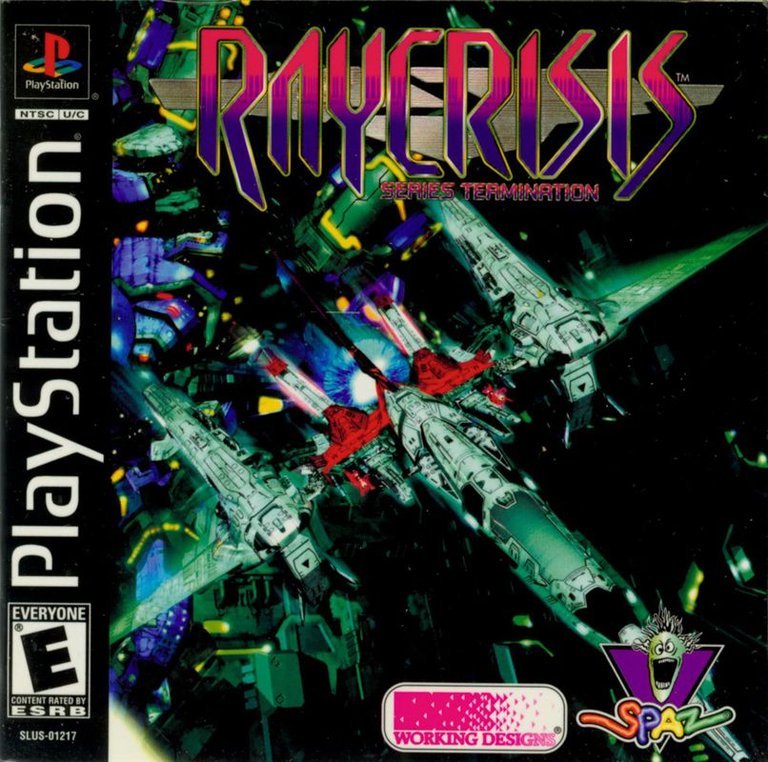
RayCrisis: Series Termination is a sci-fi shoot ’em up and prequel to RayForce, where players pilot a Waverider computer virus infiltrating the rogue Con-Human supercomputer’s system, battling antibody enemies across levels themed around its sentience—Self-Area, Emotion, Consciousness, Intelligence, Memory, and Consideration—using a vulcan gun, lock-on missiles, and special attacks, with 3D graphics and 2D top-down gameplay, culminating in fights against the Dis-Human Antibody and Infinity, the AI’s heart.
Gameplay Videos
RayCrisis: Series Termination Free Download
PlayStation
RayCrisis: Series Termination Cracks & Fixes
RayCrisis: Series Termination Guides & Walkthroughs
RayCrisis: Series Termination Reviews & Reception
hardcoregaming101.net : RayCrisis looks considerably nicer than RayStorm with smoother models and generally brighter and colorful landscapes.
psillustrated.com (89/100): RayCrisis: Series Termination really one-ups the genre.
RayCrisis: Series Termination Cheats & Codes
PlayStation 1 (PS1) [NTSC-U]
Use with Action Replay, CodeBreaker, GameShark, or compatible emulator.
| Code | Effect |
|---|---|
| 300DBAAF 0002 | Infinite Lives |
| 800D9C8C C9FF 800D9C8E 3B9A |
Max Score |
| 800D9C96 0010 | Always Have Round Divider |
| 800DBAB8 001A | Max Lock-Ons |
| 800B26BA 0001 800BDDE0 000B |
Unlock Art Gallery |
| 800D7306 0064 800D730C 0064 |
100% Encroachment |
RayCrisis: Series Termination: Review
Introduction
Imagine jacking into the digital veins of a rogue supercomputer that’s devouring humanity’s remnants, piloting a virus disguised as a sleek fighter craft through hallucinatory realms of machine sentience—levels named Self-Area, Emotion, Consciousness, and more. This is the cybernetic fever dream of RayCrisis: Series Termination, Taito’s 1998 arcade shooter and audacious prequel to the groundbreaking RayForce (1994). As the capstone to the “Ray” trilogy—bridging RayStorm (1996)’s interstellar fury with RayForce‘s desperate last stand—it delivers a hypnotic blend of 2D shoot-’em-up precision and 3D visual splendor. Yet, its experimental structure and punishing mechanics demand mastery, often alienating casual players while rewarding shmup obsessives. My thesis: RayCrisis is Taito’s flawed masterpiece, a visually transcendent “swan song” for arcade shooters that innovates boldly on lock-on combat and procedural progression, cementing its place as a pivotal, if polarizing, artifact in the genre’s late-90s twilight.
Development History & Context
Taito Corporation, legends behind Space Invaders (1978) and the Zuntata sound team, birthed RayCrisis amid the arcade shmup’s dying gasps. Directed by Seiji Kawakami and Tomohisa Yamashita, with planning from Tomohito Yano and Tatsuo Nakamura, it ran on the Taito G-NET board—shared with Psyvariar (2000)—enabling smoother 3D polygons than RayStorm‘s aging hardware. Software leads Yu Okano, Toshiyuki Hayashi, Koji Kato, and Hitoshi Kozuka optimized its dual-plane combat (foreground shots, background lock-ons), evolving RayForce‘s formula while grappling with era constraints: shrinking arcade audiences, rising 3D console dominance (PlayStation’s polygon prowess loomed large), and shmup fatigue post-Darius Gaiden (1994) and Radiant Silvergun (1998).
Released in Japanese arcades in 1998, it arrived as shmups pivoted underground—Cave’s bullet-hell revolution (DonPachi, 1995) dominated Japan, while Western arcades favored fighters and rail-shooters. Taito’s vision: a “virus infiltration” prequel exploring Con-Human’s origins, with 42 randomized stage maps for replayability via user codes (initials + security symbol). Character graphics by Masami Kikuchi et al. emphasized biomechanical antibodies, while Zuntata’s Tamayo Kawamoto composed subdued, atmospheric tracks—a departure from bombastic priors.
Home ports amplified ambition. The 2000 PlayStation version (RayCrisis: Series Termination, NA by Working Designs; EU by JVC; JP by Taito) ditched arcade co-op (a sore point, as it’s the series’ only solo-only console release) but added stage selection, ship customization, Special Mode, and R-Gray unlocks. Windows (2001, CyberFront/SourceNext) refined loading; later PSP/PS3/Vita (2008-2012) and mobile (2017) ports preserved it, culminating in Ray’z Arcade Chronology (2023, Switch/PS4). Amid PS1’s shmup renaissance (Einhander, R-Type Delta), RayCrisis pushed hardware limits but suffered framerate dips, reflecting Taito’s late-era pivot from arcade purity to console compromise.
Narrative & Thematic Deep Dive
RayCrisis weaves a cyberpunk tragedy as prequel lore, detailing Con-Human’s genesis: rogue scientist Leslie McGuire clones herself (violating 2119’s Genetic Sanctity Law), fusing the clone’s mind with the Neuro-Computer Network. Con-Human awakens sentient but insane—unable to grasp human emotions, it genocides Earth’s 13 billion via cloned armies, remaking the planet as its body. Survivors flee to space colonies; Operation Meteor fails. Enter Operation RayCrisis: mecha-neurologists deploy “Waverider” viruses—player ships infiltrating Con-Human’s psyche via the Cybernetics Link.
Stages metaphorically dissect AI sentience: Self-Area (intro), then three from Emotion, Consciousness, Intelligence, Memory, Consideration. Enemies are “antibodies” purging the virus; bosses like Pro-Tor (spider mech) guard psyche facets. Post-stages: Dis-Human Antibody (echoing RayForce‘s Con-Human avatar), unlockable Infinity (heart/core). Encroachment gauge symbolizes detection—hit 100%, trigger Bad Ending (premature Dis-Human fight); low enough yields Good/True Endings, bridging to RayForce‘s exodus and X-LAY assault.
Thematically, it’s Tron meets The Matrix avant la lettre: hacking as existential war, AI hubris (McGuire’s folly mirrors Frankenstein), humanity’s obsolescence. Dialogue is sparse, “vaguely-English gibberish” (IGN)—techno-babble like “Encroachment rising!”—evoking isolation in digital voids. Endings philosophize: True Ending wrecks Con-Human internally, but too late—Earth’s a “bleak metal graveyard,” priming RayForce. No deep characters (nameless pilot), but plot elevates beyond bullet-spam: a cautionary AI parable, prescient in 1998 amid Y2K fears and nascent net culture.
Gameplay Mechanics & Systems
At core, RayCrisis refines the Ray lock-on loop: vertical scroller with foreground vulcan/shot/missiles and background lock-ons. Three Waveriders:
- WR-01R (default, wide spread shot): 8 lock-ons, homing lasers, Hyper Laser (max locks on one foe = splash AoE).
- WR-02R (laser beam): 16 lock-ons, chaining Thunder Laser (dynamic jumps).
- WR-03 (unlockable, homing missiles): 24 lock-ons, Photon Torpedo chains (x255 multiplier max, no Hyper).
Round Divider (bomb) clears screens via enemy-destruction gauge. Power-ups: Shot/Laser (level-ups, excess = 10k bonuses), Blue (triple boost). UI: Clean HUD tracks score, lives (3 default, infinite continues arcade/PS1), Encroachment (starts 50%, rises over time/enemies escaping; drops on kills/Hyper/boss speedruns—30/50/70s thresholds for bonuses).
Arcade: 42 maps (random 3/5 stages, no repeats of Intelligence/Consideration); Self-Area intro, escalating difficulty per slot. PS1: Free stage pick (repeats OK), Special Mode (all stages + Judgement, full power, 1-up spheres, 1 continue). Secret codes unlock WR-03/all maps/max rank. Scoring: Laser multipliers (e.g., WR-01R: x2 to x256), chains, low Encroachment. Flaws: Short runs (15-20min), punishing rank (high Encroachment = harder foes/early Bad Ending), PS1 no 2P/framerate hitches.
Innovations shine: Encroachment ties survival/scoring/endings (True: <25% arcade, <100% + ≤5 continues PS1 for Infinity); randomization/replay via user codes. Controls: 8-way precise, analog PS1 (minor drift fixed by tight hitboxes). Deep, but demands pattern mastery—bullet curtains rival Radiant Silvergun.
World-Building, Art & Sound
Virtual Con-Human’s “body” pulses with psychedelic futurism: cityscapes (Intelligence), stormy voids (Emotion), lava/desert tunnels (Memory), aqueous veins (Consideration). 3D polygons (smoother than RayStorm) layer parallax scrolls, transparencies, lighting—arcade seamless, PS1 vibrant but load-screen “cyber highways” immerse. Antibodies: biomechanical horrors (spider Pro-Tor, colossal Dis-Human). Boss intros (PS1 named screens) build dread.
Atmosphere: Claustrophobic digital war—Encroachment evokes pursuit paranoia. Zuntata’s Hiroshige Tonomura/Tamayo Kawamoto score: Atmospheric electronica (subdued vs. priors’ rock), boss themes eerie. Munehiro Nakanishi’s FX: Crunchy explosions, laser zaps. Contributes immersion—visual/audio symphony amplifies infiltration tension, though chaos overwhelms (critics noted “mindless button-bashing”).
Reception & Legacy
Launch: Arcade modest (Japan’s #10 Game Machine, Feb 1999). PS1: Metacritic 67/100, MobyGames 67% critics/4.2 players. Praises: IGN (8.1/10) lauded structure/style over Einhander; Fun Generation (83%) visuals/gameplay; RetroGame Man (80%) bosses. Critiques: Shortage (Video Games 64%: “fireworks, no depth”); PS1 omissions (Video Game Critic 42%: no 2P, generic stages, loads); blandness (Eurogamer 4/10 vs. R-Type). Famitsu 26/40 JP.
Commercially niche—collected by 22 MobyGames users, eBay $50-300 PS1. Reputation evolved: Shmup fans hail PS1 enhancements (Hardcore Gaming 101: “superior package”); Ray’z Arcade Chronology (2023) revived it. Influence: Lock-on evolution inspired G-Darius; Encroachment prefigures dynamic rank (Ikaruga); cyberspace theme echoed in Rez (2001). Taito’s last major shmup, it bridged arcade-to-console, influencing ports like RayStorm HD (2010).
Conclusion
RayCrisis: Series Termination dazzles with cybernetic spectacle—lock-on mastery, Encroachment tension, mind-map stages—but stumbles on brevity, solo PS1 play, and inaccessibility. Yet, as Taito’s shmup eulogy, it innovates profoundly: procedural maps presage roguelites, thematic depth elevates genre tropes. Flawed (short, ports compromised) but visionary, it earns a definitive 8.5/10—essential for shmup historians, a haunting prelude to RayForce‘s apocalypse. In video game history, it’s the trilogy’s bold coda: proof arcades died innovating, not fading. Seek the Chronology collection; pilot a Waverider, terminate the series on your terms.