
- Release Year: 2004
- Platforms: Windows
- Publisher: Ubisoft Entertainment SA
- Developer: GSC Game World
- Genre: Strategy, Tactics
- Perspective: Diagonal-down
- Game Mode: LAN, Online PVP, Single-player
- Gameplay: characters control, Multiple units, Point and select, Real-time strategy, RTS
- Setting: Classical antiquity, Historical events
- Average Score: 57/100
Description
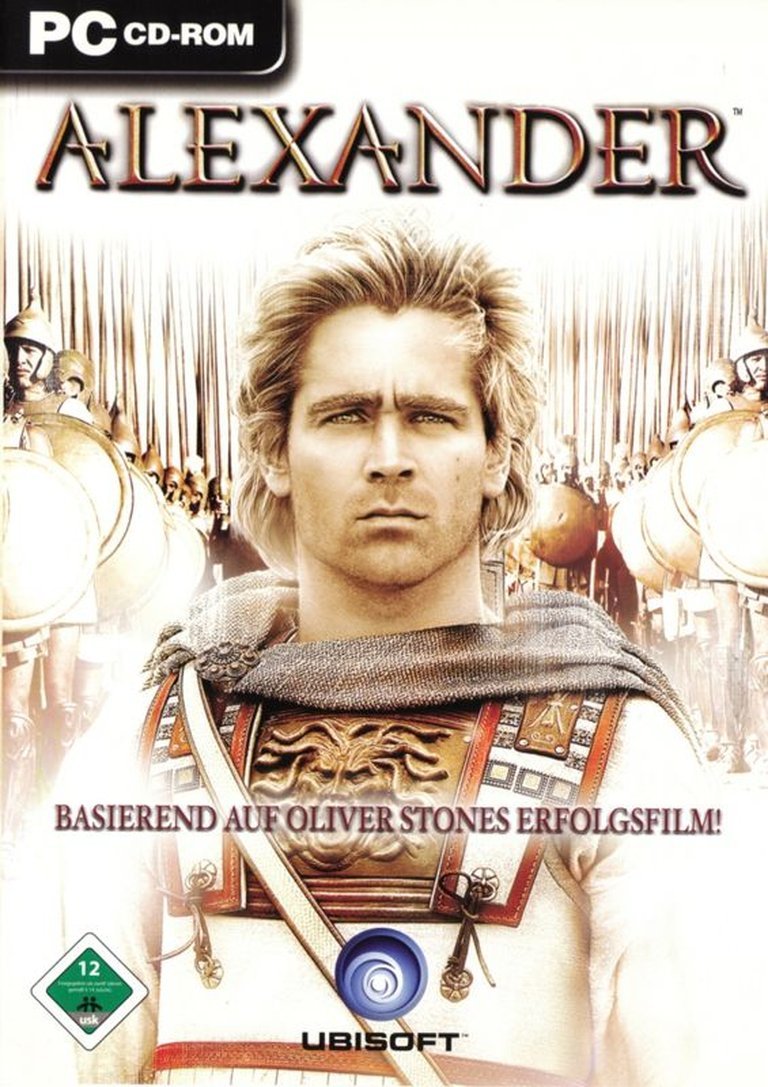
Alexander is a real-time strategy game based on Oliver Stone’s film and the historical conquests of Alexander the Great, where players command massive armies of Greek, Persian, Indian, and Egyptian forces across campaigns recreating key ancient battles. Featuring a hybrid 2D/3D engine that supports hundreds of units on vast 3D terrain, the game offers destroy/survive/escort missions, skirmish and multiplayer modes, and Vangelis’ soundtrack from the movie.
Gameplay Videos
Where to Buy Alexander
PC
Alexander Cracks & Fixes
Alexander Reviews & Reception
metacritic.com (56/100): Mixed or Average
en.wikipedia.org (56/100): received mixed reviews
worthplaying.com : the depth of strategy is severely lacking
Alexander Cheats & Codes
PC
While playing the game, press [Enter] to display the console window, then enter one of the following codes to activate the corresponding cheat function.
| Code | Effect |
|---|---|
| babki | 50,000 resources |
| viewall | Clear map and show enemy’s moves |
| victory | Automatic win |
| qwe | Press P for effects |
Alexander: Review
Introduction
Imagine commanding legions of phalangites, war elephants, and chariots clashing across sun-baked plains from Macedonia to the Indus River—epic warfare on a scale that dwarfs most RTS contemporaries. Released in late 2004 to capitalize on Oliver Stone’s controversial biopic, Alexander promised players the chance to relive the conquests of history’s greatest general. Developed by Ukraine’s GSC Game World, the studio behind the acclaimed Cossacks series, this real-time strategy title aimed to blend massive battles with cinematic flair. Yet, for all its grandeur, Alexander is a tale of unfulfilled potential: a visually staggering spectacle hampered by mechanical mediocrity, cementing its legacy as a flawed movie tie-in rather than a strategic masterpiece. My thesis? While it excels in raw spectacle and atmospheric immersion, its shallow tactics, buggy execution, and rushed design relegate it to a curiosity in RTS history—one best appreciated by fans of epic scale over tactical nuance.
Development History & Context
GSC Game World, founded in 1998 by Sergey Grygorovych, had already carved a niche in historical RTS with Cossacks: European Wars (2001) and its expansions, emphasizing vast armies and 17th-18th century warfare. By 2004, the studio was iterating on its signature hybrid engine—2D sprites for units atop 3D terrain—which powered Alexander alongside Cossacks II: Napoleonic Wars and American Conquest. Key figures included Project Leader Anton Bolshakov, Lead Programmer Andrew Shpagin, and Lead Designer Andrew Zavolokin, with a credits list swelling to 270 names, including artists like Andrey Lutskevich for 3D environments.
The game’s context was a perfect storm of Hollywood opportunism. Ubisoft, seeking tie-ins for Stone’s Alexander (starring Colin Farrell), greenlit rapid development to align with the film’s November 2004 release (NA: Nov 23; EU: Nov 26). This movie-licensed RTS followed the film’s narrative arc, incorporating direct footage via Bink Video middleware and Vangelis’ sweeping score. Technologically, the era’s mid-2000s PC landscape favored isometric RTS giants like Age of Empires II and the impending Rome: Total War (Sept 2004), but Alexander pushed boundaries with up to 8,000 on-screen units (64,000 total per map), no population caps, and unlimited resources—innovations rooted in GSC’s engine but strained by optimization limits on Pentium-era hardware (min: 1.5GHz CPU, 512MB RAM, DirectX 8.1).
The gaming market brimmed with historical epics: Rise of Nations (2003) innovated resource systems, while Total War series emphasized grand strategy. Alexander‘s “zerg-rush” leanings echoed Cossacks, but critics later noted its rushed polish—spelling errors, glitches, and pathfinding woes—stemmed from the tie-in deadline, prioritizing spectacle over refinement. Multiplayer (2-8 players via LAN/Internet) and skirmish modes rounded it out, but installation woes (e.g., CD2 bugs) plagued abandonware revivals even today.
Narrative & Thematic Deep Dive
Alexander weaves a historically inspired yarn mirroring Stone’s film and real events, framing conquest as inexorable destiny. The core Macedonian campaign spans 15 missions, escorting Philip II’s assassination to Hydaspes River triumph, unlocking Persian, Indian, and Egyptian countersides post-completion. Objectives cycle through “destroy/survive/escort” archetypes: defend Thebes, siege Tyre, or rout Porus’ elephants. Heroes like Alexander (charismatic leader with morale boosts), Darius III (Persian kingpin), Porus (Indian warlord), Ptolemy, and Nectanebo anchor the tale, voiced in multiple languages (e.g., Harry Capehorn as English Alexander, Benoît Allemane as French Bessus).
Dialogue is sparse but flavorful, blending movie clips with in-game briefings—Farrell’s brooding intensity sets tones of ambition and hubris. Themes probe imperialism’s double edge: Alexander’s genius yields glory but breeds betrayal (e.g., Parmenion’s execution), echoing the film’s Oedipal psychodrama. Factions embody cultural clashes—Greeks with phalanxes and hoplites; Persians with immortals and camels; Indians with elephants and chariots; Egyptians with chariots and archers—highlighting hybrid warfare. Yet, narrative depth falters: missions lack twists, voice acting is wooden (critics lambasted “surkeita” delivery), and typos abound (“archers are the same as other archers”). Subtextually, it romanticizes war’s chaos, but shoddy scripting undermines gravitas, reducing Alexander from tactician to mob-manager. Unlocked campaigns flip perspectives, adding replay via “what-if” counters, but repetitive “Destroy X” goals dilute thematic weight.
Gameplay Mechanics & Systems
At its core, Alexander iterates Cossacks‘ loop: gather infinite resources via auto-tasking peasants, erect 120 buildings (barracks, farms, siege workshops), and amass endless troops. Interface is point-and-select isometric, with lasso for multi-unit control—intuitive for veterans but cluttered sans manual. Progression skips tech trees; units upgrade via continuous production (click once, spam until halt), enabling 1,000+ armies in minutes.
Combat deconstructs into spectacle over subtlety:
– Formations & Postures: Line, column, square; aggressive/defensive/stand-ground. Cavalry flanks theoretically, but sieges detach.
– Unit Rock-Paper-Scissors: Hoplites shred infantry, archers pepper ranges, elephants trample—but balance crumbles; spearmen flop vs. cavalry equally.
– Heroes & Abilities: Alexander rallies, but AI micromanages poorly, charging solo to doom.
Flaws abound: pathfinding is “a bad joke” (PC Games), units clump at gates; AI zerg-rushes mindlessly; no pop caps spawn quagmires (GameSpy). Victory demands mass-over-tactics—lasso, charge, win. UI bugs (multi-click commands) and glitches (installation crashes, save loss) frustrate. Multiplayer/skirmish amplify scale but lag (no cap option). Innovations like naval/land integration shine briefly, but repetitive loops (Pontius-to-Pilatus fetch quests) bore. Verdict: Thrilling chaos for casuals, tactical void for pros.
World-Building, Art & Sound
The map sprawls from Macedonia to India, terrains varying deserts, rivers, and hills—3D landscapes host 2D sprites, yielding “fulminante Massenschlachten” (PC Action). Visuals impress: 8,000 pixelated soldiers swarm pixel-perfectly, fog-shrouded vistas evoke antiquity. Art direction borrows movie authenticity—Greek hoplites gleam, Persian silks flow—but pixelation jars post-Rome: Total War‘s 3D polish. UI is functional yet dated; highest settings tax era hardware but mesmerize.
Sound elevates: Vangelis’ heroic synths swell battles, movie OST integrates seamlessly. Clashing steel, elephant trumpets, and war cries immerse, though voice acting grates (“worst ever,” Pelit). FMVs (Stone clips) bridge missions cinematically, fostering atmosphere. Collectively, they conjure conquest’s epic sweep—chaotic melees feel visceral—yet technical hitches (ruckelnde animations) undercut.
Reception & Legacy
Launch reception split hairs: MobyGames 59% critics (32 reviews; highs: JeuxVideoPC 80%, lows: GameSpy 30%), Metacritic 56/100, player 2.6/5. Praises hailed scale (“most units per sqm,” PC Powerplay award—satirical?), graphics, film ties (IGN 70%: “loads of footage”). Pans dominated: “rushed click-fest” (Eurogamer 40%), “no strategy” (Joystick 30%), pathing/controls/bugs (GameSpot 52%: “sloppy”). Compared to Rome: Total War, it faltered—zergs trumped genius.
Commercially modest (eBay relics $12-25), legacy endures as GSC footnote. Abandonware now (win10 patches via forums), it influenced none directly but spotlighted hybrid engines. GSC pivoted to S.T.A.L.K.E.R., elevating repute; Alexander lingers for Cossacks fans/mods, but as “movie cash-in” epithet. No ports/sequels; trivia: multilingual voices, Stone inspiration.
Conclusion
Alexander dazzles with battlefield Armageddon—thousands clashing under Vangelis’ strains, movie grandeur intact—but crumbles under tactical anemia, AI idiocy, and hasty bugs. GSC’s ambition outpaced execution, yielding a middling tie-in eclipsed by superiors like Rome: Total War. In RTS history, it occupies a niche: spectacle for history buffs, cautionary rushed-license tale. Score it 6/10—play for scale, forgive flaws; a conqueror dethroned by its era. Final Verdict: Flawed Epic (Worth a skirmish revival).