
- Release Year: 2006
- Platforms: Windows
- Publisher: astragon Software GmbH
- Developer: Gzwo Softwareentwicklung
- Genre: Action
- Perspective: 3rd-person (Other)
- Game Mode: Single-player
- Gameplay: Arcade
- Average Score: 48/100
Description
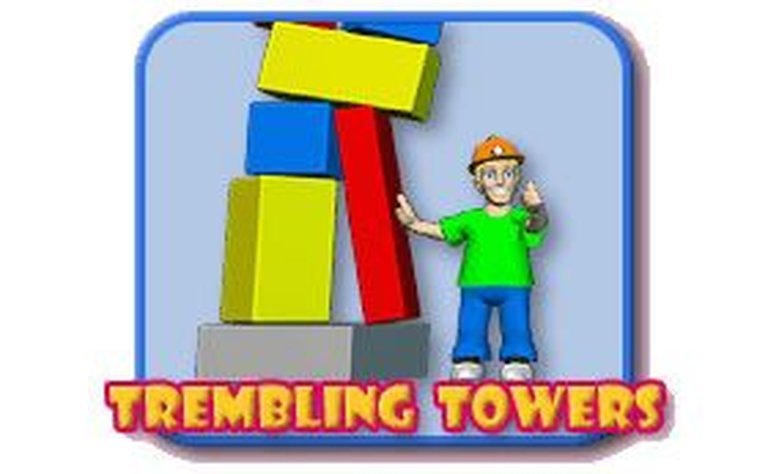
Trembling Towers is a physics-based arcade game released in 2006 for Windows, where players stack Tetris-like blocks on a small grey square base to build precarious towers, using the mouse to position and rotate pieces while realistic physics dictate their behavior upon landing. Across 70 missions, players must meet specific objectives like achieving certain heights, widths, or shapes, earning points for each block used in sophisticated structures, with no time limit and failure only if blocks fall outside the base.
Trembling Towers: Review
Introduction
Imagine stacking irregular Tetris-like blocks in a gravity-defying ballet, where one misplaced piece sends your precarious edifice crashing in glorious, physics-simulated chaos—welcome to Trembling Towers, a 2006 Windows indie darling that captures the addictive thrill of architectural peril. Released amid the AAA blockbuster era of Gears of War and The Elder Scrolls IV: Oblivion, this unassuming puzzle-arcade hybrid from German developer Gzwo Softwareentwicklung dared to blend Jenga-style tension with realistic physics, predating the indie physics craze of games like World of Goo. Though critically overlooked and commercially obscure, Trembling Towers endures as a testament to minimalist ingenuity, rewarding patience and precision in its 70-mission gauntlet. My thesis: Far from a mere novelty, it stands as an underappreciated pioneer in accessible physics puzzling, whose elegant simplicity belies profound lessons in balance, strategy, and the unforgiving beauty of real-world simulation.
Development History & Context
Trembling Towers emerged from the modest workshops of Gzwo Softwareentwicklung, a small German indie studio whose output appears limited to this title, reflecting the grassroots European dev scene bubbling up in 2006. Publisher astragon Software GmbH, known for simulation fare, handled distribution via CD-ROM and download, pricing it as shareware at $9.95—a bargain for its era’s modest requirements (DirectX 8.1, 128 MB RAM, 12 MB HDD). The nine-person credit roll reads like a family affair: Peter Gunn on programming, Stefan Werner crafting the 3D engine, Alexander Kornrumpf wrapping the Newton Game Dynamics physics engine, Sigrid Putzmann designing levels, Ulrich Hofmann on graphics, and beta testers including Marko Hofmann and the Thirions. Notably, most contributors (like Werner, Gunn, and Hofmann) list this as their sole MobyGames credit, underscoring Gzwo’s boutique operation.
The 2006 landscape was dominated by high-budget spectacles—PlayStation 3’s launch, Gears of War‘s cover-shooter revolution, and graphical peaks like Crysis—yet indies were stirring, with Portal and early Euro hits like Penumbra: Overture signaling a shift. Technological constraints favored PC puzzles; Newton Dynamics enabled “real-world modeled” physics without AAA budgets, allowing slippery ice blocks or low-gravity moons on consumer hardware. Gzwo’s vision crystallized a “build the highest tower” archetype (echoing playground games and prior titles like 1992’s Towers), but innovated with dynamic instability, no time pressure, and silhouette challenges. In an era of repetitive franchises (Call of Duty, The Sims), Trembling Towers embodied indie risk-taking, prioritizing clever mechanics over spectacle amid Europe’s rising dev hubs (Germany, Sweden, Poland).
Narrative & Thematic Deep Dive
Trembling Towers eschews traditional storytelling for pure mechanical poetry, a deliberate choice amplifying its meditative essence—no protagonists, no dialogue, no cutscenes clutter its 3rd-person vista. Instead, “plot” unfolds through 70 missions across seven worlds, each a vignette in structural hubris: from earthen basics to icy slips, lunar leaps, and lava binds. Objectives—achieve height X with Y blocks, match a silhouette, or cap width—serve as implicit lore, evoking humanity’s defiant spires against nature’s chaos.
Thematically, it’s a profound allegory for precarious equilibrium. Blocks symbolize life’s irregular pieces; players, the architect-god wrestling entropy via Newton physics. Success demands harmony—overbuild for points, but risk wobble and collapse, mirroring Jenga’s tension or Tangram’s spatial wit. Silhouette puzzles (20 total) add mystery, forcing reverse-engineering from shadows, thematizing perception versus reality. Worlds deepen this: Ice’s frictionless dread probes adaptability; Moon’s low-g whimsy fragility; Lava’s sticky fusion, permanence’s double-edge. Absent overt narrative elevates subtext—rewarded for “sophisticated structures” (points per block), it celebrates complexity amid collapse’s catharsis. In 2006’s narrative-heavy RPGs (Oblivion), this silence is radical, forging themes of trial-error resilience, where failure’s spectacular falls educate more than exposition ever could.
Gameplay Mechanics & Systems
At its core, Trembling Towers distills tower-building into an exquisite loop: A grey square base awaits; seize a Tetris-esque stone (12 polyomino-inspired shapes), mouse-drag to position, buttons-rotate, release to let physics reign. Contact ground or stack relinquishes control—blocks tumble realistically via Newton Dynamics, demanding foresight over reaction. Mission failure? Any protrusion beyond the square. Victory? Meet goals (height/width/shape), stabilize sans topple, no timer enforcing zen focus.
Progression rewards elaboration: Points scale with blocks used, incentivizing elaborate lattices over minimalism, though instability scales too—early levels teach basics, later demand multi-tier cantilevers. UI shines in simplicity: Clean 3rd-person cam orbits freely, zoom aids precision; mission HUD tracks objectives crisply. Innovations abound—silhouettes as “exact shape” brainteasers; world modifiers (ice-slide, moon-bounce, lava-stick) diversify without bloat. Flaws? Mouse-only controls feel era-limited (no keyboard fine-tune), and physics, while accurate, can frustrate with finicky collisions. No progression unlocks (all missions sequential-ish), but replayability via high-score chases endures. Loops evolve masterfully: Novices stack crudely; experts exploit physics—balance teetering spires on edges, chain placements mid-fall. It’s arcade purity: Intuitive entry, exponential depth.
World-Building, Art & Sound
The game’s “world” is a minimalist diorama, yet its seven themed realms craft immersive atmospheres rivaling AAA vistas. Base earth yields to Ice (glossy, frictionless cubes skid perilously), Moon (ethereal low-g drifts, blocks float dreamily), Lava (viscous, glowing orbs merge organically), plus implied variants like windy or bouncy biomes—each alters physics for tactile novelty. Visuals, via Werner’s 3D engine and Hofmann’s graphics, prioritize function: Clean polyomino models, dynamic lighting on wobbles/collapses (impressive ragdoll cascades), subtle textures (craggy stone, molten drip). 3rd-person “other” perspective immerses without clutter, greyscale base a stark canvas.
Art direction evokes abstract sculpture—silhouettes loom ghostly, rewarding reveal’s triumph. Sound design (uncredited, but integral) amplifies tactility: Clunks of placement, ominous creaks signaling doom, thunderous crashes punctuate failure. Ambient whooshes (wind? gravity?) and world-specific cues (icy scrapes, lava bubbles) heighten peril, sans music overload for focus. Collectively, they forge ASMR-like tension: Visual sway predicts audio peril, collapse a symphonic payoff. Modest specs belie polish—contributes meditative flow, turning puzzles into visceral experiences.
Reception & Legacy
Launch reception was tepid: GameStar’s lone critic score (48/100, Dec 2006) praised ease (“simple to learn, tricky and motivating”) but implied middling depth amid 2006’s giants (Zelda: Twilight Princess at 95 Metacritic). No player reviews on MobyGames (one collector), forums silent—obscurity sealed by indie status, no ports, shareware model. Commercially? Negligible; Softpile/Qweas listings tout it as “hit,” but no sales data surfaces.
Legacy evolves quietly: Pioneer in Newton-powered stacking (pre-Tiki Towers 2008, World of Goo 2008), influencing physics-arcades (Besiege, Poly Bridge). Joins “towers” lineage (Tommy’s Towers 1986 to Strong Towers 2020), amplifying Jenga/Tetris fusion. In indiedom’s rise (2006-2016 per Pieter Smal), it exemplifies Euro micro-studios challenging AAA—Gzwo’s physics wrapper innovated affordably. Cult status? Niche; MobyGames begs contributors. Yet, amid mobile Angry Birds/Minecraft, it prefigures casual engineering sims, a forgotten spark in puzzle evolution.
Conclusion
Trembling Towers distills gaming’s primal joy—creation’s thrill, destruction’s awe—into 70 physics-poised challenges, its small-team brilliance outshining 2006’s bombast. Strengths (intuitive depth, thematic resonance, world variety) eclipse flaws (dated controls, obscurity), cementing it as indie history’s hidden gem. Definitive verdict: Essential for puzzle aficionados, a 8/10 relic warranting re-release—proof that trembling towers teach stability better than any epic saga. In video game canon, it towers modestly but unforgettably.