
- Release Year: 2018
- Platforms: Nintendo Switch, PlayStation 4, Windows, Xbox One
- Publisher: 2K Games, Inc., Take-Two Interactive Software, Inc., Take-Two Interactive Software UK Limited
- Developer: Cat Daddy Games, LLC, Mass Media Games, Inc.
- Genre: Action
- Perspective: 1st-person / 3rd-person
- Game Mode: Co-op, Online Co-op, Single-player
- Gameplay: Mini-games, Party game
- Average Score: 39/100
Description
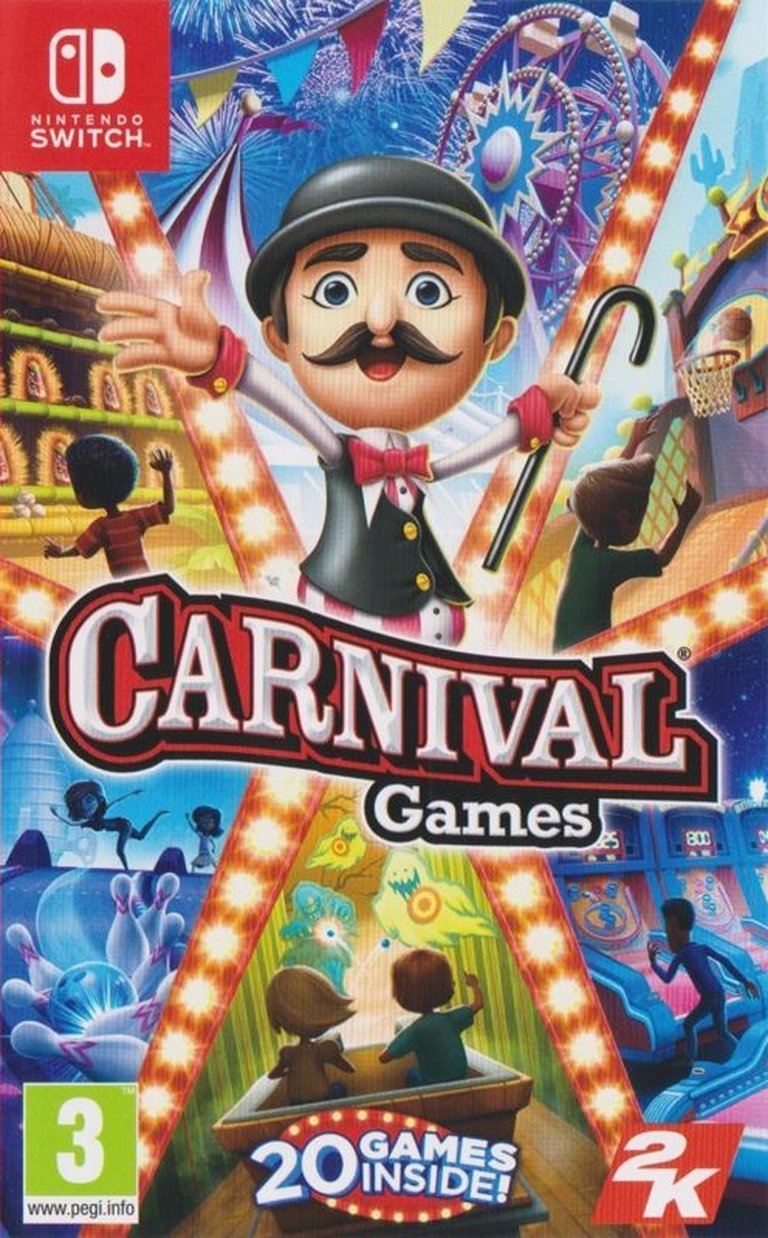
Carnival Games is a lively party game that recreates the thrill of a carnival fairground with a diverse collection of mini-games, supporting 1st-person and 3rd-person perspectives, direct control, and multiplayer for up to 4 players offline or online. Released in 2018 for PlayStation 4, Xbox One, and Nintendo Switch, with a 2020 Windows port by developers Cat Daddy Games and Mass Media Games under 2K Games, it offers family-friendly, pick-up-and-play fun as a colorful alternative to games like Super Mario Party.
Gameplay Videos
Where to Buy Carnival Games
PC
Carnival Games Free Download
Carnival Games Cracks & Fixes
Carnival Games Guides & Walkthroughs
Carnival Games Reviews & Reception
metacritic.com (49/100): Offers plenty of silly mini-games to get everyone swinging their Joy-Con.
nintendolife.com : Carnival Games is still an entertaining alternative to the likes of 1-2 Switch and The Jackbox Party Pack.
imore.com : Carnival Games is a great addition to your collection for the kids to enjoy.
nintendoworldreport.com (30/100): Enjoyable multiplayer doesn’t save locked motion controls and a limited selection of games.
Carnival Games: Review
Introduction
Step right up to the digital midway, where the air hums with nostalgia for cotton candy-scented summers and the crack of baseball bats against milk bottles—welcome to Carnival Games (2018), the vibrant revival of a franchise that turned Wii-era shovelware into surprise gold. Born from the ashes of the 2007 original, which sold over six million copies despite middling reviews, this iteration from 2K and Mass Media Games transplants 20 carnival-inspired mini-games to modern consoles like PlayStation 4, Xbox One, Nintendo Switch, and later PC. As a historian of gaming’s casual revolution, I see Carnival Games as a time capsule of family entertainment: unpretentious, replayable chaos designed for couch co-op laughter. My thesis? While it recaptures the accessible joy of fairground frolics and proves a solid alternative to Super Mario Party, grindy unlocks, shallow depth, and dated visuals prevent it from transcending its roots into a modern classic.
Development History & Context
Carnival Games emerged from the storied lineage of a series kickstarted by Cat Daddy Games’ 2007 Wii hit, published by the short-lived Global Star Software just before its absorption into Take-Two Interactive’s 2K empire. The 2018 edition shifted development to Mass Media Games—a veteran studio with a quirky resume spanning ports like StarCraft on N64, Namco arcade revivals, and even Jak & Daxter 3D upgrades—bolstered by a massive credit list of 624 contributors, many overlapping with 2K heavyweights like NBA 2K21 and Mafia: Definitive Edition. Powered by Unity engine and Bink Video middleware, it targeted cross-platform appeal amid the 2018 party-game renaissance.
The era’s technological constraints were minimal on PS4/Xbox One hardware, but Nintendo Switch demanded portable optimization—no frame drops in handheld or docked modes, as noted in reviews. Mass Media’s vision echoed the original’s “pick-up-and-play” ethos, blending fan-favorites (e.g., Swish basketball) with fresh twists like drone racing in Light Speed, all leveraging Joy-Con motion for that Wii-like swing. Released November 6, 2018 (PC in 2020), it arrived in a landscape dominated by Super Mario Party, Jackbox Party Pack, and 1-2-Switch, where family multiplayer reigned supreme post-Wii U flop. 2K positioned it as “Carnival Games everywhere,” capitalizing on Switch’s hybrid appeal amid Take-Two’s growing hybrid-portfolio success (e.g., NBA 2K18). Yet, echoes of Wii shovelware persisted: economical design prioritizing quantity over polish, with unlockable motion controls hinting at budget-conscious iteration rather than bold reinvention.
Narrative & Thematic Deep Dive
Carnival Games eschews traditional plotting for immersive carnival immersion, framing its 20 mini-games across four themed alleys—Jungle Lane, Saturn Station, Vulture Gulch, and Nuts & Bolts—like a virtual county fair alive with barkers and bustle. Absent a linear story, the “narrative” unfolds through Carnival Bob (voiced by Charlie Bennett), the sleazy-yet-charming ringmaster who ushers players in with booming patter: “Step right up!” His dialogue, dripping with carny cheese—”Hit home runs, pile the highest stack of cakes, take your horse to the finish line!”—sets a tone of unbridled whimsy, evoking real-world fairs’ escapist allure.
Characters are customizable avatars: grotesque, ’90s-CGI caricatures with adjustable skin tones, face shapes, and wacky outfits unlocked via tickets. No deep backstories, but they embody thematic cores—nostalgic Americana funfair fantasy, family bonding amid chaos, and light-hearted competition. Themes delve into carnival mythology: luck vs. skill (Lucky Cups, Nerves of Steel), absurdity (Clowning Around’s unfriendly clowns, Cosmic Strike’s space bowling), and triumphant excess (stacking cakes in an unseen but hyped mode). Easter eggs from the 2007 original persist, rewarding explorers with hidden nods. Critically, it’s a thematic deep dive into “pure play”—no violence, just joyful idiocy—mirroring the series’ evolution from Wii Mii prizes to ticket-hoarding progression. Yet, the grind (e.g., 1,000 tickets for High Noon) undercuts themes of instant gratification, turning whimsy into chore.
Gameplay Mechanics & Systems
At its core, Carnival Games loops through select → play → score → spend, a frictionless cycle distilled into 20 one-minute blasts of carnival chaos supporting 1-4 players via split-screen, same-screen, or online lobbies (up to 4). Mini-games span genres: precision tossing (Post Master rings, Hoops), shooting (Swish basketball, Clowning Around water guns), racing (Light Speed drones, Day at the Races horses), and oddities (Supernova planet-collecting, Ka-Pow punching). Controls default to direct analog/button inputs—intuitive for all ages—but motion shines on Switch: swing Joy-Cons for baseball home runs or ring tosses, unlocked per-game via high-score thresholds (e.g., beat AI in Swish for gyro aiming).
Progression hinges on tickets: win matches, rack up points (solo vs. AI or multiplayer showdowns), redeem for games (25-1,000 tickets post-patch), outfits, or tournaments. UI is clean yet static—animated previews in themed hubs replace Wii’s explorable fairground, with pre-game tutorials detailing timers (usually 60s), controls, and player counts. Innovations include drone force-fields for sabotage and cosmic bowling’s zero-G flair, adding replayability. Flaws abound: repetitive loops (many boil to “aim and tap”), brutal AI, grindy unlocks (pre-patch: 200-400 tickets/game), and uneven motion calibration (“aim left, throw right”). Tournaments chain games for escalating competition, but no online boards dilute longevity. Post-2018 patch eased ticket costs, boosting flow, yet it remains a “one-and-done” party filler, not a depth-diver.
| Key Mechanics | Strengths | Weaknesses |
|---|---|---|
| Mini-Games | 20 varied attractions; quick sessions | Repetitive inputs; few standouts |
| Multiplayer | 4-player local/online; sabotage elements | No team modes; AI dominates solo |
| Progression | Custom avatars; rewards incentive | Grindy tickets; motion locks |
| Controls/UI | Accessible; tutorials | Static menus; calibration issues |
World-Building, Art & Sound
The “world” is a fragmented funfair: four alleys bursting with garish theming—Jungle Lane’s vines and beasts, Saturn Station’s neon cosmos, Vulture Gulch’s Wild West dust, Nuts & Bolts’ steampunk gears—evoking a bustling midway without free-roam. Atmosphere thrives on sensory overload: cheering crowds, bell rings, and explosive wins build tension/release cycles, immersing players in fairground fever. Visuals, colorful yet dated (low-poly models, clashing palettes in Light Speed), prioritize performance over fidelity—solid 30fps handheld/docked, no dips. Art direction nails “cheesy charm”: avatars’ uncanny-valley grins amplify humor, while mini-game arenas pop with particle effects (splashing water, soaring drones).
Sound design elevates: upbeat carnival organ jingles, tailored SFX (thwacks, whooshes), and Bob’s gravelly hype (“You’re a winner!”) create auditory joy. No standout score, but looping chiptunes fit the vibe. Collectively, these forge an escapist bubble—flawed but evocative, turning living rooms into midways, though graphical cheese (per Video Chums) clashes with 2018 expectations.
Reception & Legacy
Launch reception split hairs: MobyGames averages 68% critics (Nintendo Life 70%: “silly mini-games for family”; Video Chums 67%: “dripping with cheese but fun”), Metacritic 49/100 on Switch (“generally unfavorable”). Players averaged 3.5/5, praising multiplayer but slamming grinds (e.g., “Mario Party alternative” vs. “family boredom”). Commercially, it rode series coattails (9.5M+ units lifetime), but no sales bombshells—Switch version hit modest charts (VGChartz: ~0.27M first weeks).
Reputation evolved post-patch (ticket fixes), softening gripes, yet it lingers as “Wii nostalgia bait.” Influence? Minimal direct—spawned no blockbusters—but solidified 2K’s casual push, paving VR spin-offs (Carnival Games VR, 2016). In history, it’s a footnote to Wii’s party boom, proving mini-game collections endure via accessibility, echoing Mario Party‘s throne amid Fortnite-era battle royales. Cult status for families, but no industry shaker.
Conclusion
Carnival Games distills fairground euphoria into 20 bite-sized blasts, excelling as couch co-op fodder with motion magic and thematic zest, yet stumbles on unlocks, repetition, and visual antiquity— a nostalgic echo, not reinvention. In video game history, it cements the franchise’s improbable longevity: from Wii bestseller to Switch also-ran, embodying casual gaming’s resilient charm. Verdict: 7/10—grab for family nights or sales ($7.99 Steam/PC), skip for depth. Step right up if laughs await; otherwise, the real fair calls.