
- Release Year: 2005
- Platforms: Windows
- Publisher: Buka Entertainment, CDV Software Entertainment AG
- Developer: Revolution of Strategy GmbH
- Genre: Strategy, Tactics
- Perspective: Isometric
- Game Mode: Single-player
- Gameplay: Historical events, Real-time
- Setting: Historical events
- Average Score: 58/100
Description
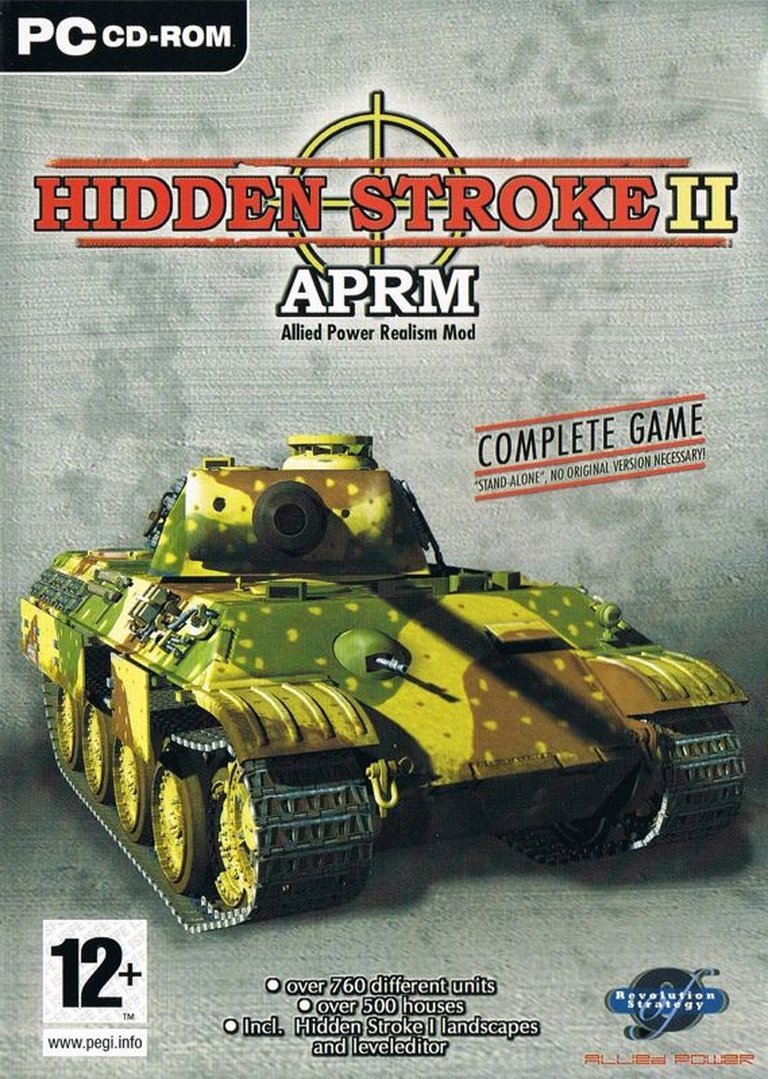
Hidden Stroke II: APRM is a standalone expansion in the Sudden Strike series, utilizing the Sudden Strike II engine to deliver intense real-time tactical warfare set during World War II. Players command forces from five nations—Americans, British, Russians, Japanese, and Germans—across 40 historically inspired missions featuring dynamic objectives like holding positions or intercepting enemies. The game introduces over 80 new units, including heavy tanks and submarines, as well as environmental interactions like stealth under camouflage nets. Despite its dated 2D graphics and notoriously high difficulty, it offers a robust scenario editor for custom content, catering primarily to dedicated fans of the series.
Gameplay Videos
Hidden Stroke II: APRM Cracks & Fixes
Hidden Stroke II: APRM Patches & Updates
Hidden Stroke II: APRM Mods
Hidden Stroke II: APRM Reviews & Reception
gamepressure.com (54/100): A second, unofficial addition to the popular real-time strategy Sudden Strike 2, offering new campaigns and units but facing criticism for its lack of polish.
mobygames.com (62/100): A stand-alone game in the Sudden Strike series with new campaigns, missions, units, and features, though it received mixed reviews from critics.
Hidden Stroke II: APRM: A Tactical Relic Caught Between Innovation and Obsolescence
Introduction
In the pantheon of World War II real-time strategy (RTS) games, Hidden Stroke II: APRM (2005) occupies a paradoxical space: a standalone expansion to Sudden Strike II that tries to modernize a aging formula while being shackled to its technological past. Developed by Revolution of Strategy GmbH and published by CDV Software Entertainment, the game aimed to satisfy hardcore fans of the Sudden Strike series with new units, campaigns, and tactical depth. Yet, its reception—averaging a lukewarm 62% from critics—revealed a title torn between homage and stagnation. This review dissects Hidden Stroke II: APRM’s ambitions, its successes and failures, and its place in the lineage of WWII strategy games.
Development History & Context
Studio Vision & Technological Constraints
Revolution of Strategy GmbH, a studio known for its niche focus on WWII strategy titles, leveraged the Sudden Strike II engine—a decision that proved both a blessing and a curse. By 2005, the RTS landscape was shifting toward 3D graphics and dynamic physics engines (Company of Heroes loomed on the horizon), but Hidden Stroke II clung to its 2D isometric roots. In an interview, producer Nico Zettler emphasized the studio’s commitment to detail, citing “over 760 units” and “150,000 carefully placed objects” per map. Yet, this ambition was hamstrung by the engine’s limitations, resulting in pixelated visuals that critics compared unfavorably to contemporaries like Codename: Panzers.
The 2005 RTS Landscape
The mid-2000s saw RTS games experimenting with hybrid mechanics (e.g., Empire Earth II, Rome: Total War). Hidden Stroke II, however, doubled down on the Sudden Strike formula: realistic unit behavior, no base-building, and a focus on tactical micro-management. This conservative approach alienated newer audiences but resonated with series loyalists who craved historical authenticity over innovation.
Narrative & Thematic Deep Dive
Campaign Structure & Historical Authenticity
The game’s five campaigns—centered on the Americans, British, Russians, Germans, and Japanese—span pivotal WWII theaters like Africa (1941), Sicily (1943), and the Western Front. Missions oscillate between holding positions, intercepting enemies, and sudden counterattacks, mirroring the chaotic unpredictability of war. However, the narrative is threadbare, prioritizing historical reenactment over storytelling. There are no memorable characters or cutscenes; the “plot” is delivered through brief mission briefings and objective updates.
Themes of Camouflage & Deception
Thematically, Hidden Stroke II explores the psychological tension of warfare through its emphasis on concealment. Units can hide in haystacks, forests, or buildings, while tanks deploy camouflage nets—a mechanic praised by GameStar as “realistic yet unforgiving.” This focus on ambush tactics elevates the game beyond mere unit spam, demanding patience and foresight.
Gameplay Mechanics & Systems
Core Loop & Unit Management
The gameplay revolves around controlling platoons of infantry, vehicles, and artillery across sprawling maps. New features like amphibious tanks, portable mortars, and destructible bridges add strategic variety, but the learning curve is steep. Missions often require juggling 100+ units, leading to what 4Players.de called “overwhelming but impressive” battles. The UI, however, feels archaic—a relic of early-2000s RTS design—with clunky unit grouping and limited camera controls.
Innovations & Flaws
The introduction of unit-specific behaviors—e.g., heavy tanks collapsing bridges or infantry occupying trenches—added depth. Yet, these innovations were undermined by inconsistent AI. Enemy forces would sometimes “counter intelligently” (per Zettler’s claims), but more often, they relied on scripted triggers, leading to repetitive encounters. The lack of a skirmish mode further limited replayability.
Difficulty: A Double-Edged Sword
Critics universally noted the game’s punishing difficulty. PC Games criticized the “extremely high difficulty level” as more frustrating than rewarding, while PC Action lamented the “pixel soup” that made identifying enemies a chore. For masochistic tacticians, however, this brutality was a badge of honor.
World-Building, Art & Sound
Visuals: Aged but Detailed
The 2D isometric graphics, while outdated, brim with granular detail. Maps feature 500+ buildings, weather effects, and terrain variations (snow, desert, urban). Yet, the low resolution and lack of zoom functionality diluted these efforts, with GameStar noting the “antique optics” as a major barrier.
Sound Design: Atmospheric but Repetitive
The soundscape excels in immersion: artillery barrages roar, soldiers bark orders in native languages, and ambient tracks evoke wartime tension. However, voice lines and effects loop excessively, breaking the illusion during extended play sessions.
Reception & Legacy
Launch Reception
Critics praised the tactical depth and unit variety but panned the dated presentation. German outlets like GameStar (66/100) and 4Players.de (64/100) called it “only for absolute fans,” while PC Action (60/100) dismissed it as a “milking” of the Sudden Strike franchise.
Long-Term Influence
Hidden Stroke II left no seismic impact on the genre, but it sustained a dedicated modding community. Its map editor, hailed by Zettler as a tool for “fresh and imaginative” creations, enabled player-made scenarios that extended the game’s lifespan. Yet, its legacy was soon eclipsed by Sudden Strike 3: Arms for Victory (2007), which embraced 3D graphics.
Conclusion
Hidden Stroke II: APRM is a paradox—a game that courted obsolescence by clinging to tradition while offering flashes of tactical brilliance. Its punishing difficulty and aged presentation limit its appeal, but for WWII strategy purists, it remains a flawed gem. As a historical artifact, it captures a transitional moment in RTS history, when 2D aesthetics collided with modern design expectations. For better or worse, Hidden Stroke II is a relic of a bygone era—one that deserves recognition, if not revival.
Final Verdict:
A niche title for die-hard tacticians, Hidden Stroke II: APRM is best remembered as a love letter to Sudden Strike’s core audience—a testament to the series’ resilience, if not its evolution.