
- Release Year: 2005
- Platforms: Windows
- Publisher: Vivendi Universal Games, Inc.
- Genre: Action
- Perspective: Top-down
- Game Mode: Single-player
- Gameplay: Collecting, Robot Customization
- Setting: Futuristic, Sci-fi
Description
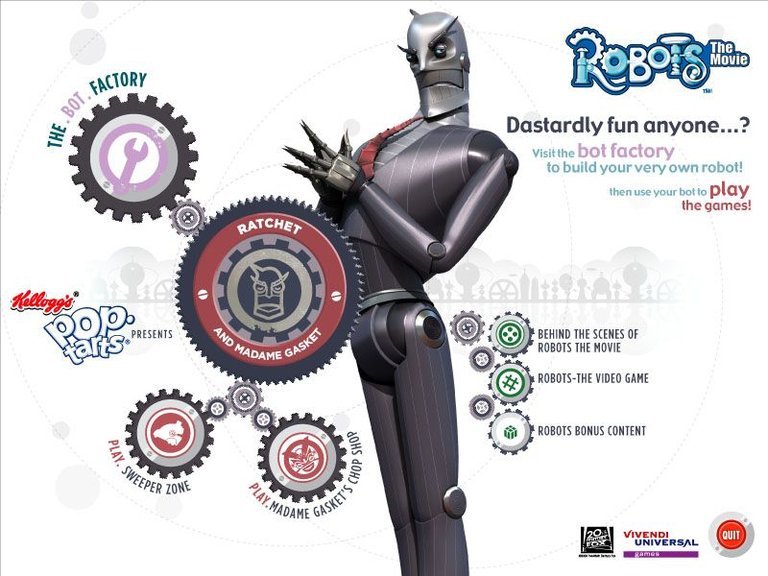
Kellogg’s Pop-Tarts Presents Ratchet & Madame Gasket’s Sweeper Zone is a promotional game released in 2005, bundled with specially marked Pop-Tarts breakfast pastries to promote the movie Robots. The game features two distinct mini-games: Sweeper Zone, where players control a robot to collect scrap metal in a busy street, and Madame Gasket’s Chop Shop, where players catch falling scrap metal and Pop-Tarts logos that act as power-ups. Additionally, there is a Bot Factory activity allowing players to build and customize their own robots.
Kellogg’s Pop-Tarts Presents Ratchet & Madame Gasket’s Sweeper Zone Reviews & Reception
retro-replay.com : Overall, the gameplay is bite-sized and deliberately uncomplicated, making it ideal for younger players or anyone looking for a quick distraction.
Kellogg’s Pop-Tarts Presents Ratchet & Madame Gasket’s Sweeper Zone: Review
Introduction
In the mid-2000s, the intersection of breakfast cereals and video games birthed a peculiar subgenre: the advergame. Among these curiosities, Kellogg’s Pop-Tarts Presents Ratchet & Madame Gasket’s Sweeper Zone (2005) stands out as a time capsule of corporate synergy, marrying the Robots movie franchise with sugary pastry marketing. This CD-ROM freebie, tucked into Pop-Tarts boxes, was never meant to redefine gaming, but it offers a fascinating glimpse into an era when licensed tie-ins dominated kids’ media. Through two rudimentary mini-games and a robot-building activity, it balanced promotional obligations with fleeting entertainment—a relic of aggressive cross-promotion now remembered more for its novelty than its gameplay.
Development History & Context
Developed and published by Vivendi Universal Games, Sweeper Zone was part of a broader 2005 campaign for Blue Sky Studios’ Robots film. The game leveraged the movie’s futuristic scrap-metal aesthetic to create a marketing trifecta: Kellogg’s sold Pop-Tarts, Vivendi pushed its Robots tie-in console games (Robots: The Video Game), and 20th Century Fox promoted its animated feature.
Technologically, the game was constrained by its purpose: it needed to run on low-spec family PCs and appeal to children with short attention spans. Built for Windows 98/XP, it utilized simple 2D sprites and top-down/side-view perspectives, avoiding the 3D complexity of its console counterparts. The CD-ROM also included supplemental content—an animated e-card, screensaver, and printable activities—to maximize brand exposure.
In 2005, advergames were peaking. Competitors like Chex Quest and Pepsi-Man had already demonstrated the genre’s potential, but Sweeper Zone’s unabashed commercialism (even its title is a mouthful of branded keywords) epitomized the era’s aggressive product placement.
Narrative & Thematic Deep Dive
Narrative depth was never the goal. The game borrows Robots’ premise—a scrap-metal world populated by quirky machines—but reduces its themes to a skeletal framework. Ratchet, the film’s protagonist, is relegated to a generic avatar in Sweeper Zone, darting across streets to collect debris. Madame Gasket, the movie’s villain, is reduced to a floating sprite dropping junk in Chop Shop.
There’s no dialogue, cutscenes, or character development. Thematically, the game mirrors Robots’ focus on recycling and creativity (the Bot Factory activity lets players build custom mechs), but these ideas are stripped of nuance. The real “story” is the branding: Pop-Tarts logos function as power-ups, and the UI drips with Kellogg’s cheerful corporate palette. It’s a transactional narrative, designed to sell breakfast treats, not to engage.
Gameplay Mechanics & Systems
The game’s three modes are mechanically barebones:
-
Sweeper Zone: A side-view scavenger hunt where players control a robot dodging traffic to collect scrap metal. The loop is repetitive—grab one piece, return to base, repeat—but the risk of being hit by vehicles adds tension. Controls are responsive but simplistic, relying on arrow keys and a single action button.
-
Madame Gasket’s Chop Shop: A top-down arcade catcher where falling scrap must be intercepted in a moving box. Pop-Tarts icons act as temporary upgrades, widening the catcher. The mode is marginally more strategic, requiring players to prioritize power-ups amid the chaos.
-
Bot Factory: A customization sandbox where players mix-and-match robot parts, paint them, and assign names. While lacking depth, it encourages creativity and serves as a playful distraction.
None of these modes evolve beyond their initial concepts. Progression is nonexistent—no unlocks, difficulty scaling, or leaderboards—making the experience best suited for short bursts. The UI is functional but cluttered with brand imagery, and the lack of save features underscores its disposable design.
World-Building, Art & Sound
Visually, Sweeper Zone echoes Robots’ stylized, industrial-chic aesthetic: gears, grungy metal textures, and neon accents dominate. The 2D art is crisp and colorful, with sprites that mirror the film’s character designs (albeit simplified). Environments are sparse—Sweeper Zone’s streets repeat tiles, while Chop Shop uses a gradient void—but the bright palette ensures readability.
Sound design is minimalistic, with jaunty synth melodies and robotic sound effects that evoke the movie’s tone. The audio never intrudes, but it also lacks memorable motifs. For a freebie, the presentation is competent, though unmistakably budget-conscious.
Reception & Legacy
Critically, Sweeper Zone was ignored at launch. With no professional reviews and a 2.2/5 user score on MobyGames (based on one rating), it slipped under the radar. Retrospectively, it’s remembered as a quirky artifact—a “playable ad” emblematic of mid-2000s marketing excess.
Its legacy is negligible in gaming circles but notable as a case study in cross-promotion. Unlike cult advergames like Cool Spot, Sweeper Zone lacked the polish to transcend its commercial roots. However, it remains a collector’s item for fans of oddities, with physical copies occasionally surfacing on eBay for nostalgic buyers.
Conclusion
Kellogg’s Pop-Tarts Presents Ratchet & Madame Gasket’s Sweeper Zone is not a good game by conventional standards. Its gameplay is shallow, its systems underdeveloped, and its narrative an afterthought. Yet, as a cultural artifact, it’s irresistible—a testament to an era when cereal boxes doubled as game distributors and IP synergy ruled all. For historians, it’s a fascinating footnote; for players, it’s a quirky diversion best enjoyed with low expectations and a toasted Pop-Tart. In the pantheon of video games, it’s a footnote—but in the annals of advertising creativity, it’s a sugary, crumb-covered relic worth revisiting.