
- Release Year: 2000
- Platforms: Macintosh, Windows
- Publisher: Yoram Gross-EM.TV Pty Ltd
- Developer: Forest Interactive Pty Ltd.
- Genre: Action, Educational, Puzzle
- Perspective: 2D
- Game Mode: Single-player
- Gameplay: Arcade, Puzzle
- Setting: Oceania
- Average Score: 14/100
Description
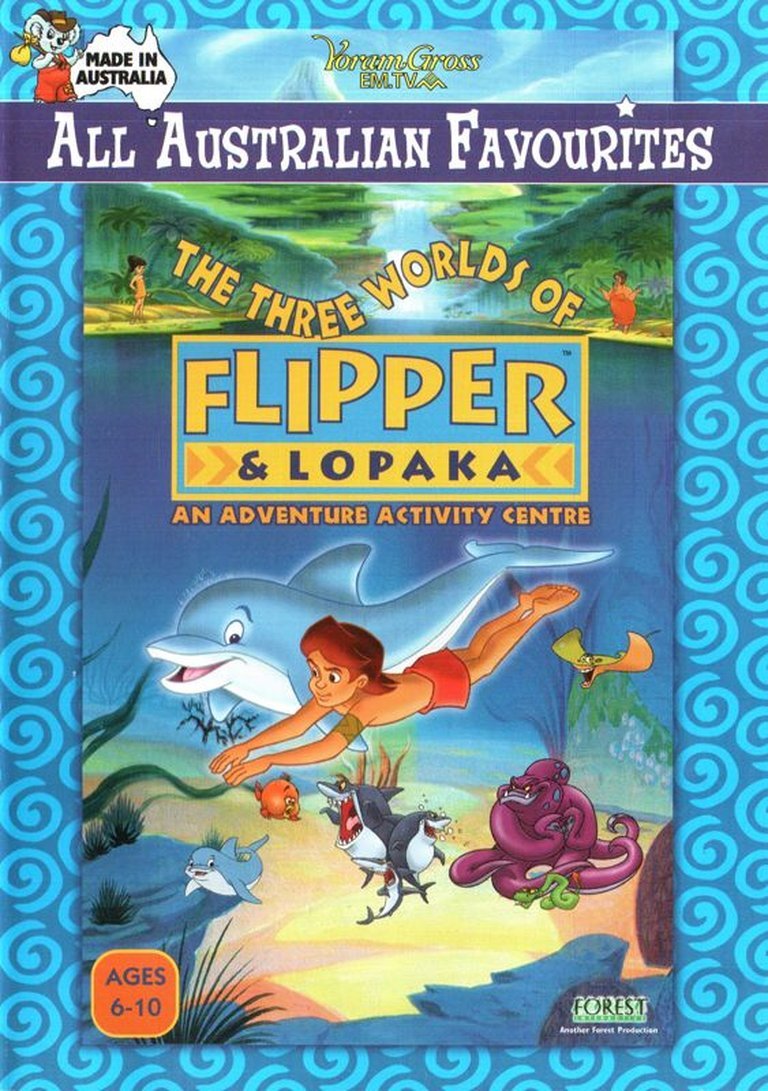
The Three Worlds of Flipper and Lopaka is an educational adventure game designed for children aged 6 to 10, based on the Australian animated series featuring Lopaka, a Polynesian boy, and his dolphin friend Flipper. The game consists of 12 mini-games set in three distinct worlds: ‘The Mountains,’ ‘The Shoreline,’ and ‘The Sea.’ Each world offers a mix of arcade-style adventures and educational puzzles, with players completing challenges in any order before progressing to the next world. After finishing all three worlds, players can engage in an ‘ultimate challenge’ involving object searches and a jigsaw puzzle.
Gameplay Videos
The Three Worlds of Flipper and Lopaka Free Download
The Three Worlds of Flipper and Lopaka Reviews & Reception
gamepressure.com (14/100): A product aimed at children, this title is about the adventures of the popular Flipper dolphin, a cartoon character who can be seen every day in numerous bedtime and who has seen many gadgets with her likeness over the years, including cards and mascots, not to mention the collection of clothes dedicated to our kids.
The Three Worlds of Flipper and Lopaka Cheats & Codes
Game Boy Color
Enter passwords at the password menu to skip to levels. Game Genie codes require a Game Genie device.
| Code | Effect |
|---|---|
| Q9MRMK | Start at Level 2 |
| Q9MPP1 | Start at Level 3 |
| Q9MR61 | Start at Level 4 |
| Q9MKPR | Start at Level 5 |
| Q9MM3Z | Start at Level 6 |
| +9MM3Z | Start at Level 6 |
| Q9MM47 | Start at Level 7 |
| Q9MMRF | Start at Level 8 |
| Q9MKKL | Start at Level 9 |
| Q9MM3S | Start at Level 10 |
| Q9MMN0 | Start at Level 11 |
| Q9MKR8 | Start at Level 12 |
| Q9MMPN | Start at Level 13 |
| Q9MKMX | Start at Level 14 |
| Q9MM44 | Start at Level 15 |
| Q9MMRG | Start at Level 16 |
| 001-BFD-E6E | Infinite Health |
| 001-8ED-E6E | Infinite Health (Dolphin Level) |
| 00E-63B-19E | Infinite O2 (Dolphin Level) |
| 002-D2D-19E | Infinite Shells |
| 3E6-F7A-6EA | Jump in Midair |
| 186-C6A-6EA | Jump in Midair |
| 3EC-C4A-191 | Max Pearls |
| 63C-C5A-7FB | Max Pearls |
| 099-A9A-E62 | Start with 9 Lives |
The Three Worlds of Flipper and Lopaka: A Forgotten Gem of Early 2000s Edutainment
Introduction
In the crowded landscape of early 2000s children’s edutainment software, The Three Worlds of Flipper and Lopaka stands as a charming but largely forgotten relic. Based on the Australian animated series, this 2000 release blended arcade-style gameplay with educational puzzles, targeting children aged 6–10. While it never achieved the fame of contemporaries like Reader Rabbit or JumpStart, the game exemplified the era’s commitment to merging entertainment with learning. This review argues that The Three Worlds of Flipper and Lopaka succeeded as a niche title, offering a vibrant, if shallow, adaptation of its source material while reflecting the technological and creative constraints of its time.
Development History & Context
Studio & Vision
Developed by Forest Interactive Pty Ltd. and published by Yoram Gross-EM.TV Pty Ltd., the game emerged from Australia’s burgeoning animation and edutainment scene. Forest Interactive had prior experience with children’s titles, including the Blinky Bill series, and leveraged this expertise to adapt Flipper and Lopaka’s oceanic adventures into an interactive format. The studio’s goal was clear: translate the show’s environmental themes and whimsical characters into bite-sized mini-games that emphasized problem-solving and hand-eye coordination.
Technological Constraints
Built using Macromedia Director, a popular tool for CD-ROM-based multimedia projects, the game faced limitations typical of its era. Graphics were 2D and sprite-based, with no ambitions for 3D rendering—a deliberate choice to mimic the cartoon’s aesthetic. The hybrid Windows/Mac release on CD-ROM also restricted storage capacity, forcing developers to prioritize simplicity over complexity.
Gaming Landscape
Released in December 2000, the game entered a market saturated with edutainment titles. Competitors like Pajama Sam and Freddi Fish dominated shelves, but Flipper and Lopaka carved a niche by leveraging its IP’s regional popularity in Australia and Germany (where it was distributed by Ubi Soft). Its structure—12 mini-games across three worlds—mirrored the episodic nature of the show, appealing to young fans.
Narrative & Thematic Deep Dive
Plot & Characters
The game follows Lopaka, an 11-year-old Polynesian boy, and his dolphin companion Flipper, alongside allies like Nola and adversaries such as the villainous octopus Dexter. The trio navigate three distinct worlds—The Mountains, The Shoreline, and The Sea—each tied to a character’s domain. While the narrative is minimal, serving primarily as a framing device for gameplay, it reinforces themes of friendship, environmental stewardship, and cultural curiosity (e.g., Polynesian mythology subtly influences world design).
Dialogue & Pacing
Voice acting, provided by veterans like Keith Scott (known for Dragon Ball Z), injects personality into the characters. Lines are simple and repetitive—a deliberate choice for young players—but Dexter’s theatrical menace adds playful stakes. The lack of a deeper story arc, however, limits emotional engagement, reducing the experience to a series of disconnected challenges.
Gameplay Mechanics & Systems
Core Loop
The game’s 12 mini-games are divided into three worlds, each offering four activities. Players complete the first three in any order to unlock a fourth “climax” challenge, culminating in a final jigsaw puzzle. Examples include:
– Memory tests (matching coral reef creatures)
– Arcade races (dodging obstacles as Flipper)
– Logic puzzles (repairing a dam with Nola)
Progression & Difficulty
Designed for casual play, the game avoids steep difficulty curves. Mini-games are short (1–3 minutes), with failure often resulting in gentle encouragement rather than punishment. However, this lack of stakes may bore older children, and the rigid structure offers little replay value.
UI & Accessibility
The interface is bright and intuitive, with larger buttons and clear icons tailored to younger audiences. However, the reliance on CD-ROM loading times (a frustration noted by players on platforms like MyAbandonware) interrupts pacing.
World-Building, Art & Sound
Visual Design
The game’s art style mirrors the show’s colorful 2D animation, with lush backdrops of tropical forests, sandy shores, and coral reefs. While technically modest, the visuals are charming and cohesive, leveraging vibrant palettes to distinguish each world. The Mountains’ earthy greens contrast with the Shoreline’s azure blues, creating a sense of progression.
Sound Design
Kate Austin’s audio production shines, blending upbeat Caribbean-inspired melodies with oceanic sound effects. Voice acting, though limited, adds warmth—Flipper’s squeaks and Dexter’s growls are particularly memorable.
Atmosphere
The game excels at immersion, using ambient sounds (crashing waves, jungle birds) to evoke its settings. This atmospheric focus compensates for the lack of narrative depth, appealing to children’s imaginations.
Reception & Legacy
Initial Reception
No formal critic reviews survive, but the game’s obscurity suggests muted commercial success. Its appeal was likely limited to fans of the show, with distribution concentrated in Australia and Germany.
Long-Term Legacy
While The Three Worlds of Flipper and Lopaka didn’t revolutionize edutainment, it remains a testament to early 2000s IP-driven games. Its emphasis on collaborative problem-solving (e.g., switching between characters) foreshadowed mechanics in later titles like LEGO Star Wars. Today, it’s preserved as a curiosity on abandonware sites, cherished by nostalgic players but largely overlooked in broader gaming history.
Conclusion
The Three Worlds of Flipper and Lopaka is a product of its time—a competent but unambitious edutainment title that delivered exactly what it promised: a playful, low-stakes adventure for young children. While its gameplay lacks depth and its legacy is minimal, the game’s vibrant art, earnest themes, and faithful adaptation of its source material make it a worthwhile study of early 2000s children’s media. For historians, it exemplifies the era’s CD-ROM-driven edutainment boom; for players, it’s a relic of childhood simplicity in an increasingly complex gaming world.
Final Verdict: A charming, if forgettable, artifact of early 2000s edutainment—best appreciated by fans of the series or retro enthusiasts.