
- Release Year: 1995
- Platforms: Windows 16-bit, Windows
- Publisher: Activision, Inc.
- Developer: Absolute Entertainment, Inc., Activision, Inc., Atari, Inc.
- Genre: Compilation
- Game Mode: Single-player
- Average Score: 64/100
Description
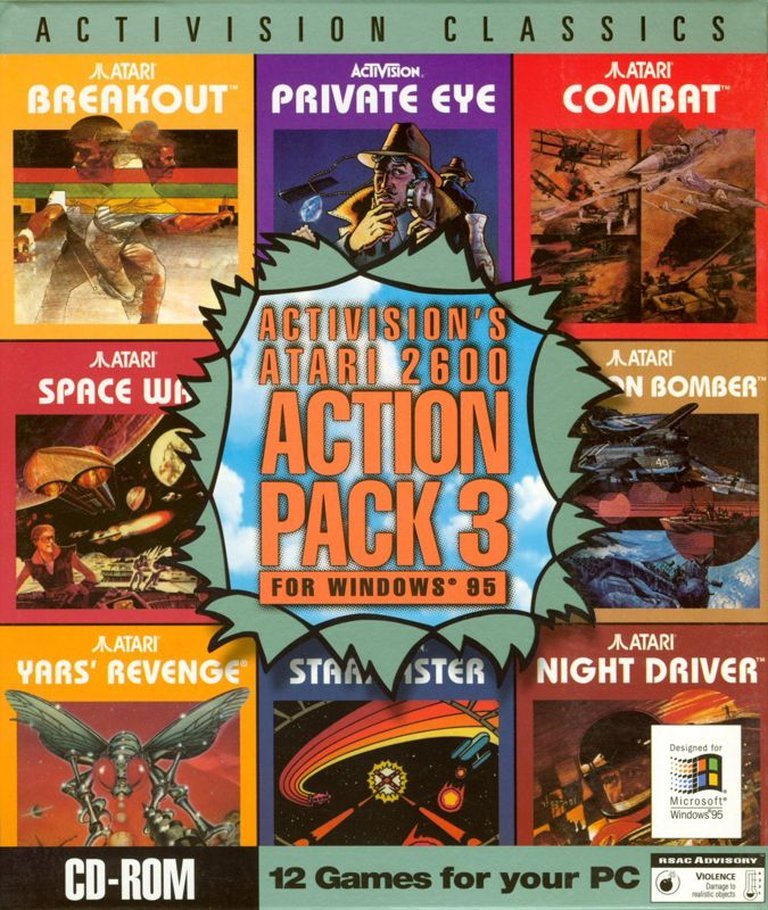
Activision’s Atari 2600 Action Pack 3 is a 1995 retro game compilation for Windows, featuring a mix of classic Atari and Activision titles from the Atari 2600 era. This third installment in the series includes games like Breakout, Combat, Space War, Pressure Cooker, and Yars’ Revenge, offering a nostalgic look at early console gaming. Though criticized for its dated gameplay and short commercial availability, the pack appeals to enthusiasts seeking to revisit foundational arcade and action experiences from the late ’70s and early ’80s.
Where to Buy Activision’s Atari 2600 Action Pack 3
PC
Activision’s Atari 2600 Action Pack 3 Free Download
Activision’s Atari 2600 Action Pack 3 Reviews & Reception
en.wikipedia.org (65/100): Several reviewers found the games were not up to the standards of contemporary titles in terms of gameplay and graphics and sound.
gamepressure.com : The last of the three sets of games which we owe their preparation to Activision.
mobygames.com (68/100): Activision relives its early glory with 15 of its most popular game cartridges.
mobygames.com (59/100): This is the third in the Atari 2600 Action Pack series – this time with Atari games as well as Activision’s.
Activision’s Atari 2600 Action Pack 3: Review
Introduction
In the mid-1990s, as the gaming industry raced toward 3D polygons and CD-ROM cinematic experiences, Activision’s Atari 2600 Action Pack 3 (1995) arrived as a time capsule—a defiant celebration of the 8-bit era’s pixelated charm. This compilation, the third in a series, bundled 12 Atari and Activision classics like Double Dragon, Yars’ Revenge, and Pressure Cooker for Windows PCs. While critics at launch dismissed its “subcartoonish” visuals and simplistic gameplay, the collection now stands as a pivotal artifact in gaming history—a bridge between nostalgia and preservation. This review argues that Action Pack 3, despite its flaws, is an essential relic of retro-gaming’s commercial awakening and a testament to Activision’s early efforts to monetize gaming’s past.
Development History & Context
Developed by Activision in collaboration with Atari, Inc. and Absolute Entertainment, Action Pack 3 was part of a wave of mid-’90s retro compilations fueled by the internet’s nascent retrogaming subculture. Usenet groups like rec.games.video.classic and fanzines like Digital Press had sparked demand for preserved classics, and Activision—led by programmer Mike Livesay—saw an opportunity. Livesay, who’d previously worked on Commodore 64 15 Pack (1995), built a Windows 95-native Atari 2600 emulator, marking one of the first commercial uses of console emulation technology.
The technical constraints were significant: the Atari 2600’s 6507 CPU and TIA sound chip had to be faithfully replicated on ’90s PCs, often resulting in frame drops and audio hiccups. Jeff Vavasour, a rival emulator developer, noted Livesay’s work was impressive but hamstrung by Windows’ inefficiency compared to MS-DOS. The compilation’s lineup—featuring Atari-published titles like Breakout and Combat alongside Activision’s Starmaster—reflected licensing deals that expanded the series’ scope beyond Activision’s original catalog.
Released on CD-ROM and floppy disk, Action Pack 3 faced skepticism in an era where “retro” was not yet a selling point. As Wired sniped, it was a “rip-off” peddling “ratchety sound effects and one-dimensional gameplay” to an indifferent mainstream audience.
Narrative & Thematic Deep Dive
As a compilation, Action Pack 3 lacks a unifying narrative, but its individual games each tell micro-stories of early gaming’s thematic simplicity. The pack’s titles fall into three broad categories:
- Arcade-Action Abstracts: Breakout and Space War epitomize pure mechanics over storytelling, where geometric shapes stand in for spaceships or paddles. The “narrative” is emergent, born from the player’s struggle against escalating difficulty.
- Genre Pioneers: Double Dragon (1988) and Title Match Pro Wrestling (1987) adapt arcade franchises to the Atari’s limitations, reducing their complex brawling to single-plane combat. Thematic depth is replaced by symbolic violence—a punch is a flickering sprite collision.
- Surrealist Experiments: Yars’ Revenge, Atari’s abstract shooter, and Pressure Cooker, a frantic food-service sim, showcase the era’s embrace of absurdist concepts. Their “plots” are oblique, conveyed through manual tidbits or box art lore.
Themes of survival, competition, and spatial mastery dominate, reflecting an era when games were scored challenges rather than narrative vehicles.
Gameplay Mechanics & Systems
The Action Pack 3 games are unified by their arcade-inspired loops:
- Core Mechanics: Titles like Combat and Canyon Bomber revolve around twitch reflexes and pattern memorization. Checkers and Private Eye offer slower-paced strategy but suffer from the Atari’s limited AI.
- Innovations & Flaws: Pressure Cooker stands out for its conveyor-belt chaos, requiring players to manage burger assembly under time pressure—a precursor to later “overload” games like Overcooked. Conversely, Night Driver’s pseudo-3D perspective feels archaic next to ’90s racers.
- UI & Emulation: Livesay’s emulator included period-accurate CRT filters and customizable controls, but the lack of save states or rewind features (common in modern retro packs) frustrates newcomers. The “Mom Mode,” which simulates a mother calling players to stop gaming, is a charming but gimmicky artifact.
As Computer Gaming World noted, these games lacked “boss characters, cutscenes, or codes,” relying instead on pure skill—a design ethos both refreshing and punishing.
World-Building, Art & Sound
The Atari 2600’s 128-color palette and 160×192 resolution defined Action Pack 3’s aesthetic:
- Visuals: Games like Starmaster use minimalist sprites to evoke starfields and alien fleets, while Yars’ Revenge dazzles with its psychedelic “neutral zone” effect—a technical marvel for 1981. The pack’s menus replicate Atari’s wood-grain console aesthetic, leaning into nostalgia.
- Sound Design: The TIA chip’s bleeps and bloops are grating by modern standards but iconic in context. Pressure Cooker’s frantic timer beeps and Double Dragon’s punch effects are etched into gaming’s auditory memory.
- Atmosphere: The compilation evokes childhood basements and arcade carpets, though the sterile Windows 95 interface clashes with the raw CRT warmth of the originals.
Reception & Legacy
Upon release, Action Pack 3 earned mixed reviews:
- Critics: PC Player Germany (59/100) dismissed it as “only bearable with nostalgia in your blood,” while Next Generation (2/5) called its gameplay “shallow.” However, Electronic Games praised Yars’ Revenge and Double Dragon for their enduring simplicity.
- Commercial Impact: The series sold 100,000 copies by late 1995, proving niche appeal. Its short shelf life—compared to earlier packs—was likely due to market saturation.
- Legacy: Despite its flaws, Action Pack 3 paved the way for refined collections like Activision Anthology (2002). It also validated emulation as a commercial tool, influencing Digital Eclipse’s later projects.
Conclusion
Activision’s Atari 2600 Action Pack 3 is neither the best retro compilation nor the most polished, but it’s a vital snapshot of gaming’s embryonic era. Its janky emulation and minimalist gameplay are overshadowed by historical significance: this was the first time many players experienced Atari classics legally on PC. For historians, it’s a crucial artifact; for nostalgic fans, a bittersweet time capsule. While modern retro packs offer QoL improvements, Action Pack 3 remains a raw, unfiltered portal to gaming’s past—worthy of preservation, if not necessarily replay. 3/5.