
- Release Year: 1983
- Platforms: Intellivision, J2ME, Windows, Xbox 360
- Publisher: Mattel Electronics, Microsoft Corporation, THQ Wireless Inc.
- Developer: Mattel Electronics
- Genre: Action
- Perspective: Side view
- Game Mode: Co-op, Single-player
- Gameplay: Arcade
- Setting: Aquatic, Underwater
- Average Score: 73/100
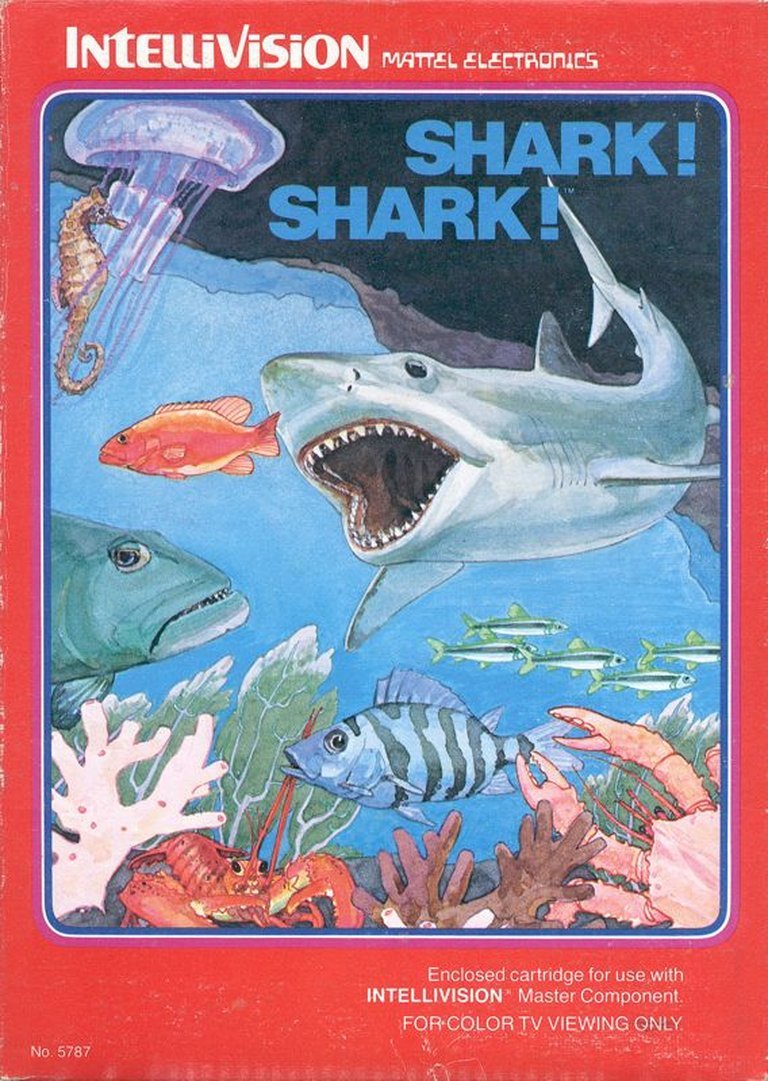
Description
In ‘Shark! Shark!’, you take control of a fish navigating an ocean filled with various marine creatures, including lobsters, crabs, jellyfish, and a swift shark. The objective is to accumulate points by eating smaller fish and nibbling at the shark’s tail, which can be killed with repeated bites. As your fish grows larger with each 1000 points scored, you can consume even more creatures. The game supports multiple speeds and allows for one or two players, offering a challenging and engaging underwater survival experience.
Gameplay Videos
Where to Buy Shark! Shark!
PC
Shark! Shark! Free Download
Shark! Shark! Reviews & Reception
metacritic.com (65/100): BBG’s remake of the Intellivison’s Shark! Shark! works better as a multiplayer game than a solo experience, but you have to be into its simple, chill vibe. Younger/newer players will stick with the game longer than those seeking more frenetic battles and challenges, but it’s priced accordingly.
Shark! Shark!: A Watershed Moment in Aquatic Arcade History
Introduction
In the annals of gaming history, few titles embody the charm and emergent complexity of early-’80s arcade design quite like Shark! Shark!. Released in 1982 for the Intellivision, this deceptively simple aquatic survival game defied expectations, transforming from a dismissed “kiddie” experiment into a cult classic praised for its addictive gameplay and pioneering mechanics. This review argues that Shark! Shark! is not just a relic of its era but a foundational text in the fish-eat-fish survival genre, blending intuitive design with surprising depth—and proving that even the smallest fish can leave a lasting ripple.
Development History & Context
A Surprise Underdog Story
Developed by Mattel Electronics, Shark! Shark! emerged during the golden age of arcade ports and single-screen action games. Designer Don Daglow conceived the core premise, while programmer Ji-Wen Tsao—one of the first female game developers in the industry—brought it to life, drawing inspiration from the Chinese proverb “Big fish eat little fish.” The game’s production was modest: Mattel initially shipped just 5,600 cartridges, dismissing it as a niche title for younger audiences.
Technological Constraints & Creativity
The Intellivision’s hardware limitations shaped Shark! Shark!’s design. With only 16-color graphics and a 1.6 MHz processor, Tsao prioritized clean visuals and fluid motion. To animate the crab’s movement, she famously studied a colleague’s pet tarantula, unsure of how crustaceans actually scurried. Sound designer Andy Sells crafted bubble effects and a jaunty tune after Warner Communications (Atari’s parent company) blocked his initial plan to use “Mack the Knife.”
The 1982 Gaming Landscape
Amid stiff competition from Pac-Man and Donkey Kong, Shark! Shark! stood out by eschewing shooting mechanics in favor of organic predation. Its success forced Mattel to rush additional copies to market, marking it as an underdog hit in an era dominated by space shooters and platformers.
Narrative & Thematic Deep Dive
While Shark! Shark! lacks a traditional plot, its themes resonate through gameplay. Players inhabit a yellow fish navigating a Darwinian food chain, where survival hinges on consuming smaller fish while avoiding larger predators. The shark—a relentless apex threat—embodies nature’s indifference, while the player’s growth mechanic mirrors the cyclical struggle for dominance.
The game’s simplicity masks darker undertones: your fish is both hunter and prey, and even victory (growing to maximum size) comes at the cost of agility. This asymmetry reflects Tsao’s vision of an ecosystem where power and vulnerability coexist—a metaphor for the precariousness of life itself.
Gameplay Mechanics & Systems
Core Loop: Eat or Be Eaten
The gameplay loop is elegantly cruel:
1. Consume smaller fish to score points.
2. Avoid larger fish, crabs, and jellyfish (the latter invincible to all but the shark).
3. Nibble the shark’s tail 3–4 times to defeat it, risking instant death if it turns.
4. Grow larger every 1,000 points, gaining speed but losing maneuverability.
Innovations & Quirks
- Two-player competitive mode: A rarity for the era, allowing simultaneous races to dominate the food chain.
- Dynamic difficulty: Jellyfish appear at higher scores, forcing players to strategize around the shark.
- Risk-reward growth: Larger fish move faster but struggle to dodge, creating tension between safety and predation.
Flaws
The Intellivision II’s timing glitches disrupted bubble sound effects, and the single-screen design limited environmental variety. Yet these shortcomings fade against the game’s compulsive “one more try” appeal.
World-Building, Art & Sound
A Vibrant Underwater Microcosm
Shark! Shark!’s side-view ocean teems with life: coral reefs anchor the screen, schools of fish dart erratically, and bubbles rise to punctuate attacks. The visuals, while rudimentary, prioritize clarity—each creature’s size and speed are instantly readable.
Sound Design: Bubbles and Terror
Andy Sells’ audio work shines in subtle ways:
– Bubble sounds create rhythmic urgency.
– Harmonized death jingles undercut the tension with dark whimsy.
– The shark’s sudden appearance is marked by a foreboding silence, heightening panic.
Reception & Legacy
Critical Acclaim
At launch, Shark! Shark! earned an 81% average critic score (MobyGames). Reviewers praised its “intuitive controls” (The Video Game Critic) and “delightful” absence of violence (Electronic Fun). The German magazine TeleMatch declared it “positively delightful… one of the finest cartridges for this system.”
Enduring Influence
- Preservation: Selected for the U.S. Library of Congress National Game Registry, alongside Pac-Man and Donkey Kong.
- Modern ports: Re-released on Xbox 360, Windows, and mobile, with a 2023 remake adding co-op and new enemies like krakens and electric eels.
- Genre legacy: Precursor to games like Feeding Frenzy and E.V.O.: Search for Eden, which expanded aquatic survival mechanics.
Conclusion
Shark! Shark! is a masterclass in minimalist design, transforming a simple premise into an enduring testament to the Intellivision’s potential. Its blend of strategic predation, risk-reward progression, and whimsical brutality secures its place as a pioneer—not just of aquatic games, but of emergent gameplay narratives. While later ports have struggled to recapture its magic (the 2023 remake scored 71% in Retro Gamer), the original remains a titan of its era.
Final Verdict: A bite-sized classic that still swims circles around the competition.