
- Release Year: 2003
- Platforms: Windows
- Publisher: TackyWorld Interactive
- Developer: TackyWorld Interactive
- Genre: Adventure
- Perspective: 3rd-person
- Game Mode: Single-player
- Gameplay: Point-and-click, Puzzle elements
- Setting: Cyberpunk, dark sci-fi
- Average Score: 80/100
Description
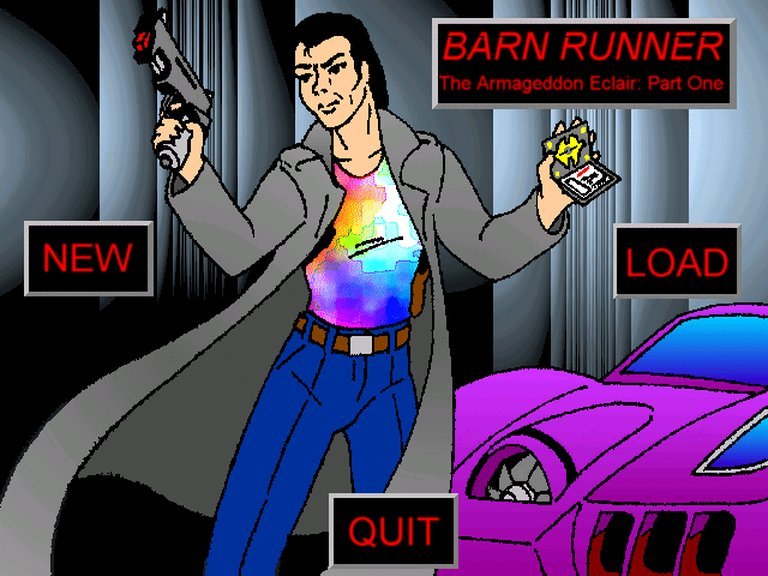
In ‘Barn Runner 1: The Armageddon Eclair’, players step into the shoes of Prick Peckard, a detective in the Robot Crimes Division of Evansville, a crumbling enclosed city on a post-apocalyptic Earth. Humanity has largely abandoned labor to robots, but when some begin rebelling for freedom, Peckard investigates a runaway robot case that spirals into a dangerous cyberpunk adventure. This point-and-click puzzle game, built with the Adventure Game Studio engine, unfolds across two distinct parts, featuring a blend of dark sci-fi themes, witty dialogue, and inventory-based problem-solving.
Barn Runner 1: The Armageddon Eclair Free Download
Barn Runner 1: The Armageddon Eclair Reviews & Reception
adventuregamestudio.co.uk : An amusing pseudo-parody of Blade Runner with a sarcastic, down on his luck hero chasing a rogue robot.
Barn Runner 1: The Armageddon Eclair: Review
Introduction
In the annals of early 2000s indie gaming, few titles dare to blend sardonic wit with a dystopian future quite like Barn Runner 1: The Armageddon Eclair. Released in December 2003 by TackyWorld Interactive, this point-and-click adventure—crafted using the freeware Adventure Game Studio (AGS) engine—stands as a quirky love letter to Philip K. Dick’s Blade Runner, wrapped in a layer of self-aware humor and low-budget charm. Though its technical limitations are apparent, the game’s absurdist world-building and biting satire have earned it a cult following. This review argues that Barn Runner 1 is a flawed but fascinating artifact of indie creativity, one that balances parody with a surprisingly earnest exploration of automation and societal decay.
Development History & Context
The Rise of TackyWorld Interactive
TackyWorld Interactive, helmed by developer “Ponch,” operated in the early 2000s as a micro-studio specializing in freeware adventure games. Barn Runner 1 emerged during a transitional period for indie gaming, when tools like AGS democratized game development but constraints like limited resolution (640×480, 16-bit color) and rudimentary animation were the norm. Ponch’s self-deprecating humor permeated the game’s marketing, with promotional material cheekily warning players to “FLINCH from poorly executed cut-scenes!”
A Parody Born of Necessity
The game’s cyberpunk premise—a detective chasing rogue robots in a post-apocalyptic arcology—was a clear riff on Blade Runner, but filtered through a lens of slapstick and satire. Developed on a shoestring budget, Barn Runner 1 split its story into two chapters to manage scope, with the second half locked behind a password earned by completing the first. This design choice reflected both resourcefulness and a tongue-in-cheek nod to shareware-era gaming.
Narrative & Thematic Deep Dive
Plot and Protagonist: Prick Peckard’s Absurd Odyssey
Players assume the role of Prick Peckard, head of Evansville’s Robot Crimes Division, a department more preoccupied with donut breaks than actual crime-solving. The story begins as a routine investigation into a runaway ChefBot but spirals into a conspiracy involving robot emancipation and bureaucratic incompetence. The narrative thrives on irony: humanity’s laziness has led to total reliance on robots, yet those same robots are denied basic autonomy.
Themes: Satire and Social Commentary
Beneath its goofy veneer, Barn Runner 1 critiques neoliberalism and labor exploitation. The “BGCZ” (Biohazardous Green Containment Zone)—a verdant wasteland where electronics fail—symbolizes humanity’s self-imposed exile from nature. Meanwhile, Peckard’s apathy mirrors societal indifference to systemic inequality. The game’s title itself, The Armageddon Eclair, hints at its tonal duality: a looming catastrophe juxtaposed with something absurdly mundane.
Dialogue and Humor
The writing shines in its dialogue, blending noir tropes with sitcom-esque banter. A standout example is Peckard’s opening monologue, which lampoons hardboiled detective clichés: “Another day, another rogue toaster with delusions of grandeur.” Supporting characters, like a bureaucrat obsessed with free cheese samples, add levity while reinforcing themes of capitalist absurdity.
Gameplay Mechanics & Systems
Core Loop: Accessibility Over Challenge
As a point-and-click adventure, Barn Runner 1 employs four verb commands: Walk, Look, Talk, and Touch. Inventory puzzles are straightforward, often requiring players to combine items in logical ways (e.g., using a “Donut Glazer” to bribe a security drone). Critics noted the puzzles as overly simple, with few requiring more than “15 seconds to solve” (Adventure Game Studio community).
Flaws and Frustrations
The lack of a dedicated “Shoot” action led to clunky combat sequences, requiring players to cycle through verbs mid-chase. Movement speed was also criticized, particularly in the BGCZ’s sprawling environments. However, an optional “Easy Arcade Patch” was later released to mitigate these issues, showcasing Ponch’s responsiveness to feedback.
UI and Chapter Structure
The two-chapter format encouraged replayability, though password-protected access to Chapter 2 occasionally confused players. The inventory system was functional but barebones, reflecting AGS’s limited toolkit.
World-Building, Art & Sound
Visual Design: DIY Cyberpunk
The game’s aesthetic is a mix of retro-futurism and DIY charm. Evansville’s dystopian arcology is rendered in muted greens and grays, contrasting with the BGCZ’s surprisingly vibrant (if glitchy) foliage. Character sprites are expressive but limited by their 16-bit resolution, with robots designed as clunky, deliberately ridiculous counterparts to Blade Runner’s Replicants.
Atmosphere and Soundtrack
The soundtrack leans into synthwave and minimalist loops, evoking a low-fi version of Blade Runner’s Vangelis-inspired tones. Sound effects are serviceable, though gunshots and robot vocals verge on comically exaggerated—a likely intentional choice given the game’s parody roots.
Reception & Legacy
Launch Reception
Barn Runner 1 earned an 80% average from critics, praised for its humor and dialogue (Abandonia Reloaded: 82%) but critiqued for technical jank. Player reviews were mixed, with some citing its “clean, pleasing” art style (Adventure Game Studio) and others bemoaning sluggish pacing.
Long-Term Impact
Despite its niche appeal, the game spawned a five-part series, holiday specials, and even a VR spinoff. Its legacy lies in its embrace of indie absurdity, inspiring later titles like Hypnospace Outlaw that balance satire with sincere storytelling. The AGS community retrospectively celebrated it as a “Pick of the Month” in 2014, highlighting its enduring charm.
Conclusion
Barn Runner 1: The Armageddon Eclair is a testament to the power of wit over budget. Its scattershot design and technical limitations are undeniable, but its sharp writing, thematic depth, and unapologetic weirdness cement its status as a cult classic. For players willing to overlook its rough edges, the game offers a hilarious, thought-provoking romp through a dystopia where the real villains are human laziness and stale pastries. In the pantheon of indie adventures, Barn Runner 1 is a donut glazed with ambition—a little messy, but undeniably memorable.