
- Release Year: 1999
- Platforms: Windows
- Publisher: Hasbro Interactive, Inc.
- Developer: Random Games, Inc.
- Genre: Compilation, Simulation
- Perspective: Top-down
- Game Mode: Online PVP, Single-player
- Gameplay: Board game, Chess
- Average Score: 80/100
Description
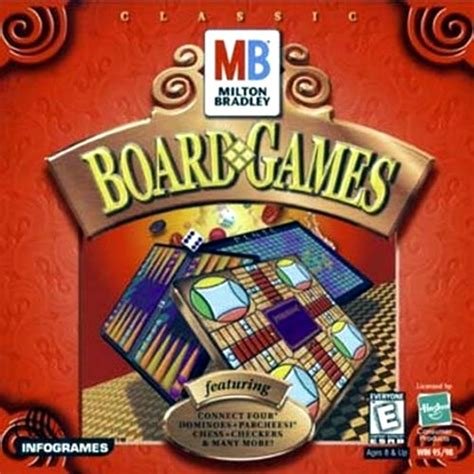
Milton Bradley Classic Board Games is a digital collection of seven classic board games licensed by Hasbro. Players can create profiles and compete against animated computer-controlled opponents in games like Checkers, Connect Four, Chess, Dominoes, Parcheesi, Pente, and Backgammon. The game also supported online multiplayer on Microsoft’s Zone.com, although the servers are no longer active.
Gameplay Videos
Milton Bradley Classic Board Games Free Download
Milton Bradley Classic Board Games: Review
Introduction
In an era where board games were synonymous with family gatherings and rainy-day entertainment, Milton Bradley Classic Board Games (1999) emerged as a digital time capsule, preserving seven timeless titles for the burgeoning PC gaming market. Released at the twilight of the 20th century, this compilation bridged the tactile joy of physical board games with the convenience of digital play. While it lacked the flash of contemporaries like Age of Empires or The Sims, its ambition was clear: to translate Milton Bradley’s 150-year legacy of analog entertainment into a pixelated format. This review argues that, despite its technical limitations, the game remains a fascinating artifact of a transitional period in gaming history—one where tradition clashed with innovation, and where classic gameplay struggled to find its footing in the digital frontier.
Development History & Context
The Studio and Vision
Developed by Random Games, Inc. and published by Hasbro Interactive (which acquired Milton Bradley in 1984), the title was part of a late-’90s push to digitize Hasbro’s portfolio of analog classics. Following the success of Parker Brothers Classic Card Games (1998), Milton Bradley Classic Board Games aimed to capitalize on the nostalgia of baby boomers while appealing to younger audiences raised on early internet gaming.
Technological Constraints
The game was constrained by the hardware of its time: CD-ROM storage limited asset quality, and internet connectivity was still in its infancy. The reliance on Microsoft’s Zone.com for multiplayer—a service that shuttered in 2006—reflected the optimism of early online gaming, though its implementation was rudimentary by today’s standards.
The Gaming Landscape
In 1999, PC gaming was dominated by RTS titans like StarCraft and narrative pioneers like Planescape: Torment. Against this backdrop, Milton Bradley Classic Board Games felt quaint but accessible, targeting casual players seeking familiar, low-stakes entertainment. Its release coincided with Hasbro’s broader strategy to reinvigorate its brands through digital adaptations, a trend seen in later titles like Monopoly Tycoon (2001).
Narrative & Thematic Deep Dive
While devoid of a traditional narrative, the game’s thematic core lies in its celebration of communal play. Each of the seven games—Checkers, Connect Four, Chess, Dominoes, Parcheesi, Pente, and Backgammon—carries its own cultural weight. Chess evokes strategic mastery; Parcheesi reflects ancient Indian royalty; Pente channels Greek tactical simplicity.
The inclusion of Ace, an animated host who tutorializes each game, adds a whimsical narrative layer. Ace’s presence frames the experience as a friendly match rather than a competitive slog, reinforcing Milton Bradley’s ethos of family-centric entertainment.
Gameplay Mechanics & Systems
Core Gameplay Loops
Each game retains its analog ruleset, with minor digital adjustments:
– Chess: Offers three difficulty levels, though the AI’s predictability limits long-term appeal.
– Backgammon: Features customizable doubling cube rules, catering to purists.
– Connect Four: The AI’s move speed feels sluggish compared to physical play.
The profile system tracks wins, losses, and high scores, providing a rudimentary progression loop.
AI Opponents
Ten AI characters, each with distinct personalities (e.g., a cautious elder, a reckless teen), attempt to mimic human quirks. However, their behaviors often devolve into repetitive patterns, undermining the illusion of adaptability.
UI/UX Analysis
The interface is functional but dated. Menus are cluttered, and the lack of scalable resolutions mars modern playback. The “hotseat” multiplayer mode is a standout, allowing four players to share a single PC—a nod to pre-online socialization.
Flaws
The absence of save states for in-progress games and the shutdown of Zone.com multiplayer (rendering online play obsolete) are significant drawbacks.
World-Building, Art & Sound
Visual Direction
The game’s aesthetic is utilitarian, prioritizing readability over flair. Boards are rendered in flat 2D with minimal animation—checkers “snap” into place, chess pieces glide—while Ace’s rubbery animations echo early Flash cartoons.
Sound Design
Ambient sounds (e.g., the clack of dominoes) and Ace’s voice-acting strive to replicate the tactile satisfaction of physical play. The MIDI-style soundtrack, though repetitive, evokes the cheerful monotony of a family game night.
Reception & Legacy
Critical Reception
The game earned an 80% score from All Game Guide, praised for its faithful adaptations but critiqued for lacking innovation. The sole review noted: “Playing against others at your computer would be cheaper with the board versions.”
Commercial Impact
Sales figures are scarce, but its niche appeal resonated with educators and families. Today, it’s preserved as abandonware, downloaded by retro enthusiasts from platforms like My Abandonware and the Internet Archive.
Industry Influence
While not groundbreaking, it paved the way for polished successors like Tabletop Simulator (2015) and Board Game Arena (2010), proving that digital board games could thrive beyond mere novelty.
Conclusion
Milton Bradley Classic Board Games is neither a masterpiece nor a relic. It’s a earnest, if flawed, attempt to digitize the warmth of analog play—a time capsule of an era when “online multiplayer” still felt magical, and when families huddled around PCs instead of boards. Its janky AI and dated presentation may deter modern players, but as a historical artifact, it offers a poignant glimpse into the challenges of translating tradition into pixels. For historians and nostalgia-seekers, it’s a charming curio; for others, a reminder that some games are best played with real pieces—and real people.
Final Verdict: A three-star relic, best appreciated as a bridge between two worlds.
For further reading, explore Milton Bradley’s 1860 origins in lithography or Hasbro’s digital adaptations like *HeroQuest (2021).*