
- Release Year: 2008
- Platforms: Linux, Macintosh, Windows
- Genre: Strategy, Tactics
- Perspective: Top-down
- Game Mode: Hotseat, Single-player
- Gameplay: Board game
Description
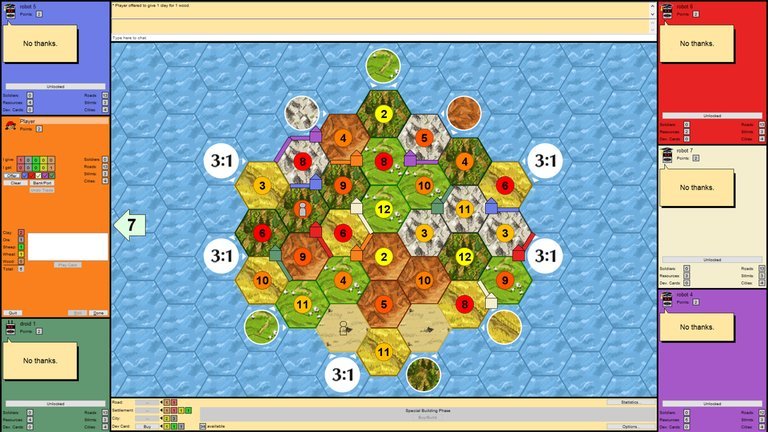
JSettlers is a digital strategy board game inspired by the classic ‘Settlers of Catan’, where players compete to build settlements, roads, and cities on the newly populated island of Catan. Players gather resources such as lumber, brick, and grain, trade with others or at seaports, and strategically expand their territories to earn victory points. The top-down, turn-based gameplay combines tactical resource management and negotiation, with the first player to reach 10 points claiming victory. Developed as an open-source Java adaptation, it retains the hexagonal map and social dynamics of the original board game.
JSettlers Guides & Walkthroughs
JSettlers: Review
Introduction
In the pantheon of digital board game adaptations, JSettlers (2008) stands as a humble yet significant tribute to Klaus Teuber’s legendary The Settlers of Catan. This Java-based reimagining, developed by Jeremy D. Monin and a passionate open-source community, distills the essence of Catan’s competitive settlement-building into a minimalist digital experience. While lacking the polish of commercial releases, JSettlers carves out a niche as an accessible, cross-platform homage to the board game classic. This review argues that JSettlers succeeds in preserving Catan’s core strategic DNA, even as it grapples with the technical and aesthetic limitations of its era.
Development History & Context
JSettlers emerged during a transitional period for both board games and digital adaptations. Released in 2008, it arrived amid the rise of indie game development and the growing popularity of open-source projects. Jeremy D. Monin, alongside contributors like Robert S. Thomas and Paul Bilnoski, leveraged Java’s “write once, run anywhere” philosophy to create a cross-platform experience for Windows, Linux, and Mac.
The project’s reliance on open-source tools and Creative Commons assets (e.g., hex tiles licensed under CC-BY-SA 3.0) reflects the collaborative ethos of its era. Technological constraints shaped its design: the fixed top-down perspective and menu-driven interface prioritized functionality over flair, while its turn-based pacing and hexagonal grid paid direct homage to Catan’s analog roots. Community contributions, such as Lee Passey’s 2020 French localization and STAC Project’s AI integration, underscore its status as a living project rather than a static product.
Narrative & Thematic Deep Dive
As a digital adaptation of The Settlers of Catan, JSettlers inherits its predecessor’s thematic framework: players compete to colonize the island of Catan through resource gathering, trade, and strategic expansion. While devoid of explicit narrative, the game’s emergent storytelling mirrors the board game’s tension between cooperation and rivalry.
Themes of scarcity and negotiation are baked into its systems. Players must balance short-term trades (e.g., swapping lumber for brick) with long-term goals like building the longest road or largest army. Dialogues are minimal—limited to trade prompts and victory announcements—but the absence of exposition reinforces the purity of its strategic focus. Unlike narrative-driven games, JSettlers finds drama in dice rolls and contested ports, making every match a microcosm of colonial ambition.
Gameplay Mechanics & Systems
At its core, JSettlers is a triumph of iterative design:
- Core Loop: Players roll dice to gather resources (wool, grain, ore, lumber, brick), spend them to build settlements and roads, and race to 10 victory points. The game preserves Catan’s “robber” mechanic, where a 7 rolled lets players block resource production from rival hexes.
- Trade & Economy: The UI simplifies bartering with AI or human opponents, while ports allow 3:1 or 2:1 resource exchanges. However, the lack of nuanced trade negotiations (a hallmark of tabletop play) occasionally flattens the social dynamics.
- Multiplayer: Networked play via LAN or online is supported, though setup can be finicky. AI opponents, ranging from “ROMANVERYEASY” to “ROMANVERYHARD” (per GitHub documentation), offer competent but predictable challenges.
- UI & Controls: The menu-driven interface is functional but dated. Contextual tooltips are sparse, and the absence of a tutorial may overwhelm newcomers. Still, hotkeys like F2 (save) and Delete (destroy buildings) streamline play for veterans.
Flaws emerge in its rigid systems. The absence of custom rule modifications limits replayability, and the fixed hex layouts lack the procedural generation of modern digital Catan versions. Yet for purists, these constraints evoke the board game’s tactile charm.
World-Building, Art & Sound
JSettlers’ visual and auditory identity is a study in minimalist pragmatism:
- Visual Design: The top-down perspective emphasizes clarity over spectacle. Hex tiles—crafted by Jeremy Monin and contributors like qubodup (Iwan Gabovitch)—range from earthy classic styles to pastel alternatives, though all retain a rudimentary, pixelated aesthetic. Ports and settlements are identifiable but lack animation, reinforcing the game’s board-like abstraction.
- Audio: Sound effects are sparse, limited to dice rolls and construction cues. The absence of a soundtrack heightens focus on strategy but diminishes atmosphere.
- Atmosphere: Despite its austerity, JSettlers evokes the quiet tension of a tabletop match. The creak of a virtual wooden board might be missed, but the digital canvas invites players to project their own drama onto its hexagonal grid.
Reception & Legacy
Critically, JSettlers flew under the radar at launch, with no formal reviews cataloged on MobyGames. Yet its legacy lies in its durability. The open-source codebase (hosted on GitHub) has spawned forks like settlers-remake, which expands the game into a Settlers III-inspired RTS. Community mods, such as the 2019 pastel tile sets and multilingual support, testify to its enduring appeal.
Comparatively, JSettlers lacks the polish of official Catan digital editions (Catan Universe, Catan VR). However, its grassroots development model and cross-platform accessibility have cemented it as a cult favorite among board game enthusiasts and Java developers alike.
Conclusion
JSettlers is not a masterpiece of technical innovation or artistic vision. Yet as a labor of love, it captures the soul of The Settlers of Catan with unpretentious fidelity. Its clunky UI and austere presentation may deter casual players, but for those seeking a no-frills digital adaptation—or a canvas for community-driven tinkering—it remains a noteworthy artifact of indie gaming history. In an age of hyper-commercialized board game apps, JSettlers stands as a reminder that joy often lies in simplicity, collaboration, and the roll of a digital die.
Final Verdict: A rough-hewn tribute to Catan’s genius, JSettlers is best appreciated by purists and open-source advocates. Its place in history is secure as a bridge between analog tradition and digital possibility.