
- Release Year: 1999
- Platforms: Windows
- Developer: Matthew Julius Brechner
- Genre: Action
- Perspective: 3rd-person (Other)
- Game Mode: Single-player
- Gameplay: Arcade
- Setting: Daytime
- Average Score: 40/100
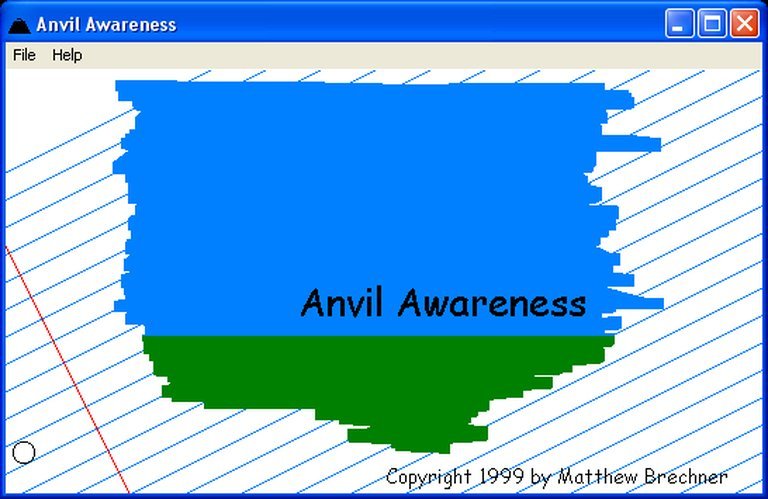
Description
Anvil Awareness is a classic arcade-style action game released in 1999. Players control a character on a sunny day who must dodge an increasing barrage of falling anvils to achieve the highest score and survive. The game’s simple yet challenging mechanics involve using the left and right arrow keys to navigate the character, with the difficulty escalating as more anvils descend faster over time.
Anvil Awareness Reviews & Reception
retro-replay.com : Anvil Awareness delivers a deceptively simple yet highly addictive gameplay loop.
Anvil Awareness Cheats & Codes
PC
| Code | Effect |
|---|---|
| BOSSjh5kl9dt7h6a | 500 Crons |
| GOAL67effbb8d10c | 500 Crons |
| INTEL500 | 500 Crons |
| GOAL47c1dfa86e10 | 1000 Crons |
| GOAL200b5aa70b12 | Jungler Gold Skin Backpack |
| GOAL78f56d7efb1f | Jungler Gold Skin Shoulder Armor |
| GOALc2bc572d9f13 | Jungler Gold Skin Head Gear |
| GOAL2bdf8c2c769c | Jungler Gold Skin Body Armor |
Anvil Awareness: Review
Introduction
In the pantheon of late-’90s freeware curiosities, Anvil Awareness stands as a bizarre yet oddly compelling artifact—a game that marries slapstick absurdity with punishing arcade rigor. Released in February 1999 by solo developer Matthew Julius Brechner, this Windows-era oddball drops players into a sun-soaked hellscape where survival hinges on dodging an endless hail of anvils. While its premise is ludicrously simple, Anvil Awareness embodies a peculiar charm: it is both a relic of an era when indie development was still in its infancy and a testament to how minimalist design can cultivate obsession. This review argues that beneath its deceptively crude exterior lies a razor-sharp test of reflexes, one that deserves recognition as a cult classic of proto-indie gaming.
Development History & Context
The Solo Developer and the Freeware Frontier
Anvil Awareness emerged during a transitional period for PC gaming. The late ’90s saw the rise of shareware and freeware titles, often distributed via fledgling internet platforms or CD-ROM compilations. Brechner, credited with eight other obscure titles, operated in this fringe space, crafting small-scale experiences that prioritized immediacy over complexity. Unlike the cinematic ambitions of Half-Life (1998) or the sprawling worlds of Baldur’s Gate (1998), Anvil Awareness leaned into the arcade ethos of the early ’80s—think Pitfall! meets Wile E. Coyote.
Technological Constraints and Design Philosophy
Built for Windows 98-era hardware, the game’s visual and mechanical simplicity was likely born of necessity. With no team or budget, Brechner focused on a single mechanic: evasion. The result was a game stripped to its essentials, reminiscent of browser-based Flash games that would dominate the 2000s. Its freeware status also positioned it as a precursor to modern indie casual games—easy to pick up, difficult to master, and freely accessible.
Narrative & Thematic Deep Dive
A Tale of Existential Absurdity
The “narrative” of Anvil Awareness is a darkly comic vignette: an unnamed everyman strolls through a pastoral landscape, only to be assaulted by anvils falling from a cloudless sky. There’s no explanation for the anvils, no villain to thwart—just an endless, Sisyphean struggle against gravity’s deadliest tool. This setup evokes the nihilistic humor of Monty Python or Looney Tunes, where violence is both arbitrary and cartoonish.
Themes of Futility and Mastery
Thematically, the game is a meditation on futility. Each playthrough ends in inevitable obliteration, yet players return, lured by the promise of a higher score. The anvils themselves are indifferent forces of nature, embodying the uncaring chaos of the universe. In this way, Anvil Awareness prefigures the “masocore” genre (e.g., Getting Over It), where repeated failure becomes a perverse source of satisfaction.
Gameplay Mechanics & Systems
The Core Loop: Tension and Repetition
The gameplay is ruthlessly straightforward:
– Controls: Left/right arrow keys to maneuver the protagonist.
– Objective: Avoid anvils, which increase in speed and frequency.
– Consequence: One hit = instant death.
This simplicity belies a meticulously tuned difficulty curve. Early seconds lull players into complacency, but by the 30-second mark, the screen becomes a maelstrom of metal. The lack of power-ups or stages heightens the purity of the challenge—success depends entirely on reaction time and pattern recognition.
Innovations and Flaws
The game’s lone innovation is its escalating tension. Unlike Tetris or Space Invaders, which introduce complexity through new mechanics, Anvil Awareness amplifies dread through sheer velocity. However, its simplicity is a double-edged sword:
– Strengths: Instant readability, zero learning curve, and addictive “one more try” appeal.
– Weaknesses: No variance in obstacles, limited replayability beyond score-chasing, and no save system.
World-Building, Art & Sound
Visual Design: Sunshine and Doom
The game’s juxtaposition of a cheery backdrop (rolling hills, blue sky) with the grim reality of falling anvils is its masterstroke. The protagonist—a pixelated stick figure with a surprised expression—adds to the dark comedy, while the anvils rotate with a convincing heft, emphasizing their lethal weight.
Sound Design: Minimalism as Atmosphere
Though specifics are scarce, Retro Replay’s review notes optional background music and sharp sound effects for near-misses and impacts. The absence of a soundtrack likely sharpens focus on the escalating thuds of approaching anvils, turning sound into a survival tool.
Reception & Legacy
Initial Obscurity
Upon release, Anvil Awareness garnered little attention. With no marketing and a single developer, it languished in the depths of early internet gaming portals. Its lone player rating on MobyGames (2.0/5) reflects its niche appeal—a game too crude for mainstream audiences but perfect for masochistic score-chasers.
Cult Status and Indirect Influence
While not directly influential, Anvil Awareness foreshadowed trends in indie design:
– The rise of “Twitch” games like Celeste or Super Meat Boy, where precision and repetition are central.
– The popularity of minimalist jam games, such as those found on itch.io.
– The absurdist humor of titles like Goat Simulator or Surgeon Simulator.
Conclusion
Anvil Awareness is neither a masterpiece nor a disaster—it is an eccentric time capsule, a game that distills arcade purity into its most elemental form. Its lack of depth limits its broad appeal, but as a testament to the creativity of solo developers and the enduring allure of high-score chasing, it remains a fascinating artifact. For historians, it offers a window into the DIY spirit of late-’90s freeware; for players, it is a brief, brutal reminder of how exhilarating—and merciless—gaming can be.
Final Verdict: Anvil Awareness is a footnote in gaming history, but its legacy lies in proving that even the simplest ideas can leave a lasting impression. For those willing to embrace its chaos, it delivers a uniquely cathartic blend of frustration and triumph.