
- Release Year: 2014
- Platforms: Linux, Macintosh, Nintendo Switch, PlayStation 4, Windows
- Publisher: Glass Knuckle Games, LLC, Skymap Games, LLC
- Developer: Glass Knuckle Games, LLC
- Genre: Action
- Perspective: Side view
- Game Mode: Co-op
- Gameplay: Stealth
- Setting: Western
- Average Score: 75/100
Description
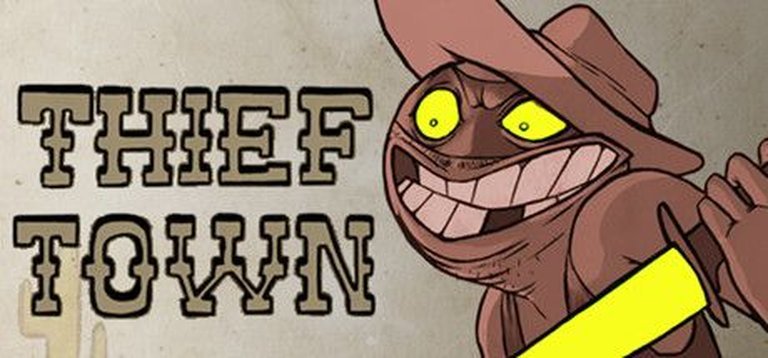
Thief Town is a local multiplayer stealth action game set in the Wild West, where 2-4 players enter an arena to identify and eliminate opponents disguised among AI-controlled characters. With a mix of deception and quick reflexes, players must outwit each other to survive, utilizing environmental elements like sandstorms and smoke bombs to gain the upper hand in fast-paced, competitive matches.
Where to Buy Thief Town
PC
Thief Town Guides & Walkthroughs
Thief Town Reviews & Reception
metacritic.com (75/100): Thief Town undoubtedly has a lot of promise, but it hasn’t reached its true potential yet.
reddit.com : I really, really enjoyed it (I have not played the other games)
opencritic.com (73/100): Thief Town undoubtedly has a lot of promise, but it hasn’t reached its true potential yet.
Thief Town Cheats & Codes
PC Version
Enter name codes at the player name input screen.
| Code | Effect |
|---|---|
| down item left down | Unlocks the ‘Oh, Come On…’ achievement |
Thief Town: Review
Introduction
In the crowded landscape of indie multiplayer games, Thief Town (2014) stands out as a clever, chaotic experiment in social stealth and deception. Developed by Glass Knuckle Games, this local multiplayer title drops 2-4 players into a tense Wild West showdown where everyone looks identical, and the only goal is to suss out who’s human and who’s AI—before getting stabbed in the back. While its simplicity might initially underwhelm, Thief Town thrives on the paranoia and unpredictability of human behavior, offering a uniquely frantic experience that recalls the best moments of Among Us and SpyParty, but with a dusty, saloon-door twist.
Development History & Context
Glass Knuckle Games, a small studio founded by Brett Davis, envisioned Thief Town as a minimalist yet intense party game. Released in 2014 amid a wave of indie local-multiplayer darlings like SpeedRunners and TowerFall, the game embraced the era’s trend of couch competition but subverted expectations by replacing precision platforming with psychological warfare.
The studio faced technical constraints typical of small teams: limited AI behavior trees, a fixed camera perspective, and a focus on tight, repeatable gameplay loops. At the time, asymmetrical multiplayer games were beginning to gain traction, but Thief Town distinguished itself by making everyone feel like both predator and prey. The Wild West setting—a staple of American mythos—provided an accessible backdrop for its deception mechanics, leveraging familiar tropes (sheriffs, outlaws, tumbleweeds) to ease players into its high-stakes hide-and-seek.
Narrative & Thematic Deep Dive
Thief Town forgoes a traditional narrative, opting instead to thematically root itself in the duplicity and distrust of the frontier. Each match is a microcosm of Western archetypes: strangers in a lawless town, where trust is a liability and survival depends on sharp observation and sharper reflexes.
The game’s AI-controlled characters (“townsfolk”) move with robotic predictability, creating a stark contrast against human players’ improvisational chaos. This dichotomy mirrors classic Western tensions between order and anarchy, civilization and savagery. While there’s no dialogue or story campaign, the emergent narratives—a player’s desperate gambit to mimic AI, or a perfectly timed smoke bomb that turns the tide—become the tales players recount long after the match ends.
Gameplay Mechanics & Systems
At its core, Thief Town is a game of imitation and elimination:
– The Loop: Players and AI wander a small, fixed-screen arena. Humans must identify and kill other players while blending in; AI follows predetermined paths.
– Tools: Smoke bombs obscure vision, while sandstorms periodically disrupt movement, adding layers of chaos.
– UI: A minimalist design keeps the focus on player observation. No health bars or indicators—just twitchy glances and sudden betrayals.
The brilliance lies in its simplicity. With no complex controls (just movement and a single attack button), the burden falls on players to perform as convincingly as possible. Flaws emerge in the AI’s rigidity: they never deviate from paths, while humans might hesitate, circle, or panic. Yet in the heat of the moment, even seasoned players can falter, leading to hilarious misreads and accidental alliances.
Critics might argue the systems lack depth—no progression, limited maps—but Thief Town’s focus on pure, unadulterated suspicion is its strength. It’s a game that laughs at meta-strategies, rewarding gut instincts over memorization.
World-Building, Art & Sound
Visually, Thief Town embraces a retro, pixel-art aesthetic that channels Gunman Clive and Hotline Miami. The environments are sparse but evocative: a saloon, a dusty main street, a lantern-lit alley. This simplicity ensures clarity amid the chaos, though more variety in locales could have added longevity.
Sound design is equally minimalist. The twang of a discordant guitar sets the mood, while abrupt stabs of noise punctuate kills. The lack of a soundtrack amplifies tension, making every footstep and sword swipe feel consequential.
Reception & Legacy
Thief Town garnered a niche following but struggled to break into the mainstream. Critics praised its concept (Gameplay Benelux called it “a nerve-wracking twist on party games”) but noted its dependence on a lively local group—a hurdle in an increasingly online world.
Despite its modest commercial reach, the game’s influence can be seen in later titles like First Class Trouble and Deceit, which expanded on social deduction mechanics. For indie designers, Thief Town remains a case study in how constrained systems can breed creativity, and how theme and mechanics can fuse to create unforgettable moments.
Conclusion
Thief Town is not a perfect game. Its lack of online multiplayer and limited content hold it back from greatness. Yet as a raw, unfiltered experiment in multiplayer tension, it’s a cult classic—a game that transforms living rooms into battlegrounds of whispered accusations and sudden betrayals. In the pantheon of indie stealth games, it carves out a unique niche: a reminder that sometimes, the most thrilling heists aren’t about stealing gold, but trust.
Final Verdict: A sharp, if unpolished, dagger in the back of conventional multiplayer design. Best enjoyed with friends, a healthy dose of paranoia, and no mercy.