
- Release Year: 2005
- Platforms: Windows
- Publisher: Atari Deutschland GmbH
- Genre: Compilation
- Average Score: 78/100
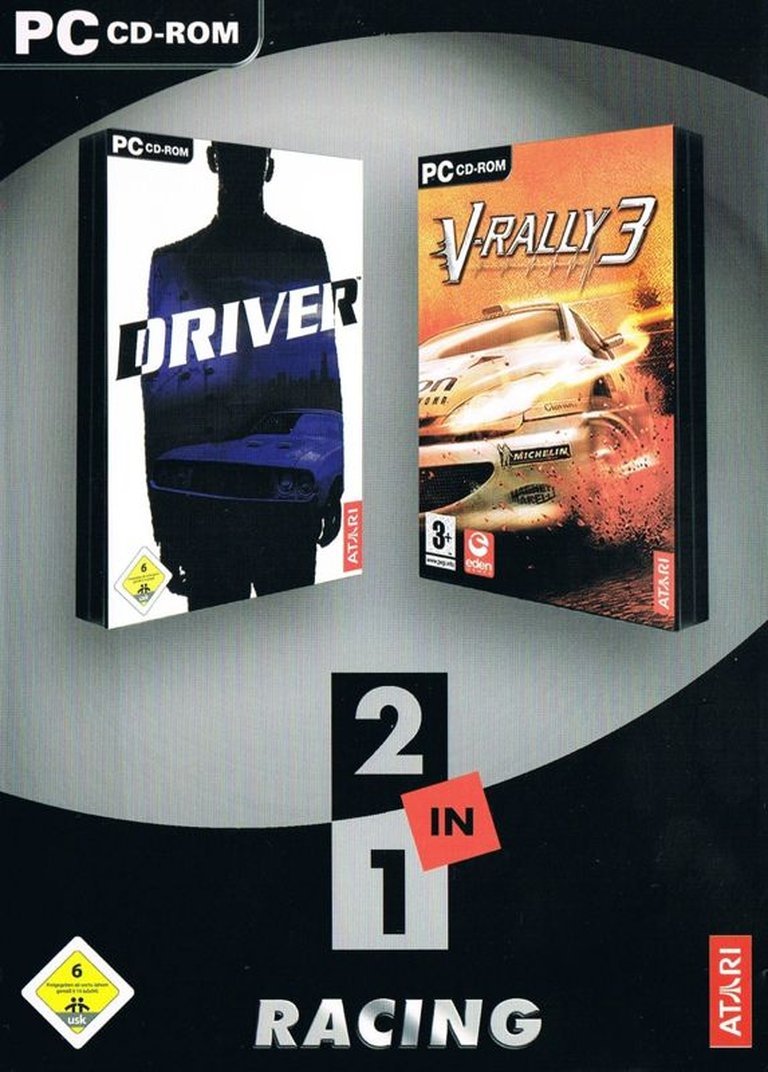
Description
2 in 1: Driver & V-Rally 3 is a 2005 Windows compilation featuring two distinct racing experiences: the classic action-driving game Driver (1999) and the rally simulation V-Rally 3 (2002). Published by Atari Deutschland GmbH, this CD-ROM bundle offers players the thrill of high-speed police chases in Driver alongside the precision of off-road racing in V-Rally 3, delivering varied gameplay for racing enthusiasts under a single package.
2 in 1: Driver & V-Rally 3 Guides & Walkthroughs
2 in 1: Driver & V-Rally 3 Reviews & Reception
metacritic.com (76/100): A rally fan’s dream come true. While the game suffers a little from graphical glitches, the game handles like a dream and most racing fans will find V-RALLY 3 to be a game that they can play for hours.
gamepressure.com (79/100): V-Rally 3 is the latest and most accomplished version of a rally driving franchise that saw its inception in the early days of the PsOne.
howlongtobeat.com (80/100): One of the most impressive GBA games ever created, with shockingly good 3D mixed with a sprite based car and handling that just feels good.
2 in 1: Driver & V-Rally 3 Cheats & Codes
PlayStation 2
Enter the codes as your first and last name.
| Code | Effect |
|---|---|
| 210741974 MARTY | Hovercraft cars |
| 01041977 BIGJIM | Mini cars |
| 07121974 FERGUS | Jelly cars |
| 21051975 PTITDAV | Flat cars |
| WHEEL REAL | Real physics (realistic physics) |
| 25121975 PILOU | Squishy cars |
| Gonzales SPEEDY | Stretched cars |
| PALACH | Small cars with high-pitched commentary (no first name) |
GameCube
Enter the codes as your first and last name.
| Code | Effect |
|---|---|
| 21051975 PTITDAV | Flat cars |
| 07121974 FERGUS | Jelly cars |
| Gonzales SPEEDY | Stretched cars |
| 01041977 BIGJIM | Small cars |
| 25121975 PILOU | Smashed cars |
| PALACH | Small cars with squeaky voices (no first name) |
| WHEEL REAL | Realistic physics |
2 in 1: Driver & V-Rally 3: Review
Introduction
In the annals of video game history, few compilations have managed to capture the essence of two distinct racing genres as effectively as “2 in 1: Driver & V-Rally 3.” Released in 2005, this collection brought together the high-octane, urban driving of “Driver” and the thrilling, off-road action of “V-Rally 3.” Both games, in their original forms, were groundbreaking in their respective genres, and their combination in a single package offered players an unparalleled racing experience. This review delves deep into the legacy, development, gameplay mechanics, and enduring impact of “2 in 1: Driver & V-Rally 3,” providing an exhaustive analysis of its place in video game history.
Development History & Context
The Studios Behind the Games
“Driver” was developed by Reflections Interactive, a studio known for its innovative approach to racing games. The original “Driver,” released in 1999, was a pioneering title that focused on open-world driving and realistic vehicle handling. Reflections Interactive’s vision was to create a game that allowed players to experience the thrill of high-speed chases through urban environments, a concept that was relatively novel at the time.
On the other hand, “V-Rally 3” was developed by Eden Studios, a company that evolved from the Infogrames team responsible for the original “V-Rally” series. Eden Studios built upon the success of previous “V-Rally” titles, which were known for their realistic rally driving simulations. “V-Rally 3,” released in 2002, pushed the boundaries of rally gaming with its detailed physics, diverse tracks, and immersive career mode.
Technological Constraints and Gaming Landscape
The early 2000s were a time of rapid technological advancement in the gaming industry. The release of the PlayStation 2, Xbox, and GameCube brought about significant improvements in graphics, processing power, and storage capacity. These advancements allowed developers to create more detailed and immersive gaming experiences. “Driver” and “V-Rally 3” both benefited from these technological leaps, offering players high-quality visuals and sophisticated gameplay mechanics.
The gaming landscape at the time was dominated by a variety of racing genres, from arcade-style racers like “Need for Speed” to more simulation-focused titles like “Gran Turismo.” “Driver” and “V-Rally 3” carved out their own niches within this competitive market, appealing to players who sought a blend of realism and excitement.
Narrative & Thematic Deep Dive
Driver
“Driver” is set in a sprawling, open-world city where players take on the role of a getaway driver. The game’s narrative revolves around a series of high-stakes heists and chases, with players navigating through crowded streets and alleyways to evade the police. The game’s plot is relatively simple, serving as a backdrop for the thrilling driving action. The characters are archetypal, with the protagonist being a skilled and daring driver who is always one step ahead of the law.
Thematically, “Driver” explores the allure of the criminal underworld and the adrenaline rush of high-speed chases. The game’s urban setting and gritty atmosphere contribute to its edgy and rebellious tone. The dialogue is minimal but effective, with brief cutscenes and voiceovers providing just enough context to keep players engaged.
V-Rally 3
“V-Rally 3” takes players on a global rallying adventure, with tracks set in diverse locations around the world. The game’s narrative is centered around the player’s journey from a rookie driver to a rally champion. The story is told through a series of races and challenges, with players earning points and upgrading their vehicles as they progress through the career mode.
Thematically, “V-Rally 3” delves into the competitive and physically demanding world of rally racing. The game highlights the importance of strategy, skill, and perseverance, as players must navigate treacherous terrains and unpredictable weather conditions. The characters in “V-Rally 3” are more fleshed out than in “Driver,” with each driver having their own unique personality and backstory.
Gameplay Mechanics & Systems
Driver
“Driver” introduced several innovative gameplay mechanics that set it apart from other racing games of the time. The game’s open-world design allowed players to explore the city freely, with no set routes or checkpoints. This freedom of movement was a significant departure from the linear tracks of traditional racing games.
The game’s handling model was designed to be realistic, with vehicles responding to the player’s inputs in a way that mimicked real-world driving. This realism extended to the game’s physics engine, which accurately simulated the effects of collisions and environmental factors on the vehicles.
The UI in “Driver” was minimalistic, with a focus on providing essential information without cluttering the screen. The HUD displayed the player’s speed, direction, and remaining time, while the minimap allowed players to navigate the city easily.
V-Rally 3
“V-Rally 3” featured a more structured gameplay experience, with players competing in a series of races and challenges. The game’s tracks were diverse, ranging from dusty African plains to snowy Swedish landscapes. Each track presented its own unique challenges, requiring players to adapt their driving style and strategy accordingly.
The game’s handling model was designed to be both realistic and accessible, with vehicles responding to the player’s inputs in a way that felt intuitive yet challenging. The physics engine accurately simulated the effects of terrain, weather, and vehicle damage on the driving experience.
The UI in “V-Rally 3” was more detailed than in “Driver,” with a focus on providing players with comprehensive information about their vehicle and the race. The HUD displayed the player’s speed, position, and remaining time, while the minimap allowed players to navigate the track easily. The game also featured a detailed garage management system, where players could upgrade and customize their vehicles.
World-Building, Art & Sound
Driver
The world-building in “Driver” was impressive for its time, with the game’s open-world city serving as a playground for players to explore. The city was densely populated with buildings, vehicles, and pedestrians, creating a bustling and immersive environment. The art direction was gritty and realistic, with a focus on capturing the essence of urban life.
The sound design in “Driver” was equally impressive, with a dynamic soundtrack that adapted to the player’s actions. The game featured a variety of licensed tracks, ranging from rock to hip-hop, which added to the game’s edgy and rebellious tone. The sound effects were realistic, with the engine noises, tire screeches, and collision sounds all contributing to the game’s immersive audio experience.
V-Rally 3
The world-building in “V-Rally 3” was equally impressive, with the game’s diverse tracks and environments creating a sense of global adventure. The art direction was detailed and realistic, with a focus on capturing the unique characteristics of each location. The game’s weather effects, such as rain, snow, and fog, added an extra layer of realism and challenge to the driving experience.
The sound design in “V-Rally 3” was also top-notch, with a dynamic soundtrack that adapted to the player’s actions. The game featured a variety of licensed tracks, ranging from electronic to rock, which added to the game’s high-energy and competitive tone. The sound effects were realistic, with the engine noises, tire screeches, and environmental sounds all contributing to the game’s immersive audio experience.
Reception & Legacy
Critical and Commercial Reception
Upon its release, “2 in 1: Driver & V-Rally 3” received generally positive reviews from critics. The compilation was praised for its diverse gameplay experiences, with both “Driver” and “V-Rally 3” offering unique and engaging racing challenges. The game’s graphics, sound design, and handling models were all highlighted as standout features.
Commercially, the compilation was a success, appealing to a wide range of racing game fans. The combination of two popular and critically acclaimed titles in a single package made it an attractive option for both casual and hardcore gamers.
Influence on Subsequent Games and the Industry
The legacy of “2 in 1: Driver & V-Rally 3” can be seen in the numerous racing games that followed in its footsteps. The open-world design and realistic handling model of “Driver” influenced future titles like “Need for Speed: Underground” and “Midnight Club.” Similarly, the detailed physics and diverse tracks of “V-Rally 3” inspired games like “Colin McRae Rally” and “WRC: FIA World Rally Championship.”
The compilation also highlighted the potential of combining multiple gaming experiences in a single package, paving the way for future compilations and bundles. The success of “2 in 1: Driver & V-Rally 3” demonstrated that players were willing to invest in collections that offered a variety of gameplay experiences, leading to the creation of similar compilations in other genres.
Conclusion
In conclusion, “2 in 1: Driver & V-Rally 3” is a landmark title in the history of racing games. Its combination of two distinct and innovative racing experiences made it a standout compilation, appealing to a wide range of players. The game’s legacy can be seen in the numerous titles that followed in its footsteps, as well as in the industry’s continued exploration of open-world and realistic racing simulations.
The compilation’s enduring impact is a testament to the vision and creativity of its developers, as well as to the timeless appeal of high-speed, adrenaline-fueled racing. Whether you’re a fan of urban driving or off-road rallying, “2 in 1: Driver & V-Rally 3” offers an unparalleled gaming experience that continues to captivate and inspire players to this day.