
- Release Year: 2000
- Platforms: Windows
- Publisher: Microsoft Corporation
- Developer: Access Provisions Inc.
- Genre: Compilation
- Perspective: First-person
- Game Mode: Single-player
- Setting: Golf Course
- Average Score: 76/100
Description
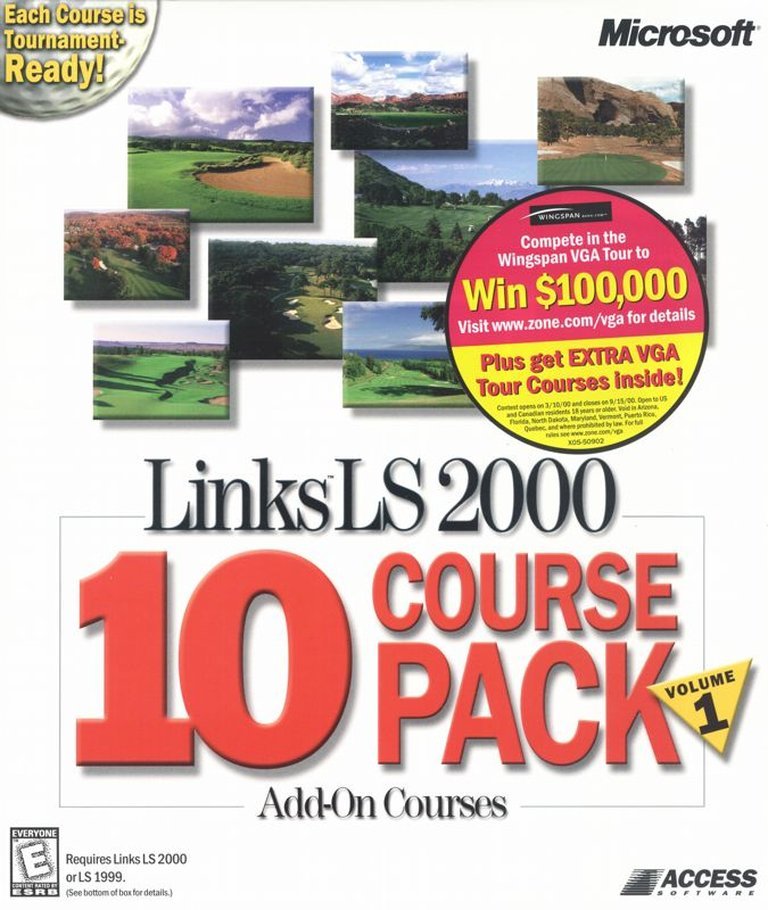
Links LS 2000: 10 Course Pack is an expansion add-on for the golf simulation game Links LS 2000, featuring ten fully designed courses including real-world locations like Pinehurst No. 2, Firestone Country Club, and Kapalua Plantation, alongside fantasy creations like Three Canyons. Released in 2000 for Windows, this CD-ROM compilation enhances gameplay with upgraded courses optimized for the Links 2000 engine while remaining compatible with Links LS 1999. Ideal for golf enthusiasts seeking variety, the pack offers a cost-effective way to expand their virtual golfing experience without requiring additional hard drive space.
Links LS 2000: 10 Course Pack Cracks & Fixes
Links LS 2000: 10 Course Pack Reviews & Reception
mobygames.com (80/100): This add-on for Links LS 2000 includes the following fully featured courses: Bountiful Golf Club, Castle Pines Golf Club, Entrada at Snow Canyon, Firestone Country Club, Kapalua Plantation, Kapalua Village, Latrobe Country Club, Pinehurst NO. 2, Sea Island (The Cloister), and Three Canyons Fantasy Course.
gamepressure.com (72/100): Links LS 2000: 10 Course Pack is the first official extension to the 1999 release of Links LS 2000. The intention of developers from Access Software studio was to enrich the gameplay with new arenas of virtual golfers’ struggles.
gamespot.com : Links LS 2000 is indeed a different game from its predecessor. But its additional features are so unimpressive both in quantity and quality that there’s simply not much reason for owners of the previous version to get excited.
Links LS 2000: 10 Course Pack: Years Later, Is Microsoft’s Golf Expansion Still a Hole-in-One?
Introduction
In an era before ubiquitous digital marketplaces, Links LS 2000: 10 Course Pack (2000) symbolized a transitional moment in PC gaming: the rise of expansion packs as gateways to extended play. Developed by Access Software (fresh off its acquisition by Microsoft) and priced at a budget-friendly $20, this compilation targeted golfers craving fresh digital terrain. But does it hold up as more than a nostalgic artifact? Through the lens of archival criticism, this review argues that the 10 Course Pack epitomizes early-2000s iterative design—offering undeniable value for newcomers while testing the patience of series veterans.
Development History & Context
The Access Software-Microsoft Synergy
Released in February 2000, the 10 Course Pack arrived just four months after Links LS 2000’s debut. Access Software—founded in 1982 and renowned for pioneering golf sims like Links 386 Pro—found itself under Microsoft’s wing after a 1999 buyout. This corporate shift prioritized rapid iteration: Links LS 2000 itself was criticized as a minor upgrade over LS 1999, with 70% of its codebase reused (per PC Accelerator). The 10 Course Pack emerged as a stopgap to bolster content while the team prepped Links 2001.
Technological Constraints and Market Pressures
Late-90s PC hardware limitations shaped the pack’s design. With Pentium II 300MHz CPUs and 64MB RAM as baseline specs, courses like Firestone Country Club prioritized efficient asset reuse—textures were upscaled from LS 1999 assets, and golfer models remained stiffly digitized sprites. Competing against Jack Nicklaus 6: Golden Bear Challenge—which featured a course editor—Microsoft doubled down on licensed real-world courses to leverage brand recognition. Short dev cycles (the pack went gold in January 2000) left little room for innovation beyond a $20 price point.
Narrative & Thematic Deep Dive
The “Story” of Place
Unlike RPGs or adventure titles, 10 Course Pack derives narrative weight from environmental storytelling. Each course embodies a distinct geographical and design ethos:
– Pinehurst No. 2: A tribute to Donald Ross’s strategic bunkering, evoking early 20th-century golf’s “steepled church” mystique.
– Three Canyons Fantasy Course: A volcanic, crater-laden landscape that channels Jurassic Park-era exoticism, contrasting starkly with real-world locales.
– Latrobe Country Club: Arnold Palmer’s redesigned home course, presented in summer/fall variants to emphasize seasonal atmosphere.
Thematic throughlines emerge: tradition vs. fantasy, natural beauty vs. sculpted challenge. By excluding a campaign or golfer backstories, the pack fixates on golf as a solitary dialogue between player and terrain—a design choice mirroring pre-Tiger Woods PGA Tour sim austerity.
Gameplay Mechanics & Systems
Iterative, Not Revolutionary
As an expansion, 10 Course Pack inherits LS 2000’s core mechanics:
– Three Swing Systems: From arcade-style “Easy Swing” to the nuanced “PowerStroke” mouse-gesture system (praised by Electric Games for its “non-real-time precision”).
– Adjustable Conditions: Wind, fog, and the new “SkyScape” cloud-density slider dynamically alter shot calculus.
– Multiplayer: MSN Gaming Zone support enables 4-player tournaments, though lag plagued real-time play (GameSpot noted “considerable delays”).
Critically, no new modes or golfer animations were added—this is a content dump, not a systemic overhaul. The sole innovation was tournament dressing: crowds, leaderboards, and broadcast towers adorned courses to evoke televised PGA events.
Value Proposition and Pain Points
At $2 per course, the math was compelling—but caveats abounded:
– Redundancy: Veterans who owned prior Links DLC (e.g., 5-Course Library Vols. 1-4) already had Bountiful Golf Club and Firestone.
– Storage Savvy: Courses ran directly from the CD-ROM to conserve HDD space—a godsend for era-constrained 4GB drives.
– No Course Editor: A glaring omission next to rivals like Jack Nicklaus 6, limiting creative replayability (PC Zone called this “unforgivable”).
World-Building, Art & Sound
Aesthetic Triumphs and Limitations
10 Course Pack’s visual philosophy balanced photorealism and technical pragmatism:
– Environmental Fidelity: Sports Gaming Network lauded Castle Pines’ “cliffside tee shots” and Entrada’s red-rock canyons, rendered with era-leading texture detail.
– Static Flaws: Water remained unnervingly placid; trees resembled “Sega Genesis-era bitmaps” (PC Accelerator), and crowds were low-res “wax figures” (IGN).
Sound design proved divisive:
– Commentary: David Feherty and Craig Bolerjack’s quips recycled LS 2000’s sparse, often-silent audio clips.
– Ambience: Wind howled authentically across Kapalua Plantation, but Macworld noted abrupt sound cuts after putting.
The Fantasy Exception
Three Canyons stood out—its lava flows and vertiginous drops showcased Access’s flair for imaginative design, presaging later fantasy courses in Tiger Woods PGA Tour.
Reception & Legacy
Contemporary Reviews: A Split Verdict
- Critical Response: Earned 80% from Electric Games, praising “a good deal at $2 per course” but docked points for rehashes.
- Player Reception: MobyGames user scores averaged 2.8/5, with complaints about “cash-grab” repetition (via archival forum posts).
Industry Impact
The pack’s legacy is twofold:
1. DLC Precursor: It normalized affordable expansions, echoing today’s course packs in PGA Tour 2K23.
2. Preservation Challenges: Lack of digital re-releases (absent from GOG or Steam) renders it a physical-media relic.
Microsoft’s 2001 shift to console-focused Links titles marked the end of this PC-centric era—but modding communities still update these courses for emulation.
Conclusion
Links LS 2000: 10 Course Pack is a time capsule of transitional design. For $20, it delivered ten meticulously crafted courses that blended real-world reverence with bold fantasy—yet its lack of innovation, reuse of legacy assets, and absence of a course editor underscored Microsoft’s risk-averse post-acquisition strategy. Today, it remains essential for golf sim historians and newcomers seeking budget-friendly depth, but emblematic of an era when “more content” often trumped “meaningful evolution.” In the pantheon of golf games, it’s a solid par—not an eagle, but far from a bogey.
Final Verdict: A worthwhile artifact for collectors and casual players, but a missed opportunity for transformative ambition.