
- Release Year: 2009
- Platforms: Nintendo DS, Windows
- Publisher: Crimson Cow GmbH, Focus Home Interactive SAS
- Developer: Péndulo Studios, S.L.
- Genre: Adventure
- Perspective: Third-person
- Game Mode: Single-player
- Gameplay: Graphic adventure, Puzzle elements
- Average Score: 84/100
Description
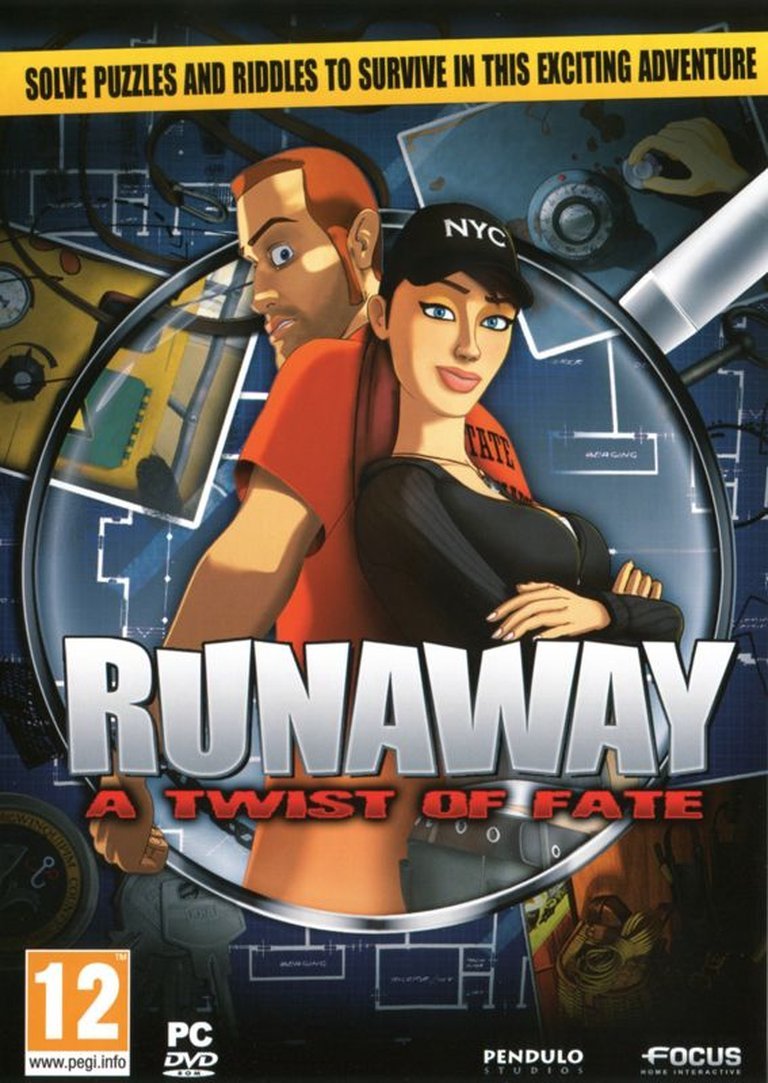
Runaway: A Twist of Fate is the third installment in the Runaway series, blending mystery and humor in a graphic adventure. The story follows Brian Basco, who awakens in an asylum with amnesia, accused of murder, while his partner Gina Timmins begins her journey at his graveside—only to unravel a deeper conspiracy. Players alternate between Gina’s investigations in the present and flashbacks revealing Brian’s lost memories, solving intricate inventory puzzles and interacting with quirky characters. Retaining the series’ signature humor and point-and-click mechanics, the game features optional comedic interactions, a hint system, and platform-specific adaptations, such as stylus-driven controls on the Nintendo DS version.
Gameplay Videos
Where to Buy Runaway: A Twist of Fate
PC
Runaway: A Twist of Fate Free Download
Runaway: A Twist of Fate Cracks & Fixes
Runaway: A Twist of Fate Patches & Updates
Runaway: A Twist of Fate Guides & Walkthroughs
Runaway: A Twist of Fate Reviews & Reception
metacritic.com (79/100): It’s an instant classic, not less.
Runaway: A Twist of Fate: Review
Introduction
In the golden era of point-and-click adventures, few series captured the blend of screwball comedy and noir intrigue as vibrantly as Pendulo Studios’ Runaway trilogy. Runaway: A Twist of Fate (2009), the capstone to Brian Basco and Gina Timmins’ misadventures, arrives not with a whimper but a fake funeral—a bold narrative stroke emblematic of its audacious spirit. This review argues that A Twist of Fate is both a redemption arc for its creators and a masterclass in refined adventure design, marrying Pendulo’s signature humor with a structurally ingenious plot. While it doesn’t escape the genre’s occasional absurdities, it remains a poignant farewell to a franchise that defined a decade of Spanish game development.
Development History & Context
Studio Vision & Challenges
Pendulo Studios, founded in 1994, had already cemented its reputation with the first two Runaway titles (A Road Adventure in 2001 and The Dream of the Turtle in 2006). However, the team was notoriously dissatisfied with Runaway 2, citing rushed development and convoluted puzzles that alienated players. For A Twist of Fate, director Ramón Hernáez sought to course-correct by emphasizing narrative coherence and player accessibility. Originally conceived as Runaway 3 with a Japan-set storyline at its 2007 Games Convention reveal, the project was retooled into a “standalone sequel” to attract newcomers.
Technological Constraints & Innovations
Built on a revamped engine, the game retained its 2D pre-rendered backdrops but introduced higher-resolution assets and smoother animations. Pendulo faced criticism for delaying the Spanish release until March 2010 (months after its European debut), a move compounded by their previous controversies. To mollify fans, a “Gina Forever” collector’s edition—featuring alternate cover art and a New York shopping spree lottery—was distributed. The Nintendo DS port (2010) streamlined interactions with stylus-based hotspot highlighting but sacrificed voice acting depth.
Industry Landscape
Released in late 2009 amid a resurgent interest in narrative-driven indies (Machinarium, The Whispered World), A Twist of Fate stood out for its cinematic aspirations. Yet it also contended with waning commercial enthusiasm for traditional adventures, a factor that’d later influence Pendulo’s pivot toward casual mobile spin-offs like Hidden Runaway (2012).
Narrative & Thematic Deep Dive
Plot Mechanics & Structure
The game opens audaciously at Brian’s funeral—a feigned death to escape a psychiatric ward where he’s institutionalized for Colonel Kordsmeier’s murder. Players alternate between Gina’s present-day investigation and Brian’s asylum-break flashbacks, unraveling a conspiracy involving alien tech, mind-control devices, and the mercenary Tarantula. This dual-timeline structure not only resolves Runaway 2’s cliffhanger but subverts expectations by making Gina the primary protagonist early on.
Character Evolution
Gina, previously relegated to damsel-in-distress tropes, emerges as a witty, resourceful lead—pole-dancing past acknowledged but not exploited. Brian’s amnesia-driven vulnerability humanizes him, while supporting characters like Gabbo (a Steve Buscemi-esque asylum artist) inject dark humor. Pendulo’s exhaustion with Brian’s character—evident in a staff anecdote about “applause” for his faux burial—ironically fuels the narrative’s introspective tone.
Themes & Dialogue
Thematically, A Twist of Fate critiques institutional corruption and the fragility of memory. Brian’s hypnosis sessions reveal how trauma distorts truth, while Tarantula’s betrayal underscores capitalist greed. Dialogue, praised by GameBoomers as “spitzfindig” (sharp-witted), balances slapstick (Gabbo’s compulsive “Banana!” interjections) with noir gravitas. However, Adventure Gamers noted inconsistencies, with some exchanges leaning into “awkward potty humor.”
Gameplay Mechanics & Systems
Core Loop & Puzzle Design
Pendulo addressed Runaway 2’s most infamous flaw—Korzysta’s time fork—by prioritizing logical puzzle chains. A cemetery sequence requiring Gina to summon a Swedish ghost for translation epitomizes their refined approach: absurd yet self-aware, with a punchline exposing the medium’s fraudulence. Inventory puzzles, like replicating Brian’s corpse with Kurgan’s decapitated body, reward macabre creativity but occasionally stumble into moon logic (e.g., using a hobo’s dentures to disable lasers).
UI & Accessibility
The PC version’s hotspot highlighter and context-sensitive cursor streamlined exploration, while a revolutionary hint system framed help requests as calls to “Joshua,” a Pendulo employee parodying tech support. This meta-comedy, coupled with fast travel between areas, welcomed newcomers without alienating purists. The DS port simplified interactions but reduced voice acting by 30%, diluting character dynamics.
Flaws & Innovations
While GameStar lauded its “modern classic” sensibilities, critics lambasted abrupt difficulty spikes (e.g., Chapman’s murder reconstruction) and technical bugs, including save-file corruption on multi-monitor setups. The 10-hour runtime, though brisk, left subplots like Brian’s parents’ absence unresolved.
World-Building, Art & Sound
Visual Identity
A Twist of Fate’s art direction melds comic-book aesthetics with noir shadows. Asylum cells and NYC alleyways exude claustrophobia via dim lighting and skewed angles, while cel-shaded character models (rendered in 3D) animate with Broadway-esque exaggeration. PC Games praised “cineastische Zwischensequenzen” (cinematic cutscenes), particularly Brian’s hallucinatory Mala Island flashbacks.
Soundscape
Vera Dominguez’s bluesy theme song bookends the tragedy, while diegetic sounds—seagulls in diners, buzzing asylum fluorescents—anchor surreality. Voice acting drew mixed responses: David Gasman’s Brian (recast from earlier titles) split fans, but Gina’s new actress earned plaudits for balancing sarcasm and sincerity. The DS version’s compressed audio, however, muted emotional beats.
Atmosphere
The game’s tonal shift—from Runaway 2’s tropical escapism to urban paranoia—echoes Film Noir conventions. Hardcore Gaming 101 likened its final chapter’s rain-soaked streets to “a Chandler novel,” complete with fedora-clad detectives and shadowy conspiracies.
Reception & Legacy
Launch Reception
Critics hailed A Twist of Fate as Pendulo’s pinnacle, earning an 84% average on MobyGames and Metacritic scores of 79 (PC) and 66 (DS). Adventurespiele declared it “unequivocally the best in the series,” applauding its “seamless” hint integration. Detractors (GameSpot, 6/10) critiqued archaic design and “stretched” dialogue. Commercially, the trilogy surpassed 1.5 million sales by 2010, with 11,348 units sold at full price in Spain alone.
Long-Term Influence
Though Pendulo retired the franchise citing creative burnout—Rafael Latiegui lamented, “We needed a break after a decade”—the game’s legacy endures. It ranked #97 on Adventure Gamers’ 2011 all-time list, while its iOS port (2013) introduced the series to mobile audiences. Modern indies like Thimbleweed Park echo its meta-humor, though none replicate its Iberian irreverence.
Conclusion
Runaway: A Twist of Fate is a triumphant, if flawed, farewell to one of adventure gaming’s most idiosyncratic sagas. Its interwoven narratives, polished puzzles, and stylistic confidence mark Pendulo’s maturation, even as lingering bugs and rushed pacing betray the studio’s fatigue. For all its fake deaths and alien MacGuffins, the game’s heart lies in Gina’s evolution from punchline to protagonist—a twist that redeems not just Brian, but the series itself. Though overshadowed by genre titans like Monkey Island, A Twist of Fate remains a cult gem: a raucous, heartfelt epitaph for an era when point-and-click ruled.
Verdict: 4/5 – A flawed yet essential send-off for fans, blending noir ambition with Pendulo’s signature wit.