
- Release Year: 2014
- Platforms: Windows
- Publisher: Kalypso Media Digital Ltd.
- Developer: Longbow Digital Arts Inc.
- Genre: Strategy, Tactics
- Perspective: Diagonal-down
- Game Mode: Single-player
- Gameplay: Wargame
- Setting: Ancient Roman, Classical antiquity, War
- Average Score: 71/100
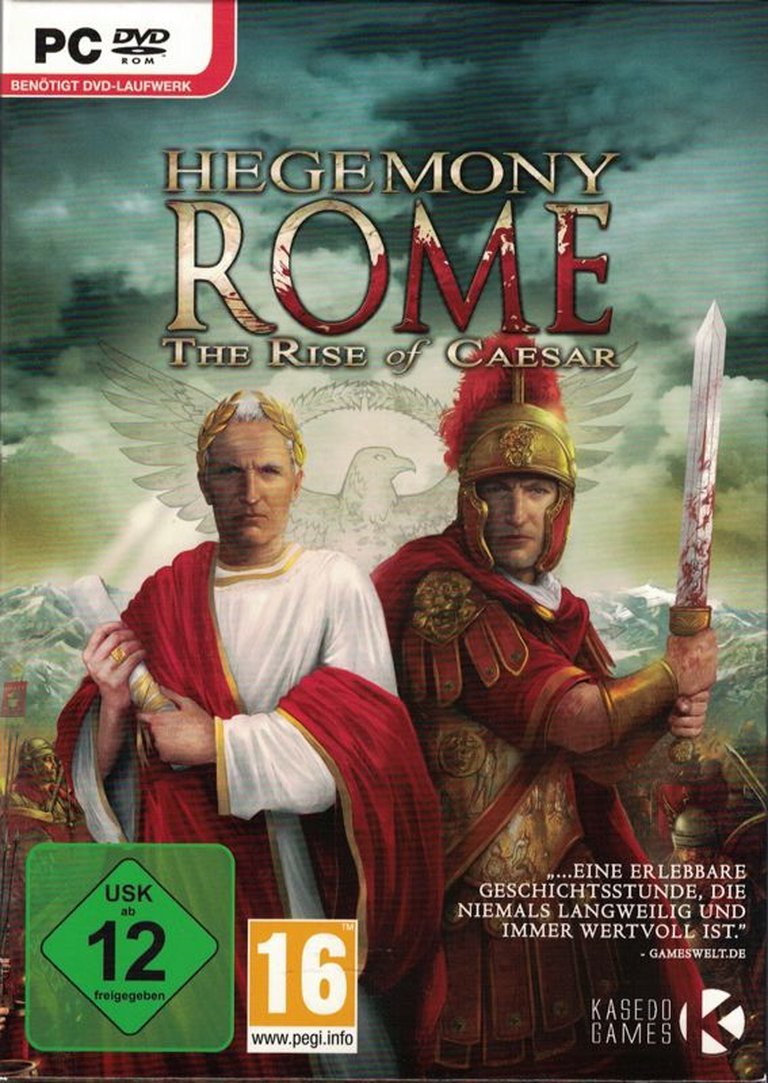
Description
Hegemony Rome: The Rise of Caesar is a real-time strategy game set in classical antiquity, focusing on the rise of Julius Caesar. The game emphasizes tactical warfare and logistics, allowing players to manage small units and build a vast empire. It reinvents the genre by prioritizing strategic depth over flashy graphics, offering a unique and challenging experience for hardcore strategists.
Gameplay Videos
Where to Buy Hegemony Rome: The Rise of Caesar
Hegemony Rome: The Rise of Caesar Cracks & Fixes
Hegemony Rome: The Rise of Caesar Reviews & Reception
en.wikipedia.org (60/100): The game is repetitive though it scales up the challenge.
metacritic.com (82/100): It throws out pretty much everything you thought you knew about Real‑Time Strategy and then reinvents the genre.
Hegemony Rome: The Rise of Caesar Cheats & Codes
PC
Press F2 to bring up console
| Code | Effect |
|---|---|
| getplayerfaction():givegold(#) | gives a certain number of gold |
| getselected():capture() | flips selected object to player faction |
| getselected():giveresource(“supplies”, #) | gives a certain number of food to a selected settlement |
| getselected():giveresource(“wood”, #) | gives a certain number of wood to a selected settlement |
| getselected():giveresource(“recruits”, #) | gives a certain number of recruits to a selected settlement |
| getselected():giveupgrade(“upgrade#”) | gives selected brigade upgrade level # |
| getselected():givexp(#) | gives selected brigade a certain number of xp |
| getselected():addunits(#) | adds a number of units to brigade; can go above maximum for brigade |
| brigadehere(“BrigadeNameHere”) | creates a brigade where the cursor is |
| getselected():setfaction(getplayerfaction()) | sets a settlement or brigade to player faction |
Hegemony Rome: The Rise of Caesar: Review
Introduction
In the pantheon of historical strategy games, Hegemony Rome: The Rise of Caesar (2014) stands as a bold experiment—a title that dared to redefine real-time strategy (RTS) by emphasizing logistics, granular control, and historical immersion over spectacle. Developed by Longbow Digital Arts, this sequel to Hegemony Gold: Wars of Ancient Greece invites players to relive Julius Caesar’s brutal conquest of Gaul, weaving grand strategy with tactical precision. While critics were divided on its execution, the game’s ambition to simulate the grind of ancient warfare—where supply lines matter as much as swords—secured its place as a cult classic. This review argues that Hegemony Rome is a flawed gem, offering unparalleled strategic depth for patient commanders but stumbling under the weight of its own scope.
Development History & Context
Longbow Digital Arts, a Canadian studio founded by Jim McNally and Rob McConnell, carved a niche with the Hegemony series by blending real-time tactics with empire management. Released in 2014, Hegemony Rome arrived during a resurgence of historical strategy games, competing with titans like Total War: Rome II (2013). However, Longbow’s vision diverged sharply: instead of cinematic battles, they prioritized a “satellite-accurate” map spanning one million square kilometers, from the Rhine to Britannia, and a logistics system modeling Caesar’s famed ingenuity.
Technological constraints of the era limited graphical fidelity—textures were rudimentary, and unit animations lacked polish—but the studio leveraged their proprietary engine to enable seamless zoom between strategic overviews and individual battlefields. While ambitious, the game’s development faced challenges. Early access feedback cited bugs and repetitive gameplay, which persisted at launch. Yet, Longbow’s commitment to historical authenticity, drawing directly from Commentarii de Bello Gallico, lent the project a scholarly gravitas rare in the genre.
Narrative & Thematic Deep Dive
Hegemony Rome structures its campaign into four chapters mirroring Caesar’s memoirs: “Emigrants and Conquerors,” “The Most Courageous of All,” “Conquer the Island,” and “The Power of Desires.” Players begin by repelling the Helvetii migration, then crush Belgian revolts, invade Britain, and finally confront Vercingetorix’s Arverni confederation. This narrative scaffolding excels in historical pedagogy, meticulously recreating events like the bridging of the Rhine or the siege of Alesia.
Themes of Roman supremacy and the “civilizing” brutality of empire permeate the story. Caesar himself is voiced with imperial gravitas (Gareth Armstrong in English, Wolf Frass in German), though supporting characters are thinly developed. Dialogue is functional, serving tactical objectives rather than dramatic arcs. The real narrative depth emerges through gameplay: players experience the cost of conquest. Starving out rebellious tribes, managing seasonal attrition, and pacifying distant provinces evoke the Sisyphean grind of empire-building.
Gameplay Mechanics & Systems
At its core, Hegemony Rome is a game of control—over resources, terrain, and time. Key mechanics include:
Logistics & Supply Lines
The game’s standout innovation is its supply system. Armies require food carried by mule trains, and depots must be built along advance routes. Sieges involve encircling settlements to cut off supplies, mirroring Caesar’s tactics. Neglecting logistics risks starvation or mutiny, adding visceral stakes to campaigns.
Construction & Resource Management
Wood, a new resource, enables building forts, bridges, and watchtowers. Players sculpt the landscape to secure territories, though micromanaging construction across vast maps grows tedious. Cities can be upgraded with farms, barracks, and markets, but lacks the depth of Caesar III-style city-building.
Unit Progression & Tactics
Units gain experience and unlock upgrades like “marsh mobility” or “scorched earth.” Officers and governors provide passive buffs, but combat itself is underwhelming. Battles devolve into blob-on-blob clashes, with pathfinding issues and rudimentary AI dampening tactical nuance.
UI & Accessibility
The interface is cluttered, burying critical information under nested menus. While the tutorial sandbox mode helps, the learning curve remains steep.
World-Building, Art & Sound
Hegemony Rome’s world is its crowning achievement. The map—woven from satellite data—boasts forests, rivers, and mountains that shape strategy. Zooming from a continent-wide view to individual soldiers tending crops creates an unparalleled sense of scale.
Visually, the game is a mixed bag. Terrain detail improved tenfold over its predecessor, but unit models are dated, and animations lack flair. The art style leans utilitarian, evoking a digital diorama more than a cinematic spectacle.
Sound design is functional: clashing swords and marching legions meet expectations, while a subdued score blends Greco-Roman instrumentation with ambient tones. Voice acting, particularly Caesar’s imperious dispatches, elevates the atmosphere, though repetitive barks from advisors grate over time.
Reception & Legacy
Critics praised Hegemony Rome’s ambition but lamented its uneven execution. Hooked Gamers awarded it 82%, heralding it as a genre-redefining triumph, while GameSpot (50%) called it “mediocre” and repetitive. The German GameStar (40%) skewered its “unfinished” feel, yet praised its logistical realism. User reviews on Steam remain “Mixed” (60% positive), with fans touting its immersive campaigns and critics decrying clunky combat.
Legacy-wise, the game influenced later titles like Field of Glory: Empires (2019) with its supply mechanics, but its commercial underperformance relegated it to niche status. Three DLC packs—Bannermen, Advanced Tactics, and Mercenaries—added cosmetic and unit variety but failed to address core issues.
Conclusion
Hegemony Rome: The Rise of Caesar is a paradoxical masterpiece. It succeeds brilliantly as a historical simulator, demanding players think like Caesar—calculating, resourceful, ruthless—but falters as a polished RTS. Its粗糙 edges—repetitive battles, a steep learning curve, and technical hiccups—may deter casual strategists, yet for history buffs and logistics fetishists, it remains unmatched.
In the annals of video game history, Hegemony Rome is no Total War killer. But as a labor of love—an ode to the unglamorous work of empire—it deserves recognition. Longbow Digital Arts crafted a game that feels less like play and more like governing, and therein lies its enduring, if flawed, genius.
Final Verdict: A niche triumph—best suited for patient commanders willing to trade spectacle for substance.