
- Release Year: 2002
- Platforms: Windows
- Publisher: Blackstar Interactive GmbH
- Genre: Strategy, Tactics
- Perspective: Third-person
- Game Mode: Hotseat, Single-player
- Gameplay: Game show, quiz, trivia
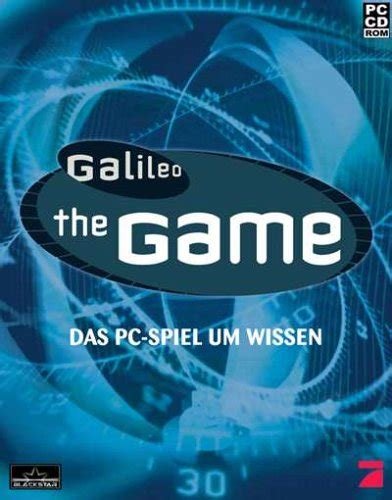
Description
Galileo: The Game is a strategy-based quiz game inspired by the German TV show of the same name. Players compete in three rounds, answering trivia questions and solving logic puzzles to win money. The first round involves answering ten questions in ten seconds each, with spare time credited as points. The second round uses the accumulated time from the first round to answer twelve questions. The final round features intelligence quotient tests, such as completing numerical series or anagrams. The game includes 2500 questions and an online high-score list.
Galileo: The Game Reviews & Reception
spielmonster.de : Sieht man einmal von dem wirklich unübersichtlichen Spielplan ab, ist ‘Galileo – The Game’ ein unterhaltsames und brauchbares Quizspiel, welches besonders für Familien geeignet ist.
Galileo: The Game: Review
Introduction
In the early 2000s, licensed video games based on TV shows were a dime a dozen, but few sank into obscurity as swiftly as Galileo: The Game. Developed by Blackstar Interactive GmbH and released in 2002, this digital adaptation of the popular German infotainment quiz show Galileo promised to bring scientific trivia and logic puzzles to PC screens. Instead, it became a cautionary tale of how poor execution can undermine even the most straightforward concepts. This review dissects Galileo: The Game’s failures and fleeting merits, arguing that while it mechanically replicates its source material, its lifeless presentation and technical shortcomings render it a footnote in gaming history.
Development History & Context
Studio and Vision
Blackstar Interactive GmbH, a now-defunct German studio, specialized in licensed games and educational software. Their vision for Galileo: The Game was to translate the show’s blend of science, trivia, and competition into a multiplayer-friendly experience. However, the studio’s ambition clashed with the era’s technological constraints. Released exclusively on Windows via CD-ROM, the game’s budget limitations are evident in its sparse production values.
Gaming Landscape
The early 2000s saw a surge in quiz and trivia games, such as Who Wants to Be a Millionaire?, which leveraged TV show popularity to attract casual audiences. Galileo: The Game aimed to capitalize on this trend but lacked the polish of its contemporaries. Its release alongside compilations like Totally TV (2002) further cemented its status as a low-priority title.
Narrative & Thematic Deep Dive
Structure and Tone
As a quiz show adaptation, Galileo: The Game forgoes traditional narrative for three structured rounds:
1. Speed Round: Players answer 10 questions in 10 seconds each, banking unused time.
2. Timed Round: Contestants use their saved time to answer 12 questions.
3. Puzzle Finale: Logic-based challenges, such as numerical sequences or anagrams, determine the winner.
The game leans into the show’s educational ethos, with questions spanning science, nature, and general knowledge. However, its sterile presentation strips away the show’s dynamic energy. As Computer Bild Spiele noted, the absence of a charismatic host or audience interaction reduces the experience to a “lifeless spreadsheet of questions.”
Missed Opportunities
Thematically, Galileo: The Game could have explored the tension between speed and accuracy or the psychology of competition. Instead, it offers no commentary beyond its mechanical framework, opting for a repetitive loop of trivia and puzzles.
Gameplay Mechanics & Systems
Core Loop
The game’s structure is its sole strength. The banking of time in Round 1 adds mild strategy, incentivizing players to balance speed and precision. Round 3’s puzzles, while simplistic, provide a welcome break from trivia.
Flaws and Frustrations
- Answer Rigidity: Critics like GameStar lambasted the “penalizing” answer system, which rejected minor typos (e.g., “Abudhabi” vs. “Abu Dhabi”).
- Repetition: With only 2,297 of the promised 2,500 questions (Computer Bild Spiele), cycles of duplicate queries quickly emerged.
- UI Issues: Players reported disappearing scoreboards (Computer Bild Spiele) and a clunky hot-seat multiplayer setup.
Multiplayer
The 1-3 player hot-seat mode is functional but devoid of engagement, lacking even basic animations to celebrate correct answers.
World-Building, Art & Sound
Visual Design
Galileo: The Game’s aesthetics were universally panned. PC Games mocked its “grotesque” presentation: static, poorly cropped photos of contestants cycled through four emotions (neutral, thoughtful, happy, sad). The UI resembled a rushed PowerPoint slide, with minimal effort invested in transitions or visual flair.
Sound Design
The game’s silence is deafening. No host commentary, no crowd cheers, not even background music—a stark contrast to the TV show’s lively atmosphere. Computer Bild Spiele summed it up: “Totenstille” (dead silence).
Reception & Legacy
Critical Panning
The game scored an abysmal 46% average from critics (MobyGames), with complaints centering on its “unfinished” feel (PC Games) and “belanglos” (trivial) content (GameStar). Player reviews averaged 2.3/5, highlighting its niche appeal.
Cultural Impact
Galileo: The Game left no mark on the industry. Its legacy lies in illustrating the pitfalls of rushed licensed games. Unlike Buzz! or Jeopardy!, it failed to innovate or capitalize on its IP, fading into abandonware obscurity.
Conclusion
Galileo: The Game is a case study in missed potential. While its three-round structure and logic puzzles hint at a competent trivia game, its execution—marred by technical flaws, barren presentation, and repetitive design—dooms it to mediocrity. For historians, it serves as a reminder of the early 2000s’ licensed-game glut; for players, it’s a relic best left undisturbed.
Final Verdict: A forgettable cash-in that even die-hard Galileo fans would struggle to love. 2/5.