
- Release Year: 1999
- Platforms: Windows 16-bit, Windows
- Publisher: Holger Priebs
- Developer: Holger Priebs
- Genre: Puzzle
- Perspective: Text-based / Spreadsheet
- Game Mode: Single-player
Description
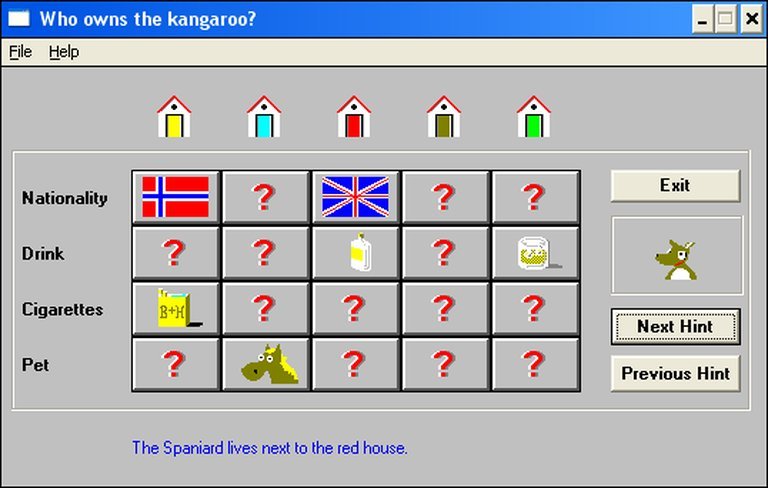
Who Owns the Kangaroo? is a text-based puzzle game released in 1999 for Windows. Players must determine which of five differently colored houses is home to the kangaroo by uncovering details about the pet owners. Each house has residents with unique nationalities, drinks, cigarettes, and pets. The game provides hints to help players deduce the correct information, making it a challenging and engaging logic puzzle.
Who owns the kangaroo?: Review
Introduction
In the late 1990s, as the gaming industry raced toward 3D graphics and cinematic storytelling, a modest German-developed puzzle game quietly asked players a deceptively simple question: Who owns the kangaroo? Released in 1999 as freeware, this text-based logic puzzle offered no flashy visuals or epic narratives—just a cerebral challenge rooted in deduction. While largely forgotten today, the game stands as a fascinating artifact of an era when indie developers experimented with minimalist design and constrained resources. This review argues that Who owns the kangaroo? is a clever, if underappreciated, homage to classic logic puzzles, offering a pure distillation of problem-solving satisfaction despite its technical limitations.
Development History & Context
Studio & Vision
Developed by Holger Priebs, a programmer with credits on four other niche titles, Who owns the kangaroo? emerged from a DIY ethos emblematic of late-’90s freeware. Priebs collaborated with M. Westphal, who contributed portions of the code via a 1995 toolbox—a detail suggesting the game’s foundations were built on recycled or repurposed software. The lack of a named writer for its “story” underscores its focus on mechanics over narrative.
Technological Constraints
Released for Windows (including a 16-bit version), the game’s spreadsheet-like interface and fixed/flip-screen visuals reflect the limitations of its era. Designed for keyboard and mouse input, it sidestepped the need for advanced graphics or sound hardware, making it accessible to users with older systems. Its freeware model—distributed as a downloadable .exe file—placed it alongside shareware curios of the time, such as Dwarf Fortress’s early prototypes.
Gaming Landscape
In 1999, the industry was dominated by titles like Half-Life and Final Fantasy VIII. Against this backdrop, Who owns the kangaroo? carved out a niche for players seeking cerebral challenges akin to newspaper logic grids or The 7th Guest’s puzzles stripped of their FMV theatrics.
Narrative & Thematic Deep Dive
Plot & Characters
The game dispenses with traditional storytelling: five houses, each inhabited by a man of distinct nationality, drink preference, cigarette brand, and pet (one of whom owns the titular kangaroo). The “plot” is purely systemic—a framework for deduction.
Themes
Beneath its austere premise lies a commentary on categorization and cultural stereotyping. By reducing identities to nationality, vices, and pets (e.g., “The Norwegian drinks water”), the game inadvertently mirrors early anthropological taxonomies—a quirky reflection of late-’90s Eurocentric perspectives.
Gameplay Mechanics & Systems
Core Loop
Players methodically replace question marks in a grid with correct answers across four categories:
1. Nationality
2. Drink
3. Cigarette brand
4. Pet (including the kangaroo)
Hints & Strategy
Clues like “The owner of the fox drinks beer” are limited, demanding careful cross-referencing. This scarcity forces players to treat each hint as a linchpin, akin to sudoku’s deductive reasoning. The difficulty escalates as overlapping variables create branching possibilities.
UI & Flaws
The interface is functional but barebones: a static grid reminiscent of Excel spreadsheets. While serviceable, the lack of undo/redo options or dynamic hint tracking could frustrate modern players.
World-Building, Art & Sound
Visual Design
The game’s “art” is its utilitarian grid—color-coded houses with text labels. This minimalism channels the aesthetic of early database software, evoking nostalgia for a pre-UI/UX-design era.
Sound Design
No audio elements are documented, suggesting a silent experience. This absence amplifies the game’s meditative, almost scholarly vibe.
Atmosphere
The austere presentation fosters a sense of isolation, as if the player is alone in a dimly lit library, scribbling notes on graph paper.
Reception & Legacy
Launch Reception
No critic or player reviews survive, placing it among gaming’s “lost media.” Its obscurity likely stems from its freeware status and lack of marketing.
Modern Reputation
Collected by just three players on MobyGames, the game remains a footnote—though its DNA can be traced to modern logic games like Return of the Obra Dinn or The Case of the Golden Idol.
Industry Influence
While not directly impactful, it exemplifies the DIY spirit that would later fuel indie darlings like Papers, Please.
Conclusion
Who owns the kangaroo? is a time capsule of late-’90s experimental game design—a no-frills celebration of deduction that sacrifices polish for purity. Its lack of accolades or fanfare only deepens its mystique: a hidden gem for puzzle purists, ripe for rediscovery. Though it will never dethrone Portal or The Witness, it deserves recognition as a minimalist triumph, proving that great games need not rely on spectacle. In the pantheon of puzzle classics, the kangaroo may not reign supreme, but it certainly hops its way into history.
Final Verdict: A charmingly austere logic puzzle that rewards patience—if you can find it.