
- Release Year: 1998
- Platforms: Macintosh, PlayStation, Windows
- Publisher: Hasbro Interactive, Inc., MacSoft
- Developer: Artech Digital Entertainment, Ltd.
- Genre: Puzzle
- Perspective: Third-person
- Game Mode: Single-player
- Gameplay: Game show, trivia, Word construction
- Setting: Game show
- Average Score: 80/100
Description
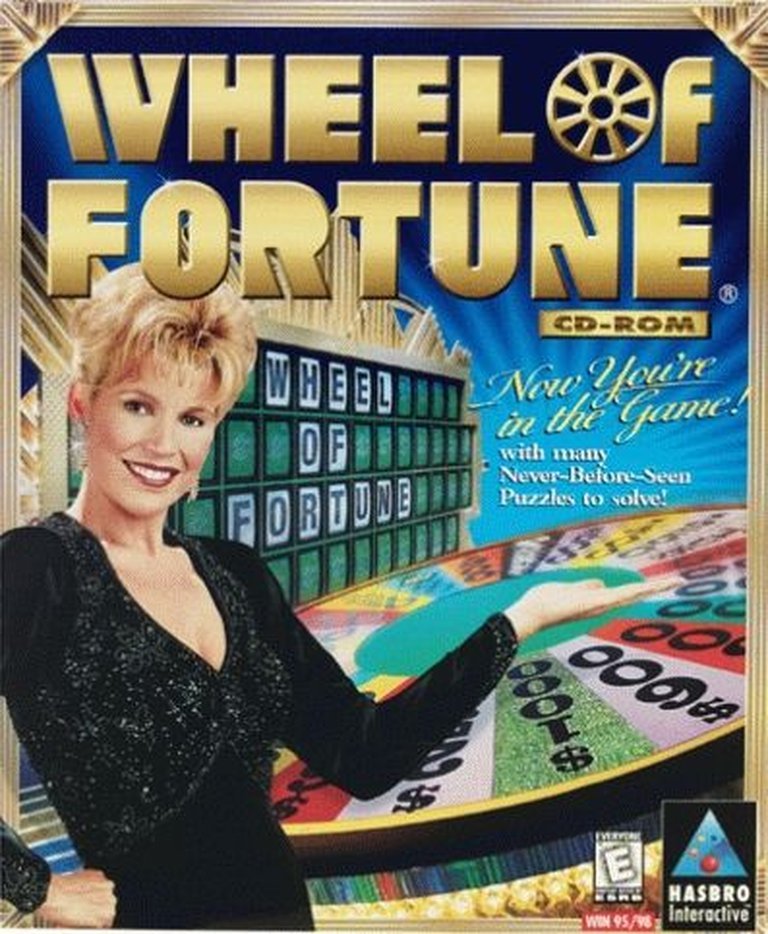
Based on the long-running TV game show, ‘Wheel of Fortune’ brings the signature puzzle-solving experience to PC, PlayStation, and Macintosh. Players spin a virtual wheel, guess letters, and solve word puzzles to win prizes, featuring over 2,000 puzzles and appearances by hostess Vanna White via FMV. A unique spin disk mechanic adds challenge—losing disks for incorrect guesses or penalties—until the game ends. Released in 1998, this licensed title captures the essence of the televised competition with trivia, wordplay, and game show flair.
Gameplay Videos
Where to Buy Wheel of Fortune
PC
Wheel of Fortune Mods
Wheel of Fortune Reviews & Reception
ign.com (80/100): With a slick 3D presentation, WHEEL OF FORTUNE plays and looks just like the real thing, which is a great bonus for fans of the television classic.
imdb.com : Wheel of Fortune is a fun game to play on the computer. I have two versions, this 1998 version and an older one from 1981. There’s one big thing with this one though, it cheats.
reddit.com : I think this is still the best video game adaptation they’ve released.
Wheel of Fortune Cheats & Codes
PC
While playing the game, go to “Solve Puzzle”
| Code | Effect |
|---|---|
| Shift + 2 | Automatically solves the puzzle and gives the player’s current money, or $200 if none |
Wheel of Fortune (1998): A Proto-Infotainment Pioneer Trapped by Its Own Ambition
Introduction
Since its television debut in 1975, Wheel of Fortune has embedded itself in American pop culture as a juggernaut of monosyllabic suspense and capitalist spectacle. When Hasbro Interactive and Artech Digital Entertainment translated the show into a 1998 video game adaptation, it was less a creative reinvention and more a meticulous facsimile—one both celebrated and shackled by its devotion to the source material. Here, we dissect this digital relic, arguing that while Wheel of Fortune (1998) succeeds as a functional tribute to televised game-show mechanics, its rigid design, technical compromises, and lack of innovation reveal the limitations of media symbiosis in the pre-online era.
Development History & Context
Studio Vision & Technological Constraints
Released amidst the PlayStation’s golden age and the burgeoning PC gaming market, Wheel of Fortune was conceived by Artech Digital Entertainment—a studio specializing in licensed titles—under Hasbro Interactive’s pragmatic mandate. Eric Hayashi (Senior Producer) and David Walls (Senior Designer) spearheaded a team of 88 credited developers, aiming to replicate the televised experience with eerie precision. The era’s constraints shaped the project: CD-ROM storage allowed for 2,000 puzzles and brief FMV clips of Vanna White—then Guinness World Record’s “Most Frequent Clapper”—while omitting host Pat Sajak, reportedly due to contractual disinterest. The PS1 version even utilized memory cards to track puzzle history, a forward-thinking touch.
Gaming Landscape
The late ’90s saw game-show adaptations (Jeopardy!, Who Wants to Be a Millionaire?) flood shelves as “casual” gateways for non-gamers. Wheel of Fortune entered a saturated but recession-proof niche, competing with edgier trivia hybrids like You Don’t Know Jack. Unlike Tiger Electronics’ handheld interactions or Mattel’s play-along modules, Artech’s version targeted living-room multiplayer—a precursor to modern family-friendly staples like Jackbox Party Pack.
Narrative & Thematic Deep Dive
A Mechanical Tapestry of Capitalism
Wheel of Fortune’s script is the antithesis of narrative-driven gaming. Its “story” is an algorithmic liturgy of consumerism: Contestants spin, speculate, and solve to accrue virtual cash and prizes (cars, vacations), echoing the American Dream’s lottery-logic. Vanna White’s FMV cameos as hostess/reified clapper serve as the game’s sole human anchor, reinforcing her role as the show’s totemic cheerleader—ironically voiceless, reduced to applause cycles.
Themes of Chance and Control
Beneath the neon veneer lies a Nietzschean tension: The wheel’s arbitrary stops—Bankrupt, Lose a Turn, the narcotic lure of $1,000+ wedges—mirror life’s destabilizing randomness. Players negotiate fate through consonant gambits, vowel investments ($250 to “buy” E), and strategic solves. Yet, as players noted in Reddit forums and IMDb critiques, the AI’s propensity to “cheat” (unexplained extra wheel nudges favoring CPU opponents) undermines fairness, exposing the artifice beneath stochastic illusion.
Gameplay Mechanics & Systems
Core Loop: Spin, Solve, Repeat
Artech’s design adhered to televised orthodoxy:
1. Spinning the wheel via mouse clicks or PlayStation controller flicks, landing on monetary values or penalties.
2. Letter guesses against category-based puzzles (e.g., “Phrase,” “Thing”).
3. Round progression through three main stages and a bonus round.
Innovations & Flaws
– FMV Integration: Vanna’s digitized presence offered nostalgic immersion but suffered era-typical choppiness.
– AI Contradictions: While critics (IGN, Gamezilla) praised its challenge, players lambasted AI “rigging” (e.g., CPU avoidance of Bankrupt).
– UI Clunk: The Mac version’s static wheel—devoid of spin physics—drained agency (macHOME, 2000).
– Game Modes: A “Tournament” mode with finite “spins” (losing turns consumed virtual tokens) added stakes but felt punitive.
Multiplayer Dynamics
Couch competition underscored the game’s ideal use-case—local multiplayer. Yet, as Computer Gaming World noted, an “unseen timer” penalized indecision, fracturing communal flow. The omission of Pat Sajak’s wry banter left interactions sterile, relying on canned audience gasps and Vanna’s looped gestures.
World-Building, Art & Sound
Visual Aesthetics: Plasticine Glamour
Artech’s 3D set replicated Merv Griffin’s studio in polygonal fidelity: A gaudy, Vegas-tier backdrop (gold trims, starbursts) surrounded contestants with chromatic intensity. PlayStation textures—pixelated yet vibrant—outshone the PC version’s flatter palette. However, “theme weeks” (Wild West, Paris) offered mere background swaps, lacking interactive flair.
Audio: A Symphony of Artificial Euphoria
Sound design mirrored the show’s Pavlovian cues:
– The wheel’s arrhythmic clicks and thuds.
– Vanna’s applause sampled like a broken toy.
– Charlie O’Donnell’s booming “Wheel… of… Fortune!” intro.
Yet, contestant voices—synthesized and uncanny—elicited derision (IGN: “unnatural-sounding”). The Sega CD port’s Red Book audio remains superior, leveraging CDDA for clearer voiceovers.
Reception & Legacy
Critical Dichotomy
Reviews split along platform lines:
– PlayStation (79% avg.): Praised for “3D presentation” (IGN) and accessibility (EGM: “entertains the whole family”).
– Windows (64% avg.): Derided as “lifeless” (GameSpot) and “unrewarding” without tangible prizes.
– Macintosh (65% avg.): Criticized for sluggish UI and “uninteresting” interfaces (Inside Mac Games).
Commercial Performance & Cultural Impact
Despite middling scores, the PlayStation version sold solidly, buoyed by Hasbro’s marketing. Its legacy is paradoxical: A preservation artifact of 1990s game-show mania, yet overshadowed by Ubisoft’s 2017 reboot (Wheel of Fortune for PS4/Xbox One) with online multiplayer. Later entries owe Artech’s template debts—puzzle databases, wheel physics—but iterated on its flaws, adding host banter (Pat Sajak in THQ’s 2010 Wii version) and AI fairness.
Industry Influence
The 1998 Wheel crystallized a template for licensed titles: Prioritize iconography over innovation. Yet, its memory-card tracking feature foreshadowed roguelike progression systems, while its FMV flirtations prefigured Her Story’s cinematic interplay.
Conclusion
Wheel of Fortune (1998) is a time capsule of analog spectacle digitized—neither triumph nor failure, but a fossil of media convergence. Its meticulous recreation of TV mechanics satisfied show devotees, yet its rigid design, uneven AI, and Vanna White’s spectral presence betrayed a lack of interactive vision. In hindsight, it exemplifies gaming’s “transitional object” phase, where licensed titles straddled education and entertainment without transcending either. For historians, it’s indispensable; for modern players, a curiosity. Final verdict: A passionate but half-turned letter in the annals of game-show adaptations.
Final Score: 6.5/10
👉 For trivia historians, not risk-takers.