
- Release Year: 2015
- Platforms: Linux, Macintosh, Windows
- Publisher: Legend Studio
- Developer: Legend Studio
- Genre: Puzzle, Role-playing (RPG)
- Perspective: Top-down
- Game Mode: Single-player
- Gameplay: Character classes, Leveling, Solitaire, Turn-based
- Setting: Fantasy
- Average Score: 75/100
Description
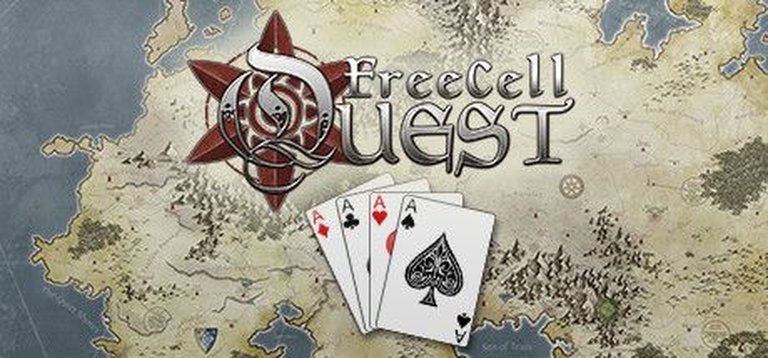
FreeCell Quest merges classic FreeCell Solitaire gameplay with RPG mechanics set in the fantasy continent of Selvarin. Players explore a map to liberate settlements from an evil archmage by engaging in strategic card battles – each victory requires solving FreeCell-style puzzles where cards cast harmful spells if left unsorted. Progression involves leveling up, purchasing armor to reduce damage, and learning spells that aid card organization, all while choosing among eight unique character classes. With over 500 increasingly challenging boards and loot-driven rewards, the game offers a fresh blend of puzzle-solving and role-playing strategy.
Gameplay Videos
Where to Buy FreeCell Quest
PC
FreeCell Quest Guides & Walkthroughs
FreeCell Quest Reviews & Reception
metacritic.com (80/100): Ultimately, FreeCell Quest is an enormous and very interesting take on a game that’s synonymous with wasting time on the PC.
store.steampowered.com : A great game that combines a solid and lovable card game with RPG features such as leveling up, gathering gold, and getting armor and spells.
twinfinite.net : FreeCell Quest is a curious RPG-framed take on the classic card game.
goldplatedgames.com : For what it is, FreeCell Quest looks and sounds fine.
FreeCell Quest: A Solitaire Odyssey Wrapped in RPG Armor
Introduction
In a digital landscape crowded with deck-building roguelikes and nostalgia-driven remakes, FreeCell Quest (2015) dared to ask: What if Windows’ most iconic time-waster became a full-fledged RPG? Developed by the indie studio Legend Studio, this quirky fusion of FreeCell solitaire and fantasy adventuring carved out a niche as both a love letter to classic card games and an experimental genre hybrid. While its execution is flawed, FreeCell Quest remains a fascinating artifact—a game that transforms the solitary act of card-stacking into a continent-spanning quest for liberation.
Development History & Context
Studio Vision: Legend Studio, a small team led by Bryan Livingston, sought to reimagine FreeCell—a game synonymous with procrastination—as a strategic RPG. Released on October 20, 2015, for Windows (later ported to macOS and Linux), the game emerged during an era when indie developers were aggressively remixing classic genres (Slay the Spire, Puzzle Quest). Built in Unity, FreeCell Quest prioritized accessibility over graphical ambition, leveraging the engine’s cross-platform capabilities to reach a broad audience.
Technological Constraints: The game’s minimalist art style and 2D interface reflect its budget, but also ensure compatibility with older systems. Twinfinite’s review noted its “surprisingly functional” design, a testament to Legend Studio’s focus on gameplay over polish.
Narrative & Thematic Deep Dive
Plot as a Pretext: The story of FreeCell Quest is a skeletal framework: an archmage conquers the continent of Selvarin, and you, a card-wielding wizard, must liberate its 533 towns and cities. There are no NPCs, cutscenes, or dialogue—only a map dotted with locations to “free” via FreeCell battles. The narrative exists solely to contextualize the gameplay loop, a missed opportunity for deeper world-building.
Themes of Mastery and Progression: The game’s true narrative lies in its progression systems. By defeating card-based “battles,” players gain levels, gold, and spells, echoing RPG tropes of empowerment. Themes of strategic discipline emerge: reckless card placement drains health, while meticulous planning rewards players with loot and new abilities.
Gameplay Mechanics & Systems
Core Loop: The game hinges on a simple premise: every location on Selvarin’s map is a FreeCell puzzle. Players sort cards into goal columns by suit and number while avoiding damage from “buried” cards that attack over time. Combat success unlocks new areas, creating a addictive loop of exploration and conquest.
RPG Integration:
– Class System: Eight classes (e.g., Warrior, Mage) offer bonuses like reduced damage or extra mana.
– Spells and Gear: Spells allow players to shuffle columns or teleport cards, while armor mitigates damage. Loot drops provide incremental stat boosts.
– Progression: With 500+ unique layouts and up to eight suits in late-game battles, difficulty escalates sharply.
Flaws and Innovations:
– Time Pressure: Steam reviewers criticized the stress of timed card attacks, which clash with FreeCell’s traditionally contemplative pacing.
– Bugs: Glitches, such as misplaced cards or broken spells, occasionally marred the experience (SteamBase reports 7% of reviews cited technical issues).
– Spell System: The inclusion of spells like “Column Shuffle” or “Card Reveal” adds tactical depth, pivoting FreeCell from pure puzzle-solving to resource management.
World-Building, Art & Sound
Aesthetic Pragmatism: FreeCell Quest opts for functional charm over visual splendor. The top-down map of Selvarin is colorful but rudimentary, evoking a board game more than a living world. Cards are brightly animated, and the UI prioritizes clarity—a necessity given the complexity of late-game boards.
Sound Design: The soundtrack, described as “relaxing” in 13% of Steam reviews, pairs folk-inspired melodies with subtle sound effects (e.g., card flips, spell casts). While unremarkable, it sustains the game’s low-stakes ambiance.
Reception & Legacy
Critical Response:
– Twinfinite awarded it 80%, praising its “enormous and very interesting take on FreeCell.”
– Steam users rated it “Mostly Positive” (71%), with highlights on its addictive blend of RPG and solitaire. Common complaints included bugs and repetitive late-game pacing.
Legacy: Though not a commercial blockbuster, FreeCell Quest influenced later genre hybrids like Slay the Spire and Ring of Pain. Its legacy lies in proving that even the most solitary puzzles could be reimagined as communal, progression-driven experiences.
Conclusion
FreeCell Quest is a game of contradictions: a deep RPG with no story, a relaxing time-waster with stress-inducing mechanics, and a janky indie project with surprising longevity. While its lack of narrative and technical hiccups prevent it from achieving greatness, its bold reimagining of FreeCell earns it a place in the pantheon of inventive card games. For fans of solitaire or experimental RPGs, it remains a cult classic—a reminder that even the humblest gameplay loops can be reshaped into epic quests.
Final Verdict: FreeCell Quest is a flawed gem, best enjoyed by patient strategists and genre-curious players. It doesn’t redefine gaming, but it does offer a fresh deck of ideas—and sometimes, that’s enough.