
- Release Year: 1996
- Platforms: Macintosh, Windows 16-bit, Windows
- Publisher: Berkeley Systems, Inc., BMG Interactive Entertainment, Jackbox Games, Inc., Sierra On-Line, Inc.
- Developer: Berkeley Systems, Inc., Jellyvision Games, Inc.
- Genre: Game show, quiz, Strategy, Tactics, trivia
- Perspective: 1st-person
- Game Mode: Hotseat, Single-player
- Gameplay: Party, quiz, trivia
- Setting: Game show
- Average Score: 90/100
Description
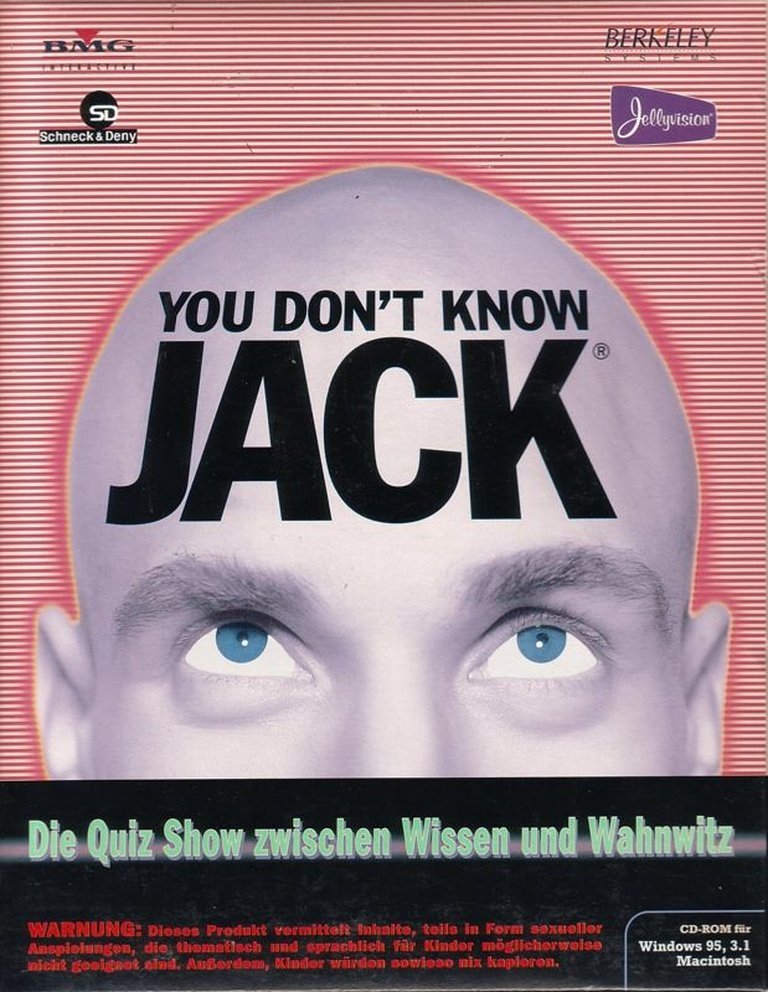
You Don’t Know Jack: Volume 2 is a humorous trivia game show-style sequel where players compete to answer pop culture-infused questions with comedic flair. Hosted by a witty announcer, the game offers both 7-question and extended 21-question rounds, featuring new modes like DisOrDat (categorizing words), Celebrity Collect Calls (quirky queries from famous personas), and Picture Questions to diversify the audio-driven experience.
Gameplay Videos
Where to Buy You Don’t Know Jack: Volume 2
PC
You Don’t Know Jack: Volume 2 Free Download
You Don’t Know Jack: Volume 2 Cracks & Fixes
You Don’t Know Jack: Volume 2 Patches & Updates
You Don’t Know Jack: Volume 2 Mods
You Don’t Know Jack: Volume 2 Guides & Walkthroughs
You Don’t Know Jack: Volume 2 Reviews & Reception
gamespot.com (90/100): You Don’t Know Jack Volume 2 brings back everything that was exciting and fun about the original.
You Don’t Know Jack: Volume 2 Cheats & Codes
PC
| Code | Effect |
|---|---|
| A,B,C,H,Space | A Bobbing head will pop out and you could move his eyes by pressing the arrow keys. |
| B | Repeatedly press B at the high-score screen and during commercials to view bloopers. |
| fuck you | Type as your player name and then again as the answer to a gibberish question to get a worse response from the host. |
| fuck you | In a three-player game, buzz in and type this code on a gibberish question three times. On the third time, press any key during the host’s quitting speech for a funny ending. |
You Don’t Know Jack: Volume 2: The Quiz Show That Redefined Trivia Gaming
Introduction
In the mid-1990s, as gaming clawed its way into mainstream culture, Berkeley Systems and Jellyvision Games unleashed a phenomenon that turned living rooms into chaotic game-show stages. You Don’t Know Jack: Volume 2 (1996) wasn’t just a sequel—it was a refinement of a formula that fused highbrow trivia with lowbrow humor, cementing its status as the definitive party game of its era. Building on the breakout success of its 1995 predecessor, Volume 2 amplified the absurdity, sharpened the satire, and introduced gameplay innovations that would define the series for decades. This review examines how YDKJ: Volume 2 perfected interactive trivia while wrestling with the technological constraints of its time, ultimately becoming a touchstone for social gaming.
Development History & Context
Jellyvision Games, a studio born from educational software roots (notably That’s a Fact, Jack!), partnered with Berkeley Systems—known for After Dark screen savers—to create a trivia experience that mocked the pomposity of traditional game shows. Released in 1996, Volume 2 arrived amid the CD-ROM boom, leveraging the medium’s capacity for audio storage to deliver its signature voice acting and sound design. However, limitations persisted: fitting 800 questions, host commentary, and music onto a single CD required meticulous compression, with programmer Tom Conrad pioneering techniques to maximize audio fidelity.
The mid-90s gaming landscape was dominated by action and strategy titles, making YDKJ’s focus on multiplayer trivia a risky outlier. Yet, its success capitalized on the era’s appetite for accessible, socially driven experiences—a counterpoint to solitary console gaming. Volume 2 also entered a market where trivia games leaned on dry formats like Trivial Pursuit; Jellyvision’s anarchic humor (influenced by writers like Ali Davis and Michelle Gorchow) positioned it as a countercultural hit.
Narrative & Thematic Deep Dive
Unlike narrative-driven games, YDKJ: Volume 2’s “story” unfolds through its sardonic host, Buzz Lippman (voiced by Peter B. Spector), whose fourth-wall-breaking rants and petty insults (“It’s a disgrace!”) parody game-show tropes. Episodic structure is absent—each session is a self-contained round of 7 or 21 questions—but thematic cohesion emerges through pop-culture satire and meta-commentary.
Questions weaponize bizarre analogies (e.g., “If sitcoms were single-celled organisms, creating a spinoff would be called… mitosis?”) and mock academic pretension, blending high-art references (Puccini operas) with gutter humor (flatulence jokes). The game’s underlying thesis? Knowledge is arbitrary, and intelligence is best served with a side of absurdity. Characters like the curmudgeonly Old Man (voiced by Tom Gottlieb) interrupt gameplay, embodying the series’ disdain for authority—a rebellion against the sanitized edutainment of the era.
Gameplay Mechanics & Systems
Core to YDKJ’s genius is its multiplayer-centric design, requiring 1-3 players to “buzz in” via keyboard keys—a tactile throwback to arcade competitions. Volume 2 introduces three pivotal additions to the original’s format:
– DisOrDat: A frenetic categorization minigame where players sort words like “Puccini” into binary groups (Pasta vs. Opera).
– Celebrity Collect Calls: Real-world stars (Tim Allen, Vanessa Williams) phone in absurdist trivia via pre-recorded audio clips.
– Picture Questions: A visual twist on the audio-focused formula, testing recognition of images.
The Jack Attack finale remains iconic: words flash on-screen, and players match them to a central theme under time pressure. However, the game’s reliance on 800 questions (praised for variety but criticized for repetition) revealed limitations—players memorized answers after heavy play.
Punishment mechanics heighten tension: buzzing early locks players into answering, while “Screw Your Neighbor” lets leaders sabotage others. Despite its party façade, Volume 2 rewards strategy, like banking money in early rounds for high-stakes wagers.
World-Building, Art & Sound
Visually, YDKJ: Volume 2 evokes a carnivalesque game-show set, with neon color palettes and surreal iconography (e.g., dancing cacti, talking sandwiches). The UI is minimalist, prioritizing readability during rapid-fire questions.
Sound design is its crowning achievement: P.J. Sonnichsen’s team crammed voice lines for 800+ questions, host banter, and sound effects into a single CD. The result is a vaudevillian audio landscape—sardonic laughter, groan-worthy puns, and a jazz-funk soundtrack that underscores the chaos. Voice acting, particularly Spector’s smug host, elevates the experience, with ad-libs (“Hel-LO, dum-dum!”) making each playthrough feel live and unpredictable.
Reception & Legacy
Critically, Volume 2 was a triumph: GameSpot awarded it 9/10, praising its “fantastic balance,” while Computer Gaming World lauded its “audacious” humor despite critiquing its “sophomoric” edges. Commercially, it became a staple of 1990s PC gaming, selling alongside bundles like You Don’t Know Jack: Jumbo (1999).
Its legacy is multifaceted:
– Genre Innovation: Pioneered the “social trivia” template later adopted by Buzz! and Jackbox Party Pack.
– Cultural Impact: Spawned books, a short-lived ABC game show (2001), and a German-localized series.
– Technological Benchmark: Demonstrated CD-ROM’s potential for voice-driven games.
Yet, flaws lingered. The finite question pool plagued replayability, prompting iterative sequels (Volume 3, Sports). Its adult humor also drew ire, cementing its reputation as a “party game for adults only.”
Conclusion
You Don’t Know Jack: Volume 2 remains a masterclass in interactive comedy—a game that weaponized trivia as a vehicle for satire and social bonding. Its innovations, from DisOrDat to celebrity call-ins, expanded the boundaries of party gaming, while its razor-sharp writing and audiovisual flair defied the technical constraints of 1996. Though later entries would refine its formula, Volume 2 crystallized the series’ identity as the anti-trivia trivia game—a riotous, irreverent spectacle where knowing “mitosis” matters less than laughing at the host’s meltdown. Three decades later, its DNA lives on in every Jackbox title, proof that intelligence and absurdity make the perfect match. ★★★★★