
- Release Year: 2002
- Platforms: Windows
- Publisher: Empire Interactive Europe Ltd., Idigicon Limited, Media-Service 2000
- Developer: MDickie Limited
- Genre: Action, Sports
- Perspective: Third-person
- Game Mode: Single-player
- Gameplay: Arena creation, Character Creation, Multiple match types, Rule customization
Description
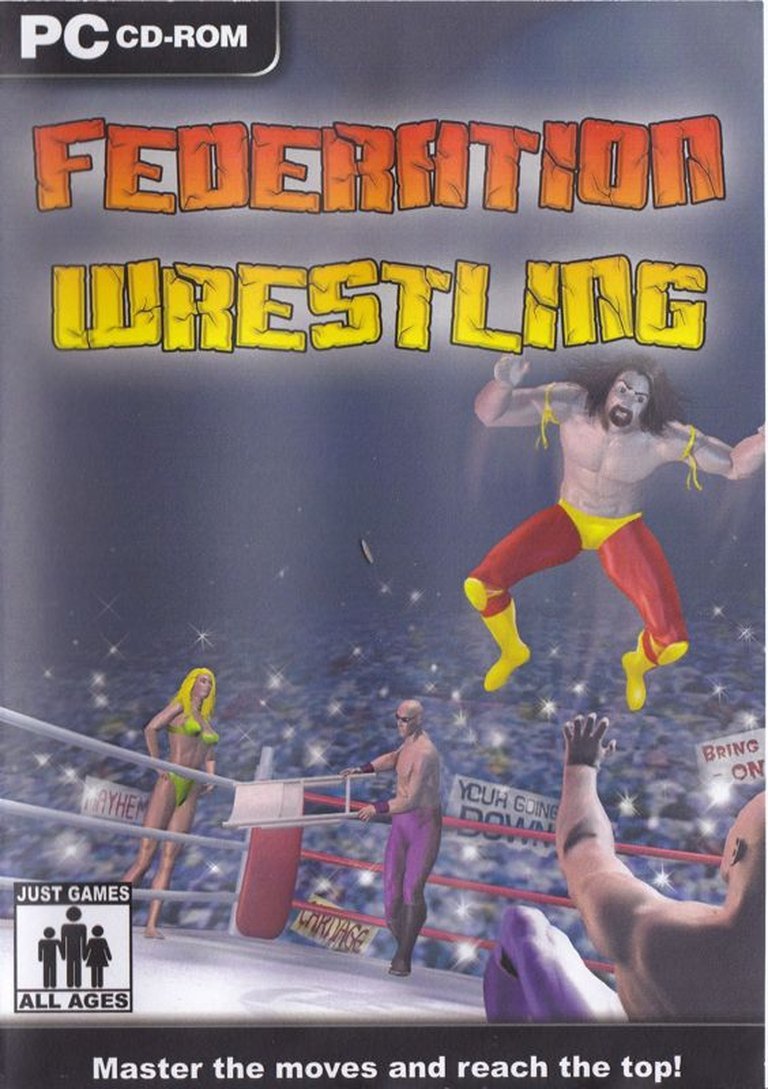
Federation Wrestling is a 2002 wrestling action-sports game featuring two primary modes: ‘The Contract’, where players guide a custom wrestler through 12 months of escalating challenges to earn a professional contract, and Exhibition mode for instant battles with pre-made or player-created wrestlers. The game offers deep customization with unlockable arena/wrestler editors, multiple match types (Confrontation, Cage matches, TAG team), varied rulesets (Hardcore, Normal, Strict), and three scoring systems, all supported by rebindable controls for flexible gameplay.
Federation Wrestling: The Indie Underdog That Cemented MDickie’s Cult Legacy
Introduction
In the shadow of WWE’s blockbuster wrestling games, a scrappy British indie title dared to redefine the genre’s possibilities with sheer creative ambition. Released in December 2002, Federation Wrestling—initially conceived as Federation Online—emerged as a DIY love letter to wrestling’s theatrical chaos. Developed almost entirely by one man, Mat Dickie, this 2D brawler fused arcade simplicity with shockingly deep customization, offering a sandbox of carnage that corporate titans ignored. While its crude presentation and janky controls drew inevitable comparisons to industry heavyweights, the game’s idiosyncratic vision—including interactive referees, destructible environments, and a nefarious “gas chamber” match type—cemented its status as a cult classic. This review argues that Federation Wrestling is less a game than a manifesto: a proof-of-concept for indie ingenuity that laid the groundwork for MDickie’s later empire of offbeat simulations.
Development History & Context
Studio and Vision
MDickie Limited, effectively a solo venture by British developer Mat Dickie, operated as a one-man rebellion against early-2000s gaming conventions. Dickie’s ethos prioritized “fun first,” leveraging the accessible Blitz BASIC engine to create low-budget passion projects (MobyGames). Federation Wrestling evolved from Federation Online (2001), a prototypical version Dickie self-published before securing distribution through Idigicon, Media-Service 2000, and Empire Interactive. The rebranding to Federation Wrestling reflected commercial pragmatism, but the core vision—a “revolutionary promotion broadcasting on the Internet” (The Smackdown Hotel)—remained intact.
Technological Constraints
Built for Windows, the game’s 2D sprites and chiptune soundtrack were born of necessity. Dickie handled all programming, art, music, and writing (MobyGames Credits), resulting in a rough-edged aesthetic critics labeled “awful” but functional (Smackdown Hotel). Hardware limitations capped matches at 20 wrestlers and 5 referees—a staggering number for 2002—though lower-end PCs choked on the chaos.
Gaming Landscape
The early 2000s wrestling scene was dominated by visually polished but formulaic titles like WWF No Mercy (2000). Dickie’s underdog entry exploited a gap: while AAA games focused on licensing and realism, Federation Wrestling offered anarchic creativity, including player-generated content years before WWE 2K’s creation suites.
Narrative & Thematic Deep Dive
Plot and Structure
The campaign, The Contract, tasks players with surviving 12 months in the fictional Federation Online promotion. Starting as an unknown, victories earn spots on weekly shows, international tours, and pay-per-views, while losses relegate fighters to obscurity. Narrative progression hinges on reinvention: before each major event, players adjust their wrestler’s “costume, skills, and moves” (Smackdown Hotel), mirroring wrestling’s real-life emphasis on gimmick evolution.
Characters and Dialog
The roster comprises 30+ original characters, including the mohawked Whack Ax, grizzled Outlaw Eaton, and villainous Whack Oz—who, in a meta-twist, is “paid to make sure you lose” the final match (Smackdown Hotel Cheats). Dialog is minimal, conveyed through taunts and grunts, but each wrestler boasts unique music, gestures, and allegiances. Their fictional nature allowed Dickie to sidestep licensing woes while fostering a self-contained lore later expanded in Federation Booker (2003).
Themes
Beneath the surface, Federation Wrestling explores wrestling’s Faustian bargains: the grind of touring, the fragility of stardom, and the performative artifice of personas. The unlockable editor—rewarded only after completing The Contract—symbolizes empowerment, letting players dismantle and rebuild the game’s world.
Gameplay Mechanics & Systems
Core Loop
Two modes define the experience:
1. The Contract: A risk/reward career mode where momentum dictates match prominence. Lose repeatedly, and you’ll job in dark matches; win consistently, and you’ll headline pay-per-views.
2. Exhibition: A sandbox featuring 15 preset match types (e.g., “Ironman,” “Royal Brawl”), customizable rules, and full roster access.
Combat and Controls
Keyboard-controlled (with gamepad support for two players), the combat blends wrestling fundamentals—grapples, pins, submissions—with arcade excess. Timing-based counters and “Special” meters enable flashy finishers, while environmental interactions (breaking tables, igniting TNT) reward improvisation. However, the control scheme’s complexity (“a great number of key combinations”) often feels overwhelming (MobyGames Description).
Innovations and Flaws
– Revolutionary Systems: Referees are fully interactive NPCs—prone to knockdowns, biased counts, and weapon confiscation. Matches can trigger “blast” (arena explosions) or “gas” (poisonous fog) events, while cage escapes require precise input combos (Cheats).
– Creation Suite: Post-campaign, players craft wrestlers (95 slots), arenas, and match rules, selecting from 100+ moves and modular arenas (Smackdown Hotel).
– Shortcomings: Clunky UI, inconsistent hit detection, and a steep learning curve hindered accessibility. The AI’s erratic behavior—teammates in tag matches often bungle tags—further marred the experience.
World-Building, Art & Sound
Visual Design
Despite rudimentary 2D sprites, the game oozes personality. Wrestlers sport exaggerated designs (e.g., Dyny’s helmet grants blindness immunity), while arenas range from standard rings to junkyards strewn with barbed wire. The palette is vibrant but garish, evoking the gritty charm of indie comics.
Atmosphere
The lack of a licensed soundtrack is offset by Dickie’s original chiptunes, which mirror wrestlers’ personas—pulsing synth for heels, triumphant loops for faces. Crowd noise is sparse but functional, amplifying the DIY aesthetic.
Interactive Spaces
Arenas are playgrounds of destruction: players smash railings to spill into crowds, set fires, and wield weapons (chairs, thumbtacks). Items persist between matches, fostering emergent storytelling—a table broken in one bout might remain shattered in the next.
Reception & Legacy
Launch Reception
No formal critic reviews surfaced (Metacritic, MobyGames Reviews), but player impressions highlighted its ambition amid jank. Bundled in compilations like 10 Krazy Kids PC Games Vol. 3 (2008), it found a niche audience valuing creativity over polish.
Long-Term Influence
– MDickie’s Universe: The game’s engine powered Federation Booker (2003), while its lore expanded in later titles like Wrestling Revolution (2012). Characters like Merc and Acer reappeared in Sure Shot (2004) and Wrecked (2005), forming a shared “MDickie-verse” (Reddit Lore Threads).
– Indie Benchmark: Proved that deep customization and emergent gameplay could trump budget limitations, inspiring successors like Fire Pro Wrestling.
– Modding Community: Save-file hacking and editor exploits birthed fan-made wrestlers and arenas, extending its lifespan years beyond release.
Conclusion
Federation Wrestling is a testament to the beauty of constraints. Mat Dickie’s singular vision—flawed, frenetic, and fiercely inventive—rejected polish in favor of possibility. Its legacy isn’t in sales figures or review scores but in its DNA: the DNA of a thousand indie gems that prioritize player agency over corporate sheen. Today, as MDickie’s Wrestling Empire (2021) thrives on Switch, we recognize this 2002 curio as the foundation of a rogue legacy—a game that dared to ask, “What if wrestling was your sandbox?” For that audacity alone, it earns its place in gaming history.
Final Verdict: A rough-cut diamond for the patient and curious, Federation Wrestling remains essential playing for historians of indie resilience—and anyone who ever dreamed of booking their own gas-chamber deathmatch.