
- Release Year: 2004
- Platforms: Android, iPad, iPhone, Windows
- Publisher: Nightly Four
- Developer: Nightly Four
- Genre: Sports
- Perspective: Side view
- Game Mode: Hotseat, Online PVP, Single-player
- Gameplay: Character customization, Volleyball
- Setting: Beach
- Average Score: 30/100
Description
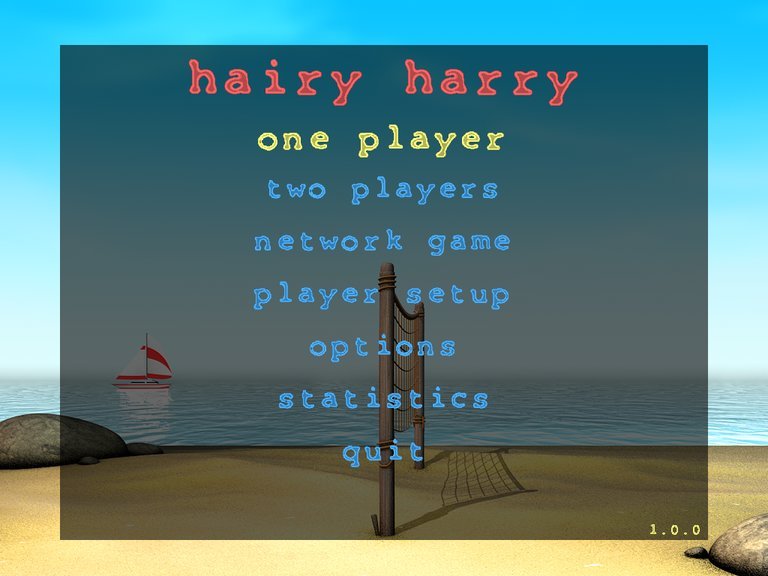
Hairy Harry is a quirky beach volleyball game featuring small, spherical creatures with long, animated hair. Set in a lighthearted sports environment, players compete using standard volleyball rules: scoring when the ball lands on the opponent’s side, limiting touches to three per side, and aiming for 15 points to win. The game supports single-player and local or online multiplayer modes, with customization options for character colors and hairstyles to personalize the experience.
Hairy Harry Free Download
PC
Hairy Harry Patches & Updates
Hairy Harry Mods
Hairy Harry Reviews & Reception
caiman.us : A funny 3D Volley ball game for 1, 2 or 4 players.
Hairy Harry Cheats & Codes
PC
On the level-select screen use the following key to activate trainer option:
| Code | Effect |
|---|---|
| F5 | Unlock All Levels |
Hairy Harry: A Fuzzy Enigma in the Indie Volleyball Pantheon
Introduction
In the annals of niche sports games, Hairy Harry (2004) exists as a peculiar footnote—a freeware beach volleyball title where spherical, follicular creatures leap across pixelated sands. Developed by the obscure German trio Nightly Four, this Windows oddball merges minimalist mechanics with absurdist charm, challenging players to take its absurd premise seriously. While its commercial footprint was negligible, Hairy Harry exemplifies early-2000s indie experimentation, leveraging customization and humor to compensate for technical constraints. This review argues that beneath its janky surface lies a cult artifact that foreshadowed the DIY ethos of mod-friendly indie games.
Development History & Context
The Dawn of Indie Ambition
Emerging in May 2004, Hairy Harry was born into a transitional era for indie developers. Digital distribution platforms were nascent, and small teams like Nightly Four—comprising Martin Stich, Michael Zeile, and Peer Draeger—relied on word-of-mouth and freeware portals like Curly’s World of Freeware. Unlike contemporaries such as Alawar Entertainment, which misattributed Hairy Harry to a prison-escape narrative in some databases, Nightly Four embraced absurdism over plot. Their vision: a volleyball game where “the moving hair looks kinda cute,” divorced from narrative pretense.
Technological Constraints
Built for Windows 98/XP, the game operated within strict limitations:
– Engine Simplicity: A fixed side-view perspective with basic 2D sprites and meager animation frames.
– Network Quirks: Early TCP/IP multiplayer support, albeit plagued by latency—a bold gamble in an era of LAN dominance.
– Scalability: The 2005 v1.2 update introduced theme modding, allowing community-created assets—a precursor to modern Steam Workshop integrations.
In a landscape dominated by Power Spike: Pro Beach Volleyball (2000), Hairy Harry’s lack of licensed athletes or 3D fidelity forced innovation through whimsy.
Narrative & Thematic Deep Dive
Absence as Aesthetic
Hairy Harry deliberately sidesteps narrative. There are no origin stories for its titular hairy spheres—no apocalypses, no intergalactic volleyball leagues. Instead, the game’s “lore” emerges from environmental humor:
– Satirical Credits: Special thanks to “iceman [for doing 0 hairstyles]” and Markus Geisler for “sexy shoes” wink at gaming’s labor crunch.
– Thematic Void: Unlike Dead Ball Zone’s dystopian bloodsport or Super Dodge Ball’s anime theatrics, Hairy Harry’s worldbuilding begins and ends with visual gags.
Existential Volleyball
The closest the game comes to subtext arises in its International Karate theme (added in v1.2), which replaces volleyballs with martial arts—a non-sequitur undermining competitive gravitas. Players project meaning onto abstraction: Is Harry’s hair a metaphor for chaos? A celebration of physics? The game revels in refusing answers.
Gameplay Mechanics & Systems
Core Loop: Simplicity vs. Depth
At its heart, Hairy Harry adheres to standard volleyball rules:
– 15-point matches, three touches per side.
– Single-player vs. AI across three difficulties.
– Local/Online Multiplayer: Up to four players via split-screen or IP connection.
Yet nuances emerge:
– Adaptive Speed: Rally tempo escalates with consecutive hits, demanding sharper reflexes.
– Physics-Driven Chaos: The ball’s arc defies realism, favoring slapstick bounces off hair.
Character Customization
Players tweak:
– Hair color and style (despite “0 hairstyles” jokes).
– Themes: Downloadable mods overhaul visuals, sound, and ball behavior—e.g., Mantis Fight theme introduces insectoid sprites and erratic trajectories.
Flaws & Frustrations
– Clunky Controls: Keyboard-only inputs (no controller support) mar precision.
– AI Quirks: Higher difficulties ramp speed unfairly rather than intelligence.
– Network Instability: Early builds suffered from desyncs, partly fixed in v1.2.
World-Building, Art & Sound
Visual Identity: Minimalist Whimsy
– Character Design: Harry and foes resemble hairy tennis balls, their locks swaying with physics-based glee.
– Environments: Static beach backdrops—palm trees, sunsets—evoke arcade-era simplicity. Theme mods injected variety, from neon grids to IK’s dojos.
Sound Design: Functional Quirkiness
– SFX: Slapstick boings punctuate serves, while theme packs swap sounds for retro bleeps (e.g., karate yells).
– Music: Absent except in mods, focusing attention on gameplay cacophony.
Atmosphere
The game radiates low-stakes absurdity—a digital toybox rather than a sports sim. Hair physics, while primitive, hypnotize; each rally feels like puppeteering sentient mops.
Reception & Legacy
Initial Reception: Polarized Silence
– Critics: Mostly absent. MobyGames records a 1.5/5 average from one user rating—likely reflecting technical frustration.
– Player Communities: Caiman.us awarded 92%, praising moddability and humor. The disconnect highlights a niche appeal: those who embraced jank found joy.
Long-Term Influence
– Modding Pioneer: Hairy Harry’s theme system presaged community-driven content in games like Minecraft and Terraria.
– Cult Resurrection: The 2014 mobile ports (Android/iOS) updated controls but languished in obscurity.
Indirectly, the game inspired indie absurdists like Divekick—proving that sports hybrids thrive on personality over polish.
Conclusion
Hairy Harry is not a “good” game by conventional metrics. Its mechanics are uneven, its presentation rudimentary, and its legacy confined to cult curios. Yet as a timestamp of indie experimentation, it fascinates. Nightly Four transformed technical limits into creative fuel, prioritizing humor and customization—values now foundational to indie success. To play Hairy Harry today is to witness the DNA of DIY game design: flawed, audacious, and irresistibly weird. While it won’t top volleyball or indie pantheons, it deserves remembrance as a hairy harbinger of gaming’s eccentric soul.
Verdict: A 3/5 relic—essential for historians, endearing for absurdists, and perplexing for everyone else.