
- Release Year: 2006
- Platforms: Windows
- Publisher: Novitas Publishing GmbH
- Developer: weltenbauer. Software Entwicklung GmbH
- Genre: Action, Driving, Puzzle, Racing
- Perspective: 3rd-person (Other)
- Game Mode: Single-player
- Gameplay: Arcade, Aviation, Flight, Game show, Platform, quiz, trivia
- Setting: Beach, City, Farm, Ice, Inca, Jungle, Middle Ages, Pirates, Science fiction, Wild West
- Average Score: 26/100
Description
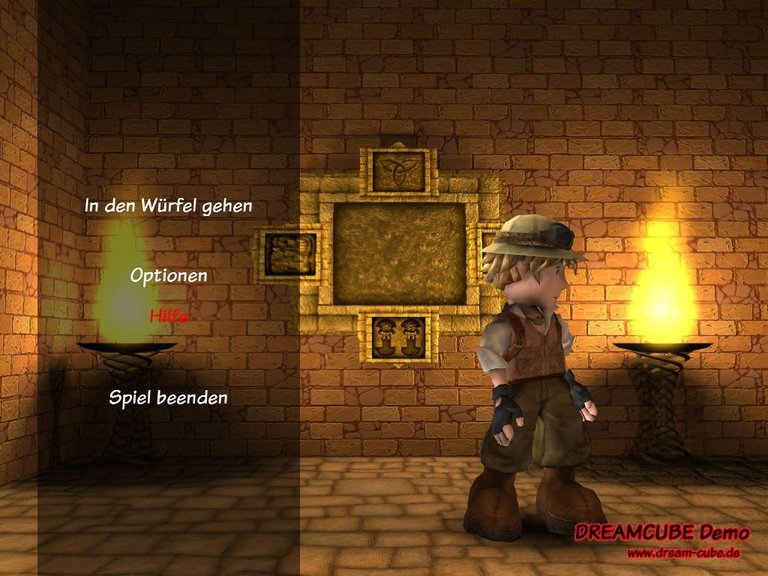
In Dreamcube, players assume the role of Jack, who receives a mysterious cube for his birthday. Upon falling asleep, he is transported into a surreal dream world trapped inside the cube, where he must collect dream crystals to escape. The game spans ten themed worlds—such as Science Fiction, Wild West, Jungle, and Pirates—each offering ten diverse mini-games. These challenges range from obstacle navigation and item collection to checkpoint races, Sokoban-style puzzles, trivia, and cannon-based combat, all playable via keyboard or gamepad.
Dreamcube: A Fractured Dreamscape of Missed Potential
Introduction
In 2006, Dreamcube arrived as a curious oddity—a mini-game compilation wrapped in a fantastical premise, yet buried under a avalanche of technical shortcomings and design missteps. Developed by German studio weltenbauer. Software Entwicklung GmbH and published by Novitas Publishing GmbH, Dreamcube promised a whimsical journey through ten dream worlds, but instead became a cautionary tale of ambition outpacing execution. This review dissects the game’s fleeting sparks of creativity, its baffling design choices, and its place in the pantheon of forgotten mid-2000s curiosities.
Development History & Context
Studio Vision and Constraints
weltenbauer. Software Entwicklung GmbH, primarily known for Construction Simulator titles, ventured into uncharted territory with Dreamcube. The mid-2000s saw a surge in mini-game collections (Mario Party, WarioWare), but PC platforms lacked a standout entry. Dreamcube aimed to fill this gap with a Eurocentric twist, blending action, puzzle, and racing elements into a family-friendly package. However, budget constraints and a small team (12 credited developers) likely limited polish.
Technological Landscape
Released in the twilight of Windows XP’s dominance, Dreamcube struggled to compete with the era’s rising 3D standards. While games like Psychonauts (2005) showcased narrative-driven 3D platforming, Dreamcube relied on simplistic, low-poly visuals and rudimentary physics. The absence of online play or multiplayer innovation further dated it, even at launch.
Narrative & Thematic Deep Dive
Surface-Level Storytelling
The premise—Jack, a boy trapped in a magical cube collecting dream crystals—is paper-thin. Each of the ten worlds (Science Fiction, Wild West, Jungle, etc.) lacks narrative cohesion, serving only as themed backdrops for mini-games. Unlike Psychonauts’ psychological depth or Sonic’s character-driven arcs, Dreamcube offers no emotional stakes or character development.
Themes of Escapism
Beneath its crude presentation lies a kernel of thematic potential: dreams as both playground and prison. The cube’s worlds echo childhood fantasies (pirate adventures, medieval quests), but repetitive gameplay undermines this whimsy. A stronger focus on surrealism or player-driven storytelling could have elevated the concept.
Gameplay Mechanics & Systems
Mini-Game Galore, Quality Ignored
Dreamcube’s 100 mini-games span genres:
– Obstacle Avoidance: Clunky platforming with floaty controls.
– Sokoban Puzzles: Functional but uninspired block-pushing.
– Checkpoint Races: Janky vehicle physics mar driving/flying segments.
– Trivia: German-centric questions limit international appeal.
German outlet PC Games derided the “catastrophic controls,” while GameStar noted the “swimming” movement made even simple tasks frustrating.
Progression and UI
A linear structure forces players through all ten worlds, with no option to skip disliked minigames. The UI is utilitarian but plagued by long load times (GamingXP), and the scoring system (graded from D to S) feels arbitrary due to inconsistent difficulty spikes.
World-Building, Art & Sound
Aesthetic Ambition vs. Execution
Each world’s theme is visually distinct but artistically bland. The Wild West’s dusty plains and the Inca jungle’s foliage lack detail, relying on garish colors to mask low-resolution textures. Character models, particularly Jack, are rigid and under-animated.
Sound Design: A Discordant Symphony
Reviews universally panned the audio. Game Captain called the music “grausam” (atrocious), and sound effects—like clumsy cannon explosions—feel ripped from early-2000s stock libraries. The absence of voice acting exacerbates the emptiness.
Reception & Legacy
Critical Dismissal
With a 26% critic average on MobyGames, Dreamcube was lambasted for its “vorsintflutlich” (antediluvian) tech (Game Captain) and “unspielbar” (unplayable) controls (PC Action). Player reviews echoed this disdain, scoring it 1.2/5.
Influence and Obscurity
Dreamcube left no discernible legacy. Its failure underscored the risks of unfocused mini-game compilations, perhaps indirectly pushing developers like Nintendo to refine the formula in Mario Party 8 (2007). Today, it exists as a footnote—a relic of Euro-jank experimentation.
Conclusion
Dreamcube is a fractured mosaic of unrealized ideas. Its ten-world structure and genre variety hint at creativity, but shoddy execution drowns any charm. For historians, it exemplifies the pitfalls of budget-driven development; for players, it’s a curiosity best left undisturbed. In the annals of gaming history, Dreamcube serves not as a dream realized, but as a cautionary tale of ambition without craft.
Final Verdict: Dreamcube is a fascinating artifact for completionists and Euro-jank aficionados, but a tedious slog for everyone else. Its place in history? A stark reminder that even dreams need a solid foundation.