
- Release Year: 1996
- Platforms: DOS, PlayStation, Windows
- Publisher: Ubi Soft Entertainment Software
- Developer: Ubi Soft Entertainment Ltd., Ubi Soft Entertainment Software
- Genre: Action, Educational
- Perspective: Side-scrolling
- Game Mode: Single-player
- Gameplay: logic, Math, Platforming, Reading, writing
- Setting: Fantasy
- Average Score: 76/100
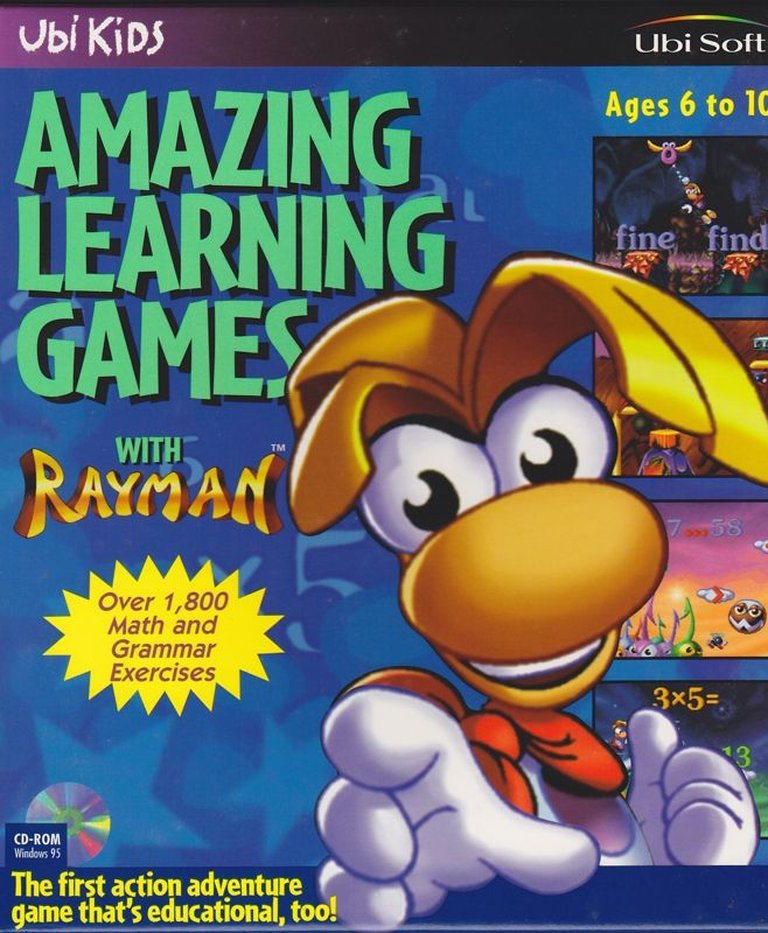
Description
In ‘Amazing Learning Games with Rayman’, players join Rayman on a quest to recover the stolen Book of Knowledge from the villain Mr. Dark. Designed for children aged 6-10, this educational platformer blends action-adventure gameplay with learning exercises across diverse landscapes. As Rayman jumps, flies, and battles enemies, players tackle challenges like identifying correctly spelled words, solving math problems (counting, addition, subtraction), and recognizing rhymes or word classifications—all guided by the Magician. The game features 180 levels across 6 worlds, integrating reading, writing, and math skills into its vibrant platforming framework.
Gameplay Videos
Amazing Learning Games with Rayman Free Download
Amazing Learning Games with Rayman Guides & Walkthroughs
Amazing Learning Games with Rayman Reviews & Reception
myabandonware.com (89/100): This is amazing, thank you for uploading!
dosgames.com (80/100): Other than that, it plays like a simpler Rayman game, with great graphics and sounds, fluid animations, and lots of things to collect.
Amazing Learning Games with Rayman Cheats & Codes
PlayStation 1 (NTSC-U) – GameShark codes
Enter the following codes using a GameShark device in the game.
| Code | Effect |
|---|---|
| D0039850 7B37 801E4D50 0060 | Unlimited Lives |
| D0039850 7B37 801F6200 0002 | Unlimited Health |
| D0039850 7B37 800AE9C8 0D0D | Mega Glove Power |
| D0039850 7B37 800AE9C8 0F0F | Glove Looks Demented (glitch) |
| 301F61E2 004D D01F7EDA FFFE 301F61E2 00FF | Invulnerability (disable with Select) |
PlayStation 1 (NTSC-U) – Cheat Code Central
Enter the following codes using a GameShark device or compatible cheat system.
| Code | Effect |
|---|---|
| 30095221 0004 | Max Health |
| D00DB9C0 FFFB 300C2CCD 0000 | Press L1 to Become Invincible |
| D00DB9C0 FFFE 30094A44 0000 | Press L2 to Unfreeze Screen |
| D00DB9C0 FFF7 8009533C FFFF | Press R1 to Skip Timed Levels |
| D00DB9C0 FFFD 30094A44 00FF | Press R2 to Freeze Screen |
PC Original 1995 Rayman
Type the cheat codes during gameplay or while paused.
| Code | Effect |
|---|---|
| kom0ogdk | Restores 5 energy points |
| 86e40g91 | Get 10 tings |
| 2x2rmfmf | Golden fist |
| trj8p | 99 lives |
| en5gol2g | All powers |
| o8feh | Skip to next level |
| 4ctrepfj | Access to all 6 worlds (map screen only) |
| b76b7081 | Hidden breakout game after defeating all cages and bosses |
PC Rayman Gold / Forever
Type the cheat codes during gameplay or while paused.
| Code | Effect |
|---|---|
| raypoint | Restores 5 energy points |
| raywiz | Get 10 tings |
| goldfist | Golden fist |
| raylives | 99 lives |
| power | All powers |
| winmap | Skip to next level |
| alworld | Access to all 6 worlds (map screen only) |
| cbray | Hidden breakout game after defeating all cages and bosses |
Amazing Learning Games with Rayman: Review
Introduction
In the mid-1990s, as the gaming industry surged with platformer mascots like Mario and Sonic, Ubisoft’s limbless hero Rayman embarked on an unconventional quest: to teach children math and spelling. Amazing Learning Games with Rayman (1996) stands as a curious artifact of the “edutainment” era, blending the vibrant world of Rayman with educational mechanics. While its legacy is overshadowed by the mainline Rayman series, this title represents a bold experiment in merging pedagogy with platforming. This review argues that while the game’s charm and creativity resonate, its educational execution often falters, leaving it a fascinating but flawed relic of its time.
Development History & Context
Developed by Ubisoft Montpellier under Michel Ancel’s creative direction, Amazing Learning Games with Rayman emerged shortly after the success of the original Rayman (1995). The studio sought to capitalize on the character’s popularity while tapping into the burgeoning market of educational software. Released for DOS and Windows in 1996, with a PlayStation port (Rayman Brain Games) in 2000, the game targeted children aged 6–10, aiming to reinforce classroom skills through interactive play.
The mid-’90s saw a wave of edutainment titles like Reader Rabbit and Math Blaster, but Ubisoft’s approach was unique: instead of abstract mini-games, it layered educational challenges onto a full-fledged platformer. Technological constraints of the era—limited voice acting, rudimentary UI design, and sprite-based graphics—shaped its development. The team repurposed assets from the original Rayman, streamlining its complexity for younger audiences while retaining its whimsical art style.
Narrative & Thematic Deep Dive
The premise is simple yet effective: the villain Mr. Dark steals the Book of Knowledge, and Rayman must recover it by traversing six worlds filled with puzzles and enemies. Guiding players are Betilla the Fairy and the Magician, who provide hints and frame educational tasks as in-universe challenges.
Thematically, the game positions knowledge as a form of empowerment. Each level reinforces this through mechanics: spelling correct words opens paths, math problems determine safe platforms, and rhyming exercises unlock rewards. Dialogue is minimal but purposeful, with the Magician’s instructions (“Step on the number that answers 5 + 3!”) seamlessly integrating into the fantasy setting. However, the narrative lacks depth, serving primarily as a vehicle for its educational goals.
Gameplay Mechanics & Systems
At its core, Amazing Learning Games with Rayman retains the original’s platforming DNA. Players jump, glide with Rayman’s helicopter hair, and throw fists at enemies. The twist lies in its educational integration:
– Reading Exercises: Selecting correctly spelled words or rhyming pairs to progress.
– Math Challenges: Solving arithmetic problems to unlock paths.
– Pattern Recognition: Identifying sequences or categorizing words.
The game features 12 activities spread across 180 levels, with three difficulty settings. However, its systems are uneven:
– Strengths: The platforming is polished, and the adaptive difficulty (e.g., simpler math for younger players) shows thoughtful design.
– Flaws: Progress is linear and rigid—completed levels cannot be replayed, limiting replayability. Critics noted that incorrect answers often punish players harshly (e.g., instant death), creating frustration rather than encouragement.
The UI is functional but dated, with text-heavy menus and limited voiceovers. Sound issues, notably muffled instructions, further hamper the learning experience—a point lamented by reviewers like Jennifer Beam (AllGame).
World-Building, Art & Sound
The game’s visual and auditory design is its strongest asset. The six worlds—from lush forests to candy-themed castles—burst with color, leveraging the original Rayman’s surreal aesthetic. Backgrounds by Éric Pelatan and animations by Alexandra Steible are lively and imaginative, keeping young players engaged.
Sound design is a mixed bag. Rémi Gazel’s soundtrack, recycled from the original game, is whimsical and upbeat, but the sparse voice acting (e.g., the Magician’s muffled cues) undermines clarity. As CNET noted, children struggling to hear instructions may lose motivation—a critical flaw in an educational title.
Reception & Legacy
Amazing Learning Games with Rayman earned mixed reviews, averaging 60% from critics. Praise centered on its visuals and concept (Electric Playground called it “a good step in edutainment”), while criticism targeted its steep difficulty and educational shortcomings. The 1999 re-release, Rayman Learning Center, attempted to refine these issues but saw limited success.
Commercial performance was modest, though it spawned sequels like Rayman Junior. Its legacy is twofold:
1. Innovation: It demonstrated how licensed IPs could be adapted for education.
2. Limitations: Scholars like George Kalmpourtzis criticized its lack of pedagogy, arguing it failed to meaningfully reinforce skills compared to structured classroom tools.
Despite its flaws, the game retains a cult following among retro enthusiasts, celebrated for its charm and nostalgia.
Conclusion
Amazing Learning Games with Rayman is a testament to the ambitions and pitfalls of 1990s edutainment. Its vibrant art and faithful platforming mechanics shine, but clunky educational integration and technical limitations hold it back. While it never achieved the cultural impact of Rayman’s mainline entries, it remains a fascinating artifact—a bridge between gaming’s playful heart and its earnest attempts to teach. For historians, it’s a case study in balancing fun and function; for players, it’s a bittersweet reminder of when learning to spell meant jumping over lava with a limbless hero.
Final Verdict: A visually delightful but mechanically flawed experiment, emblematic of its era but not timeless.