
- Release Year: 2007
- Platforms: Windows
- Publisher: Idigicon Limited
- Developer: Idigicon Limited
- Genre: Compilation
- Game Mode: Single-player
- Average Score: 98/100
Description
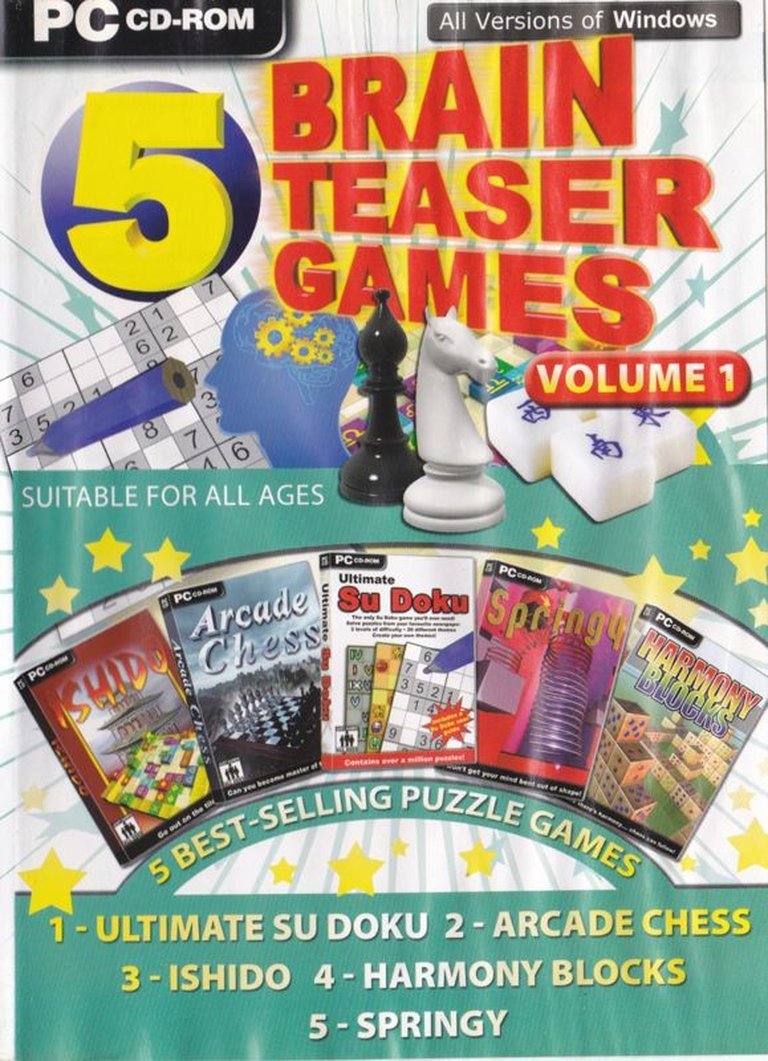
5 Brain Teaser Games: Volume 1 is a 2007 Windows compilation by Idigicon Limited featuring five puzzle-based games: Arcade Chess, Harmony Blocks, Ishido, Springy, and Ultimate Su Doku. Players install games individually via an autoloading menu, with titles launching from desktop shortcuts or the Start Menu. The disc also includes demos for Brick Buster and Removal Man, promotional offers, and the DirectX 9.0c runtime for enhanced compatibility.
5 Brain Teaser Games: Volume 1 Reviews & Reception
verticalslicegames.com (98/100): The critical reception for Metal Gear Solid Delta: Snake Eater is overwhelmingly positive, with reviewers celebrating it as a masterful and visually stunning remake that remains deeply faithful to the original classic.
5 Brain Teaser Games: Volume 1: Review
Introduction
In an era defined by Halo 3, BioShock, and Super Mario Galaxy, Idigicon Limited’s 5 Brain Teaser Games: Volume 1 (2007) occupied a quieter corner of the gaming landscape. This unassuming Windows compilation, bundling chess variants, Sudoku, and abstract puzzles, catered to a demographic often overlooked in 2007’s blockbuster-driven market: casual players seeking cerebral challenges. While overshadowed by AAA titans, the anthology epitomized the mid-2000s trend of budget CD-ROM collections designed for quick, accessible gameplay. This review argues that Volume 1’s historical significance lies not in innovation, but in its snapshot of a fading distribution model and the enduring appeal of analog-inspired puzzles in the digital age.
Development History & Context
Studio Vision & Technological Constraints
Idigicon Limited, a UK-based publisher, specialized in affordable compilations like 10 Brain Teaser Games (also 2007), targeting casual PC audiences. The studio’s ethos prioritized simplicity—games were designed to run on low-spec Windows systems, leveraging CD-ROM distribution before digital storefronts dominated. DirectX 9.0c support ensured compatibility with era-appropriate hardware, though the lack of true 3D rendering or complex physics underscored the collection’s modest ambitions.
The 2007 Gaming Landscape
This compilation debuted amid seismic industry shifts: the Xbox 360 and PlayStation 3 popularized HD gaming, while Nintendo’s Wii redefined motion controls. Against this backdrop, Volume 1’s sedentary, mouse-driven puzzles felt anachronistic—yet its timing was shrewd. The mid-2000s saw Sudoku’s global craze peak, and digital adaptations like Ultimate Su Doku capitalized on this trend. For Idigicon, bundling classics like Ishido (a 1986 tile-matching game) with contemporary logic puzzles was a low-risk strategy to monetize evergreen gameplay.
Narrative & Thematic Deep Dive
While devoid of traditional storytelling, the anthology’s thematic cohesion lies in its celebration of mental agility. Each game distills a core cognitive challenge:
- Arcade Chess reimagines chess as a timed battle, framing strategy as a race against the clock.
- Harmony Blocks and Ishido emphasize spatial reasoning, echoing millennia-old tile-based games.
- Springy (presumably a physics puzzle) and Ultimate Su Doku modernize logic and pattern recognition.
The compilation’s dialogue-free design reflects a purist philosophy: puzzles speak through mechanics, not narrative. This minimalist approach contrasts with 2007’s narrative-heavy hits, positioning Volume 1 as a digital homage to pre-video game traditions like crosswords and jigsaw puzzles.
Gameplay Mechanics & Systems
Core Loops & Innovation
- Arcade Chess: A rapid-fire chess variant with timed moves, sacrificing depth for pace.
- Harmony Blocks: Likely a color/shape-matching puzzle, akin to Tetris without gravity.
- Ishido: A tactical tile-placement game requiring symbol matching—a digital successor to Mahjong solitaire.
- Springy: Physics-based challenges (e.g., launching objects via springs), reminiscent of The Incredible Machine.
- Ultimate Su Doku: A standard Sudoku implementation with multiple difficulty tiers.
UI/UX Flaws
The disc’s autoloading menu and desktop shortcut reliance felt dated even in 2007, lacking the polish of Steam’s nascent platform. Installations were cumbersome compared to browser-based puzzles emerging at the time.
World-Building, Art & Sound
Visual Language
The games favor utilitarian aesthetics: crisp 2D grids (Su Doku), abstract tiles (Ishido), and minimalist chessboards. Art direction eschewed the era’s 3D obsession, instead evoking board games’ tactile simplicity.
Sound Design
Gentle clicks and chimes dominate, avoiding distraction. Arcade Chess’s timer ticks create tension, while Harmony Blocks likely used satisfying “match” sounds to reward players—a precursor to ASMR-esque feedback in modern puzzle games.
Reception & Legacy
No formal reviews exist, but its commercial obscurity speaks volumes. Unlike Brain Age (2006), which popularized “brain training” on the DS, Volume 1 failed to carve a niche. Yet it represents a micro-trend: the late-CD-ROM era’s budget compilations, bridging retail and digital distribution.
Industry Influence
While not groundbreaking, the anthology’s bundling of Sudoku and chess variants anticipated the puzzle megacollections later seen on mobile app stores. Its legacy is as a cultural artifact—a reminder of how pre-ubiquitous-internet PC gaming catered to niche audiences.
Conclusion
5 Brain Teaser Games: Volume 1 is no lost classic. Its games were mechanically derivative, its presentation austere, and its impact negligible. Yet as a time capsule of 2007’s peripheral gaming culture—where Sudoku CDs shared shelf space with Call of Duty 4—it fascinates. For historians, it exemplifies the dying gasp of physical puzzle compilations; for players, it offered reliable, if unambitious, challenges. In a world now dominated by Candy Crush and Chess.com, Idigicon’s anthology stands as a humble monument to puzzle gaming’s analog roots.
Final Verdict: A footnote in gaming history, but a revealing one.