
- Release Year: 2009
- Platforms: Windows
- Publisher: Empire Interactive Europe Ltd.
- Genre: Compilation
- Perspective: 2D
- Game Mode: Single-player
- Gameplay: Platformer, Puzzle, Racer, Shooter, Side-scrolling, Top-down
- Setting: Cartoon Network
Description
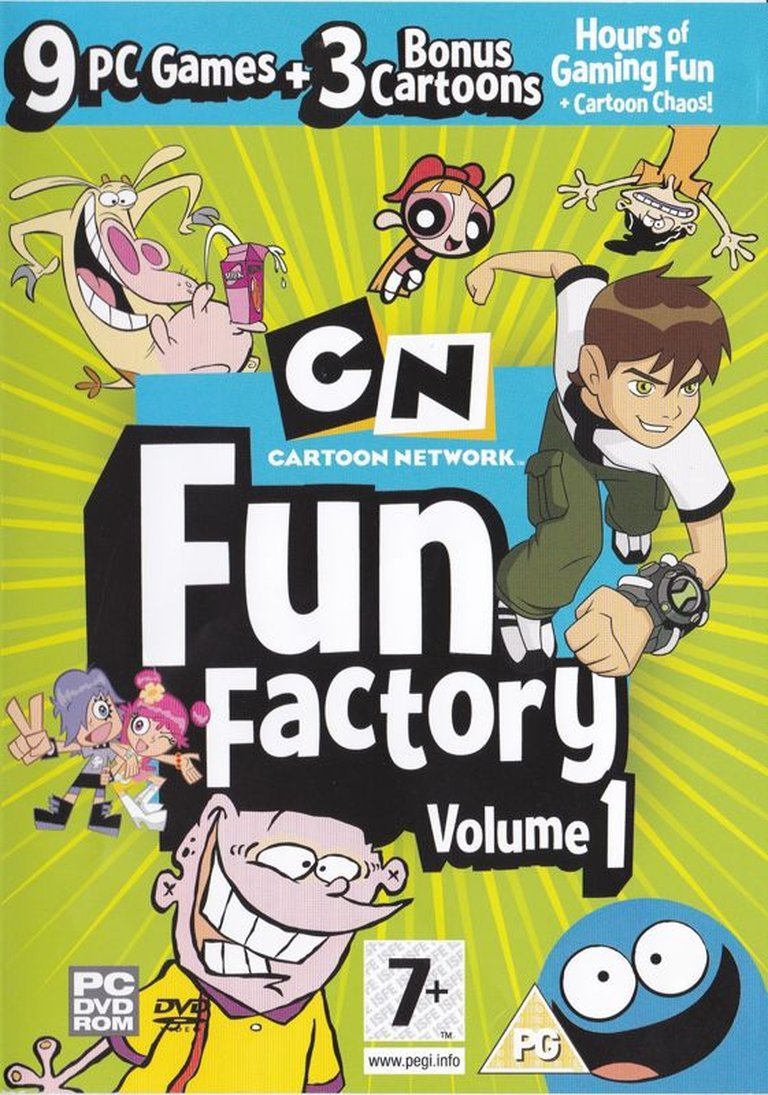
Fun Factory 1: 9 Games Plus 3 Cartoons is a DVD compilation featuring nine browser-based mini-games and three animated episodes from Cartoon Network franchises. Players engage in varied activities such as controlling Ben 10 in a side-scrolling shooter, searching Dexter’s lab for a robot, delivering love letters as Johnny Bravo, and battling monsters in a Halloween-themed platformer. Additional games include a checkers variant, a top-down racer, and a meteor-dodging shooter, all based on popular series like Samurai Jack, Megas XLR, and The Powerpuff Girls. The package includes three cartoons from Ed Edd ‘n’ Eddy, Foster’s Home for Imaginary Friends, and The Grim Adventures of Billy & Mandy, requiring Adobe Shockwave and Flash players to run the browser-compatible content.
Fun Factory 1: 9 Games Plus 3 Cartoons: Review
Introduction
A Time Capsule of Cartoon Network Nostalgia
In the late 2000s, as the golden age of browser-based Flash games peaked, Fun Factory 1: 9 Games Plus 3 Cartoons emerged as a curious artifact—a commercial DVD compilation repackaging free web games tied to Cartoon Network’s iconic franchises. Released in 2009 by Empire Interactive, this collection aimed to capitalize on the popularity of shows like Ben 10, Dexter’s Laboratory, and The Powerpuff Girls by offering a tangible, offline experience. However, its legacy is a paradox: a charming but flawed relic that bridges the gap between ephemeral web content and physical media. This review argues that while Fun Factory 1 delivers a dose of nostalgia, its technical limitations and lack of innovation relegate it to a footnote in gaming history.
Development History & Context
The Flash Game Boom and Cartoon Network’s Cross-Media Experiment
By 2009, browser games powered by Adobe Flash and Shockwave dominated casual gaming, offering low-barrier entertainment for children and teenagers. Cartoon Network, already a powerhouse in animated content, leveraged its IPs to create bite-sized games for its website. Empire Interactive Europe Ltd., known for budget-friendly compilations, saw an opportunity to monetize these free experiences by bundling nine games and three cartoons onto a double-sided DVD.
The decision to compile these games reflected a broader trend of repurposing digital content for physical retail, targeting families without consistent internet access. Yet, the reliance on deprecated plugins like Shockwave and Flash—even at the time of release—underscored the project’s fragility. In an era where Call of Duty: Modern Warfare 2 and Batman: Arkham Asylum redefined AAA gaming, Fun Factory 1 was a stark contrast: a low-risk, low-reward product banking on brand recognition rather than innovation.
Narrative & Thematic Deep Dive
Mini-Games, Micro-Stories
The compilation’s narrative depth is inherently tied to its source material, with each game echoing the themes of its respective show:
- Ben 10: Power Splash and Critical Impact: These side-scrolling shooters emphasize Ben Tennyson’s alien transformations, translating the show’s action-comedy tone into simple score-chasing gameplay.
- Dexter’s Laboratory: Runaway Robot: A point-and-click adventure mirroring Dexter’s scientific ingenuity, tasking players with reassembling his rogue creation.
- The Grim Adventures of Billy & Mandy: Harum Scarum: A Halloween-themed platformer dripping with the series’ macabre humor, pitting players against “monster pumpkins.”
- Foster’s Home for Imaginary Friends: Big Shot Checkers: A quirky twist on checkers that aligns with the show’s whimsical creativity.
While these games capture the spirit of their source material, their narratives are threadbare, serving as vignettes rather than expansive storytelling vehicles. The included cartoons (e.g., Ed Edd ‘n Eddy’s “Who, What, Where, Ed”) reinforce the compilation’s role as a nostalgia-driven product rather than a narrative powerhouse.
Gameplay Mechanics & Systems
A Patchwork of Controls and Frustrations
Fun Factory 1’s gameplay ranges from functional to frustrating, with mechanics often limited by their browser-based origins:
- Diverse Control Schemes: Games alternate between keyboard-controlled shooters (Ben 10: Power Splash) and mouse-driven puzzles (Dexter’s Laboratory: Runaway Robot). This inconsistency creates a disjointed experience, lacking a unified design philosophy.
- Innovative Flashes: Foster’s Home for Imaginary Friends: Big Shot Checkers introduces a three-path victory system (capture, block, or “king” a piece), offering strategic depth uncommon in other entries.
- Technical Hurdles: Notably, Megas XLR: Megas Vs The Universe and Foster’s Big Shot Checkers suffered from loading issues, requiring web connectivity even on the DVD version—a glaring oversight for an offline product.
The compilation’s dependency on Adobe plugins further hampered accessibility, requiring players to install third-party software just to run the games (ironic for a physical release).
World-Building, Art & Sound
Aesthetic Faithfulness Amidst Low Fidelity
Visually, the games mirror their TV counterparts with varying success:
- Art Style: Pixelated sprites and Flash-animated cutscenes evoke the early-2000s web aesthetic, prioritizing faithfulness over polish. Samurai Jack: Code of the Samurai stands out with its minimalist, cel-shaded visuals.
- Sound Design: The games feature compressed voice clips and looped background music ripped straight from the shows, reinforcing brand cohesion but offering little original audio craftsmanship.
- Atmosphere: The compilation’s Halloween-centric entries (Billy & Mandy, Powerpuff Girls: Meet the Mayor) lean into seasonal charm, but the lack of visual diversity across the collection weakens immersion.
Reception & Legacy
The Silence of Obscurity
Fun Factory 1 left almost no discernible mark on the gaming landscape. Critical reviews are nonexistent on platforms like MobyGames and IGN, suggesting minimal publicity or outreach. Commercially, it was overshadowed by 2009’s blockbusters (Left 4 Dead 2, Plants vs. Zombies), and its reliance on dying technologies (Flash/Shockwave) rendered it obsolete within years.
Yet, its legacy lies in preservation: as Flash games vanish from the internet, Fun Factory 1 unintentionally archives a slice of Cartoon Network’s interactive history. For collectors, it’s a curious footnote; for historians, a case study in cross-media experimentation.
Conclusion
Nostalgia Over Substance
Fun Factory 1: 9 Games Plus 3 Cartoons is a product of its time—a haphazard compilation that sacrifices polish for brand synergy. While it succeeds as a nostalgia trigger for Cartoon Network devotees, its technical flaws, inconsistent gameplay, and lack of critical acclaim relegate it to the margins of gaming history. Today, it serves best as a reminder of Flash gaming’s ephemeral charm and the risks of repackaging web content without refinement. For all its quirks, Fun Factory 1 is less a “fun factory” and more a fleeting time capsule.
Final Verdict: A curiosity for completionists, but hardly essential. 2/5 stars.