
- Release Year: 2008
- Platforms: Windows
- Publisher: 1C Company, Paradox Interactive AB, Snowball.ru, TaleWorlds Entertainment Ltd
- Developer: TaleWorlds Entertainment Ltd
- Genre: Role-playing (RPG), Strategy, Tactics
- Perspective: 1st-person
- Game Mode: Single-player
- Gameplay: Action RPG, Character customization, Economic simulation, Mounted Combat, Open World, Prisoner management, Real-time combat, Sandbox, Siege battles, Skill progression, Trading
- Setting: Medieval
- Average Score: 85/100
Description
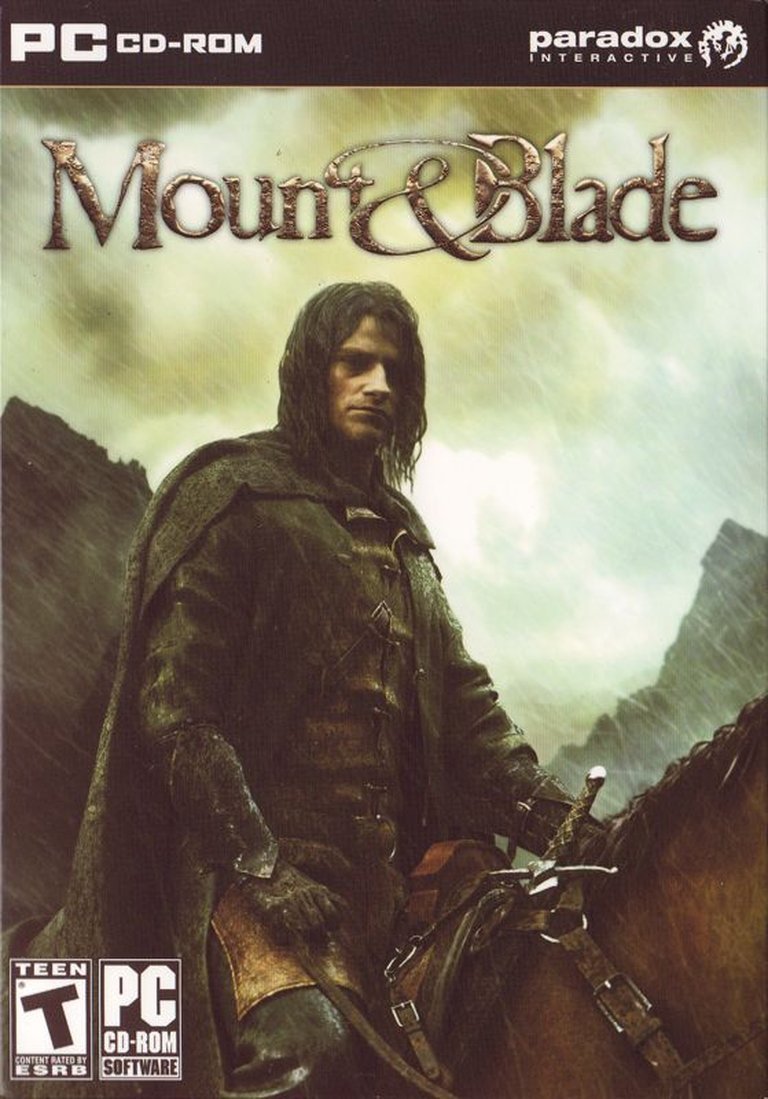
Mount & Blade is an open-ended, nonlinear game set in a realistic medieval world that combines RPG elements with strategy management, exploration, and full real-time combat. Players control a single character, exploring a vast 3D map, engaging in combat, and interacting with NPCs to shape their own story in a sandbox environment.
Gameplay Videos
Where to Buy Mount & Blade
Mount & Blade Free Download
PC
Mount & Blade Cracks & Fixes
Mount & Blade Patches & Updates
Mount & Blade Mods
Mount & Blade Guides & Walkthroughs
Mount & Blade Reviews & Reception
metacritic.com (85/100): For a game with such a heavy emphasis on medieval combat, Mount & Blade is just shy of perfection.
ign.com : There’s nothing more satisfying than a good sword slash.
gamesradar.com : Mount & Blade is a half-decent stab at the open-ended medieval RPG.
Mount & Blade Cheats & Codes
Mount & Blade (PC)
Start the game and go to Configure > Game > Enable Cheats. Then enter the codes at the specified screen.
| Code | Effect |
|---|---|
| Ctrl+X | Get 1,000 denars (gold) when used on the Inventory screen |
| Ctrl+X | Add 1,000 experience points when used on the Character screen |
| Ctrl+X | Upgrade selected unit (party member) when used on the Party screen |
| Ctrl+T | Toggle Truesight – view all parties on the map |
| Ctrl+H | Fully restore character health |
| Ctrl+W | Add 10 points to each weapon proficiency |
Mount & Blade: Warband (PC)
Enable cheats via Configure > Game > Enable Cheats or open the console with Ctrl+~ and type ‘cheatmenu’ to access console commands.
| Code | Effect |
|---|---|
| Ctrl+X | Add 1,000 XP (Character screen), add 1,000 denars (Inventory screen), or upgrade the selected party unit (Party screen) |
| Ctrl+F5 | AI takes over character in battle |
| Ctrl+F4 | Inflict massive damage to a random enemy (kills one enemy per press during battle) |
| Ctrl+Shift+F4 | Inflict massive damage to all enemies (knocks out all nearby enemies during battle) |
| Ctrl+F6 | Knock out one of your troops (delivers damage to a random ally during battle) |
| Ctrl+Shift+F6 | Knock out all your troops (delivers damage to all allies during battle) |
| Ctrl+F3 | Damage yourself (hurts the player’s character during battle) |
| Ctrl+F9 | Toggle slow motion |
| Ctrl+F11 | Pause the game |
| Ctrl+H | Fully restore your character’s health |
| Ctrl+Shift+H | Replenish your horse’s health |
| Ctrl+L | Automatic level up (levels the character up instantly – note potential overflow if used beyond level 62) |
| Ctrl+Left Click | Teleport party to the cursor location on the map |
| Ctrl+T | See all parties and tracks on the map |
| Ctrl+W | Add 10 points to each weapon proficiency |
| Ctrl+Space | Fast forward while traveling |
| cheatmenu | Enable cheat menu via console |
| nocheatmenu | Disable cheat menu via console |
Mount & Blade: A Pioneering Sandbox in Medieval Warfare
Introduction
In the pantheon of cult classic RPGs, Mount & Blade (2008) stands as a defiant outlier—a game that eschewed scripted narratives and hand-holding in favor of raw, emergent medieval chaos. Developed by Turkish studio TaleWorlds and published by Paradox Interactive, this indie gem redefined player agency with its open-ended sandbox design, blending real-time combat, strategic army management, and political intrigue. While its rough edges drew mixed reviews at launch, Mount & Blade has since become a benchmark for immersive medieval simulations, inspiring a passionate modding community and a lineage of sequels. This review unpacks its legacy, mechanics, and enduring influence.
Development History & Context
Mount & Blade began as a passion project by husband-and-wife duo Armağan and İpek Yavuz, who coded and modeled the game from their garage. Released after four years of public beta testing, it emerged in an era dominated by linear RPGs like The Elder Scrolls IV: Oblivion (2006) and Dragon Age: Origins (2009). TaleWorlds’ vision was starkly different: a gritty, low-fantasy world where players carved their own path as mercenaries, traders, or warlords, free from predefined heroes or quests.
Technological constraints were evident—the Newton Game Dynamics engine prioritized physics-based combat over graphical fidelity—but this limitation birthed a combat system praised for its tactical depth. Paradox Interactive’s 2008 retail release catapulted the niche title into wider recognition, though its indie roots remained visible in its minimalist UI and procedural quests.
Narrative & Thematic Deep Dive
Mount & Blade dispenses with a centralized plot, instead offering a skeletal framework: the fractured continent of Calradia, where six factions vie for dominance. Players forge their own stories through alliances, betrayals, and battlefield glory. Themes of power and ambition permeate the world, reflected in lords who shift allegiances based on convenience and villages pillaged in the name of conquest.
The factions mirror historical medieval cultures—Swadians as feudal knights, Rhodoks as republican crossbowmen, Khergits as steppe nomads—but lack deep lore. Instead, emergent narratives arise from gameplay: a player’s rise from peasant to king, or a rival lord’s grudge after repeated defeats. While criticized for sparse dialogue and repetitive NPC interactions, this absence of hand-crafted storytelling empowers players to project their own myths onto Calradia’s war-torn canvas.
Gameplay Mechanics & Systems
Combat & Progression
The heart of Mount & Blade lies in its physics-driven combat. Attacks are directional, requiring players to swing, thrust, or block in real-time, while mounted combat demands mastery of lance couching and horseback archery. This system rewards skill over stats, though character progression—via attributes like Strength and Agility, and skills like Surgery or Leadership—adds strategic depth.
Army Management & Economy
Players recruit and train troops from villages, balancing morale, wages, and diverse unit types (e.g., Swadian knights vs. Nord huscarls). The economy, while simplistic, lets players trade goods between towns or fund enterprises like breweries. Sieges and large-scale battles (up to 150 units) test tactical prowess, though AI pathfinding and repetitive siege layouts drew criticism.
Flaws & Innovations
The game’s lack of narrative direction polarized players, as did its “spreadsheet”-like strategic layer. However, its moddable DNA and emergent gameplay—such as balancing honor against pragmatism when raiding villages—cemented its reputation as a sandbox pioneer.
World-Building, Art & Sound
Calradia’s diverse biomes—from Vaegir tundras to Sarranid deserts—are rendered in functional, if dated, graphics. Towns and castles feel lived-in, though repetitive layouts undermine immersion. Sound design shines: clashing steel, hoofbeats, and battle cries heighten the chaos of combat. Jesse Hopkins’ score, with its faction-specific leitmotifs (e.g., Khergit throat-singing), adds cultural flavor, even if tracks grow repetitive.
Reception & Legacy
At launch, Mount & Blade earned a 72/100 on Metacritic, praised for its combat but critiqued for its sparse storytelling and janky visuals. Over time, its modding community (e.g., Prophesy of Pendor, Anno Domini 1257) and expansions like Warband (2010) transformed it into a cult classic. Its influence echoes in titles like Kingdom Come: Deliverance (2018) and Bannerlord (2022), which refined its blueprint.
Conclusion
Mount & Blade is a study in contradictions: a game both archaic and revolutionary, flawed yet indispensable. Its combat system remains unmatched in tactile realism, and its open-world ethos inspired a generation of sandbox RPGs. While not for everyone, its legacy lies in the stories players create—not the ones they’re told. For those willing to embrace its chaos, Mount & Blade isn’t just a game; it’s a medieval life simulator, warts and all.
Final Verdict: A rough-hewn masterpiece that redefined player agency, Mount & Blade earns its place in gaming history as the ultimate medieval power fantasy.