
- Release Year: 2002
- Platforms: Windows
- Publisher: Greenstreet Software Ltd.
- Developer: Various
- Genre: Compilation
- Perspective: Various
- Game Mode: Single-player
Description
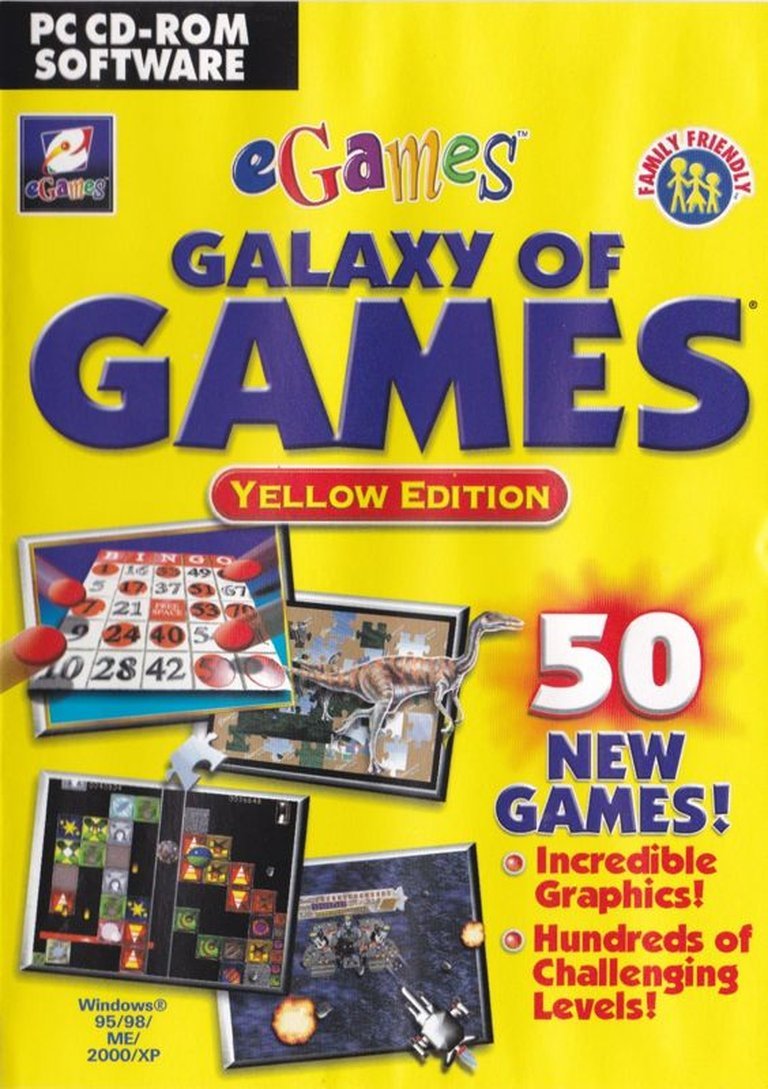
Galaxy of Games: Yellow Edition (2002) is a Windows-based compilation of casual games, part of a color-coded series including Green, Red, and Blue editions. The CD features an auto-installing menu system with 50 games—though many are bundled as single entries like ‘Solitaire 25: Volume 4’—across categories like Casino, Arcade, Strategy, Puzzle, and Card Games. Titles such as ‘Keno SE,’ ‘Blast Thru SE,’ and ‘Crossword Mania’ are included, primarily as demo or ‘Special Edition’ versions. The menu also offers access to demos, game help, and tools like DirectX 7.0 installation.
Gameplay Videos
Galaxy of Games: Yellow Edition Free Download
Galaxy of Games: Yellow Edition: Review
A Budget Compilation That Defined Early 2000s Casual Gaming
Introduction
In the early 2000s, as PC gaming entered its golden age, a quiet revolution was unfolding in bargain bins and big-box retailers: the rise of the budget compilation disc. Among these, Galaxy of Games: Yellow Edition (2002) stands as a fascinating artifact—a fragmented constellation of casual games that offered quantity over quality, accessibility over depth. Released at a time when Windows 98/XP systems dominated households, this compilation represented a bridge between shareware culture and the burgeoning casual gaming market. While not a critical darling or technical marvel, Yellow Edition epitomized a business model that thrived on repackaging bite-sized experiences for mass audiences. This review argues that the game, despite its flaws, is a vital cultural snapshot of an era when “50 games on one disc!” was a siren call to curious gamers on a budget.
Development History & Context
The Studio and Vision
Developed by eGames, Inc. (later distributed in Europe by Greenstreet Software Ltd. after their acquisition of eGames’ European division in 2001), Galaxy of Games: Yellow Edition was part of a broader strategy to monetize the shareware ecosystem. The Galaxy of Games series—color-coded into Green, Red, Blue, Gold, Silver, and Platinum editions—flooded retail chains like Best Buy and K-Mart, targeting families seeking affordable entertainment. The vision was straightforward: curate low-cost, “family friendly” titles from independent developers, bundle them under a unified menu system, and market them with bold promises of “50 games” (a claim achieved by counting individual solitaire variants as separate entries).
Technological Constraints and Landscape
Released in 2002, the compilation leveraged the ubiquity of CD-ROM drives and Windows’ plug-and-play simplicity. The disc auto-installed a rudimentary menu upon insertion, requiring no complex setup—a crucial selling point for non-technical users. However, it also revealed the limitations of its era:
– Dated Dependencies: The included “Tools” section offered installations of DirectX 7.0 and Internet Explorer 5.0, relics even in 2002 (DirectX 9.0 launched that same year).
– SE (Special Edition) Syndrome: Most games were watered-down versions—”Special,” “Shareware,” or “Standard” Editions—of existing titles, with reduced levels or features to incentivize full-game purchases.
This model thrived in a pre-digital-distribution landscape, where physical compilations were gateways to discovery for players without internet access or credit cards.
Narrative & Thematic Deep Dive
As a compilation, Yellow Edition lacks a unifying narrative. Instead, its themes reflect the eclectic, often anarchic spirit of early-2000s casual gaming:
– Casino/Trivia Games: Titles like Keno SE and Bingo Master SE leaned into gambling-lite mechanics, sanitized for living-room play.
– Arcade Action: Games such as Blast Thru SE and Oxide SE offered simplistic shoot-’em-up thrills, while Atlantis Rising (per Reddit recollections) featured quirky, top-down action with absurdist humor (e.g., health pickups like fried rice uttering “just fried rice” when collected).
– Strategy/Puzzle: Snowbound Sheri and Puzzle Master SE catered to methodical players, though depth was sacrificed for accessibility.
– Card Games: The inclusion of Solitaire 25: Volume 4—counted as “25 games” to hit the 50-title promise—exemplified the compilation’s thematic pragmatism.
Thematically, these games prioritized instant gratification over storytelling, embodying a “digital toybox” ethos where variety trumped cohesion.
Gameplay Mechanics & Systems
Core Loop and Structure
The compilation’s menu system was its backbone:
1. Auto-Install Simplicity: Inserting the disc launched a minimalist browser that installed games on-demand.
2. Categorical Organization: Titles were grouped into Casino, Arcade, Strategy, Puzzle, and Card sections, though navigation was functional rather than intuitive.
3. Demo Economy: A “Demos” tab linked to eGames’ website, teasing paid upgrades—a clever funnel from freeware to commerce.
Gameplay Highlights and Flaws
- Standouts: Tile Blazer (a color-matching puzzle game) and Euchre Deluxe (a polished card game) showcased glimpses of craftsmanship.
- Repetition and Cynicism: Many “SE” titles (Alchemist SE, Glowing Bugs) reappeared across multiple Galaxy editions, revealing a recycling strategy. Solitaire 25’s inclusion as 25 “games” underscored the compilation’s deceptive marketing.
- Technical Quirks: Games like Booym (detailed in Reddit nostalgia threads) featured janky controls and AI, but their simplicity resonated with undemanding players.
The UI was utilitarian, prioritizing function over flair—a reflection of its budget origins.
World-Building, Art & Sound
Visual and Auditory Identity
With no unified aesthetic, Yellow Edition’s identity was a patchwork of its components:
– Art Styles: Ranged from garish, pre-rendered 3D (Castle Slots) to charming 2D sprites (Garrett and Gardener). Color saturation was a common thread, appealing to casual sensibilities.
– Sound Design: Generic MIDI tracks and repetitive sound effects dominated, though games like Galaxy Poker featured upbeat casino-inspired jingles.
– Atmosphere: The compilation exuded a “demo disc” vibe—disposable yet oddly comforting, like browsing a flea-market bin of forgotten software.
While artistically inconsistent, the randomness fostered a sense of discovery, as players stumbled upon oddities like Extreme Dinosaurs (a dinosaur-themed tile game) or Roulette Fever SE.
Reception & Legacy
Contemporary Reception
No formal critic reviews exist on Metacritic or MobyGames, underscoring its status as a “shadow canon” title—popular but critically invisible. Commercial success, however, is inferred from the series’ expansion (e.g., Galaxy of Games: 50,000 in 2009) and its shelf presence in retailers.
Cultural Legacy
- Nostalgia Factor: Reddit threads (e.g., r/tipofmyjoystick, r/retrogaming) reveal fond memories of Yellow Edition as a gateway drug for young gamers, with users recounting hours spent on Atlantis Rising or Blast Thru SE.
- Influence on Casual Gaming: The compilation prefigured modern trends like mobile free-to-play models and mini-game collections (e.g., WarioWare), proving that brevity and variety could captivate audiences.
- Preservation Challenges: As a physical-only release with overlapping content across editions, Yellow Edition risks digital oblivion—yet its ISO survives on Archive.org, a testament to its subcultural significance.
Conclusion
Galaxy of Games: Yellow Edition is neither a masterpiece nor a trainwreck—it is a time capsule. Its value lies not in individual games but in its embodiment of early-2000s gaming economics: the exploitation of shareware, the allure of bulk content, and the democratization of play for non-enthusiasts. While its “50 games” claim was marketing sleight-of-hand, and its SE titles were cynical upsell vehicles, it fulfilled a need for affordable, low-stakes entertainment. Today, it stands as a relic of an era when gaming was being reshaped by accessibility, reminding us that even the most unassuming compilations can leave cosmic ripples in player memories. For historians, it is essential; for modern players, it is a curiosity—a yellowed star in gaming’s ever-expanding galaxy.
Final Verdict: A flawed but historically vital footnote in casual gaming’s evolution, best appreciated as a museum piece or nostalgia trigger.