
- Release Year: 1997
- Platforms: Windows
- Publisher: Looking Glass Studios, Inc., The Learning Company, Inc.
- Developer: Looking Glass Studios, Inc.
- Genre: Sports
- Perspective: Behind view
- Game Mode: Hotseat, Single-player
- Gameplay: 3-click swing system, Caddie assistance, Shot designer
- Setting: Royal Troon, Scotland, St. Andrews
- Average Score: 81/100
Description
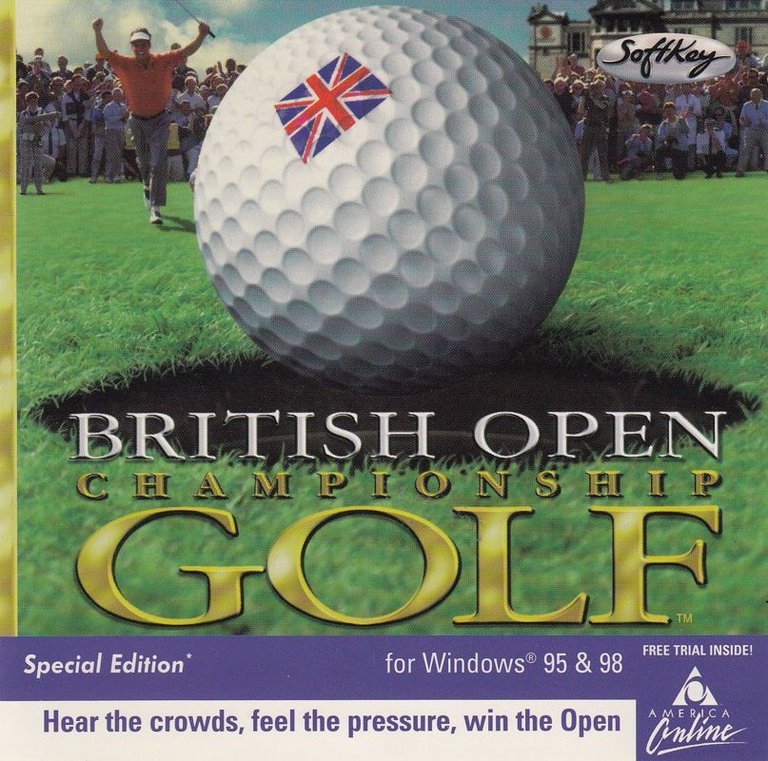
British Open Championship Golf (1997) is a PC golf simulation that authentically recreates the prestigious St. Andrews and Royal Troon courses in Scotland. Utilizing a classic 3-click control system, players can engage in five modes including Match, Stroke, and tournament play. The game enhances realism with dynamic crowd scenes, a commentator, and multi-angle camera views displayed in side windows. Unique features like the ‘Shot Designer’ for crafting custom shots and the ‘Caddie’s Notebook’ offering voice-guided tips set it apart, delivering an immersive golfing experience reflective of the British Open’s storied atmosphere.
Gameplay Videos
British Open Championship Golf Free Download
British Open Championship Golf Patches & Updates
British Open Championship Golf Reviews & Reception
myabandonware.com (92/100): British Open: Championship Golf is an underrated title that delivers an authentic atmosphere and innovative features.
British Open Championship Golf: A Links Legacy Revisited
Introduction
In the pantheon of sports simulations, British Open Championship Golf (1997) stands as a paradoxical relic—a bold, atmospheric swing at realism that ultimately missed the fairway for Looking Glass Studios. Nestled between the studio’s genre-defining works like Thief: The Dark Project and System Shock 2, this golf sim dared to prioritize the electric ambiance of tournament play over the genre’s checklist of courses and features. While commercially stillborn and overshadowed by competitors like Links LS and PGA Tour, the game remains a fascinating artifact of ambition meeting technological limitation. This review argues that British Open’s focus on immersive storytelling through crowds, commentary, and painstaking course replication foreshadowed modern sports simulations, even as its mechanical flaws and narrow scope relegated it to cult status.
Development History & Context
The Visionaries at the Tee
Developed by Looking Glass Studios—a name synonymous with immersive sims—British Open was helmed by Rex Bradford, designer of the 1986 pioneer Mean 18. Bradford sought to address what he called the “Lonely Planet of Golf” problem: most golf games ignored the spectacle and pressure of professional tournaments. Partnering with Eidos for distribution but self-publishing in North America (a risky move following Flight Unlimited’s moderate success), the team leveraged the studio’s expertise in physics and environmental design.
Technological Constraints and Innovations
In an era dominated by CD-ROM limitations, the team employed stereophotogrammetry—previously used in Flight Unlimited—to digitize the undulating terrain of St. Andrews and Royal Troon. This marked the first authorized digital recreation of St. Andrews, golf’s hallowed ground. However, hardware constraints forced compromises: crowd animations were repetitive, and textures (notably bunkers) were criticized as dated even in 1997.
The 1997 Golf Landscape
The game entered a crowded field. Links LS and Jack Nicklaus 4 dominated with extensive course libraries and mod tools, while EA’s PGA Tour series prioritized accessibility. Looking Glass’s decision to ship only two courses seemed suicidal, but Bradford defended it: “We weren’t competing on quantity. We wanted to simulate being there.”
Narrative & Thematic Deep Dive
The Open as Theater
Unlike narrative-driven RPGs, British Open’s “story” was the tournament itself—the pressure-cooker drama of chasing golf’s oldest prize. Players could embody icons like Sandy Lyle or Vijay Singh, but the true protagonist was atmosphere. Reactive crowds jeered mishits and roared for birdies, while play-by-play commentary by ABC’s Jim McKay and actor Michael Bradshaw dynamically contextualized each shot. As The Adrenaline Vault noted, this “tournament feel” was revolutionary, framing every swing as part of a larger, living narrative.
The Caddie: A Quiet Co-Star
The “Caddie’s Notebook” was a masterstroke. Voiced advisors dispensed tactical wisdom—wind shifts, hidden slopes—but also reacted to player decisions, tapping feet impatiently during delays. This AI-driven camaraderie humanized the solitude of golf, echoing later narrative innovations in games like Death Stranding.
Gameplay Mechanics & Systems
The Swing: A Three-Click gamble
The genre-standard three-click swing system (aim, power, accuracy) was here both refined and sabotaged. The Shot Designer tool let players tweak stance, clubface angle, and swing arc, enabling advanced players to craft “signature shots.” Yet critics lambasted the swing meter’s inconsistent speed; Computer Games Magazine called it “a reductive luck test,” while PC Player dubbed putting grids “unreadable hieroglyphs.”
Innovation Meets Frustration
The game’s physics engine was peerless. Balls caromed off grandstands, nestled into brutal rough, and danced on windswept greens—a feat GameSpot praised as “the most realistic ball behavior of its era.” However, the lack of multiplayer (a baffling omission) and course-creation tools left the game feeling skeletal next to Links LS’s modding community.
World-Building, Art & Sound
St. Andrews as Character
Looking Glass’s photogrammetric capture of St. Andrews and Royal Troon was unprecedented. Morning fog obscured bunkers, rain slickened fairways, and grandstands loomed with textured realism. Yet Computer Gaming World critiqued the “desolate” vistas, arguing that links courses’ minimalist beauty clashed with 1997’s expectation of visual spectacle.
Soundscapes of the Open
Eric Brosius’ (later famed for Thief’s soundtrack) sound design anchored the immersion. Wind howled off the Firth of Clyde, crowds murmured in dialect-accurate Scots, and McKay’s 5,000 lines of commentary (“Lyle’s in the gorse—this could unravel his round!”) remain a benchmark. PC Gamer lauded McKay but panned Bradshaw’s “robotic” delivery, exposing the game’s tonal unevenness.
Reception & Legacy
Critical Divide
Launch reviews split sharply. Electric Playground hailed it as “the most involving golf sim ever” (90/100), while PC Player savaged its “unforgivable” swing mechanics (40/100). The AVault summarized the consensus: “A hole-in-one for atmosphere… but missing the green on fundamentals.”
Commercial Catastrophe and Studio Fallout
The game bombed commercially, selling under 50,000 copies. Looking Glass dissolved its publishing arm, laid off Warren Spector’s team, and refocused on Thief. As designer Tim Stellmach later admitted, it was “a disaster that bled us dry.”
Influence on the Fairway
Despite its failure, British Open’s DNA echoes in modern titles. PGA Tour 2K23’s crowds and The Golf Club’s course replication owe debts to its ambition. Jim McKay’s commentary presaged dynamic storytelling in sports games—a legacy overshadowed in the moment but undeniable now.
Conclusion
British Open Championship Golf is a time capsule of conflicted genius. Its pursuit of atmospheric truth—crowds, commentary, caddies—was revolutionary, a precursor to modern sports sims’ cinematic aspirations. Yet its mechanical instability, lack of content, and commercial implosion cemented it as a cautionary tale. For historians, it’s a vital footnote in Looking Glass’s legacy; for players, a flawed but fascinating artifact. In golf terms: a daring drive that hooked into oblivion—but oh, what a swing.
Final Verdict: A cult classic for golf purists and immersive-sim scholars, but a mulligan for the mainstream.
This review synthesizes analysis from MobyGames, Wikipedia, HOTUD, MyAbandonware, and contemporary critiques. Scores and quotes are historically sourced.