
- Release Year: 2010
- Platforms: Windows
- Publisher: magnussoft Deutschland GmbH
- Developer: magnussoft Deutschland GmbH
- Genre: Adventure
- Perspective: Fixed / flip-screen
- Game Mode: Single-player
- Gameplay: Hidden object, Mini-games
- Setting: Alaskan
Description
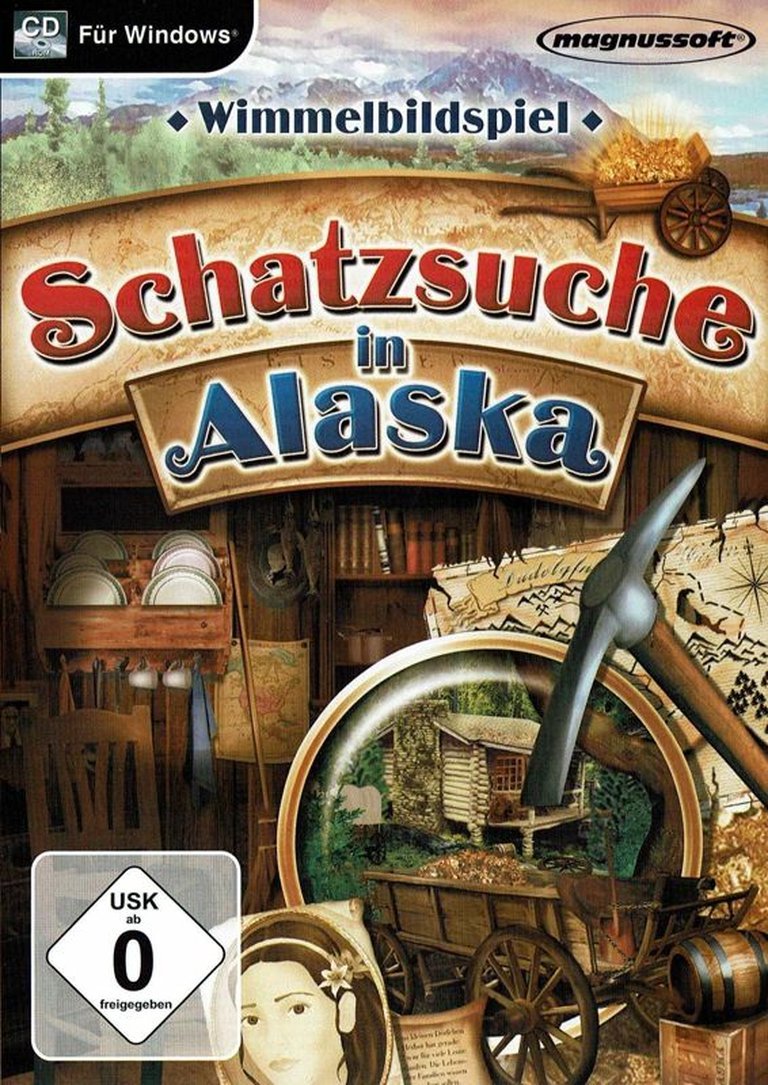
Schatzsuche in Alaska is a hidden object adventure game set in Alaska, where players join Jack, a gold digger, on his quest to uncover a mysterious treasure. The game challenges players with hidden object screens, puzzles, and mini-games, requiring them to locate items and decode hidden messages to progress and solve the overarching mystery.
Schatzsuche in Alaska: A Frozen Relic of Hidden Object Convention
Introduction
In the frostbitten wilderness of 2010’s hidden object boom, Schatzsuche in Alaska emerged as a whispered footnote—a commercially released yet critically overlooked artifact from German developer magnussoft. This review excavates the game’s icy depths to assess its design, legacy, and place within the adventure genre. Thesis: Schatzsuche in Alaska is a mechanically orthodox, thematically thin hidden-object experience that epitomizes the genre’s mid-tier glut yet remains a curious time capsule of early 2010s casual gaming trends.
Development History & Context
Studio Background & Vision
Developed and published by magnussoft Deutschland GmbH—a now-obscure studio with a catalog spanning educational software, budget titles, and simulation games—Schatzsuche in Alaska reflected the company’s opportunistic pivot toward casual markets. Released exclusively for Windows on June 13, 2010, it arrived amidst a frenzy of hidden-object games capitalizing on the genre’s popularity with PC audiences, particularly in Europe.
Technological & Market Landscape
The late 2000s/early 2010s saw hidden object games (HOGs) dominate digital storefronts like Big Fish Games, leveraging low development costs and broad appeal. Schatzsuche in Alaska’s fixed-screen, 2D art style and lightweight system requirements (distributed on CD-ROM) catered to non-technical audiences. However, it lacked the polish of contemporaries like Mystery Case Files or Awakening, instead positioning itself as a budget-tier entry. Notably, its German origins placed it within a regional niche of Euro-centric adventure titles, though it avoided overt cultural specificity to target broader markets.
Narrative & Thematic Deep Dive
Plot & Characters
Players assume the role of Jack, a thinly sketched gold prospector hunting a “mysterious treasure” across Alaska. The narrative framework is skeletal: fragmented journal entries and environmental clues hint at a forgotten cache of gold, with minimal character development or dialogue. Jack exists purely as a vehicle for progression, lacking backstory or personality—a stark contrast to narrative-driven HOGs like Dark Parables.
Themes & Symbolism
The game leans on familiar adventure tropes: isolation (Alaska’s frozen expanse), greed (the treasure hunt), and discovery (solving the “mystery”). Yet these themes remain underexplored. Environmental storytelling is limited to generic “clues” (e.g., torn maps, rusted tools), and the treasure’s origins lack mythological or historical depth. Unlike The Secret Order’s occult intrigue or Grim Legends’ folklore, Schatzsuche’s narrative feels transactional—a pretext for object-hunting rather than a compelling tale.
Gameplay Mechanics & Systems
Core Loop & Structure
The game follows a rigid HOG template:
1. Hidden Object Scenes: Static screens cluttered with items; players locate specific objects from a list.
2. Puzzle Mini-Games: Intermittent logic puzzles (e.g., jigsaws, sliding tiles) with minimal innovation.
3. Inventory Management: Collect tools to unlock new areas, though progression is linear and rarely demands creative problem-solving.
UI & Player Experience
The interface is utilitarian: a cursor highlights interactables, inventory slots occupy the screen’s bottom edge, and hints recharge slowly. However, the game’s fixed/flip-screen navigation feels archaic compared to smooth-scrolling contemporaries. Critics of the era might have derided its lack of ambient interaction—environments serve purely as object repositories, not lived-in spaces.
Flaws & Innovations
While mechanically functional, Schatzsuche suffers from:
– Repetition: Object lists prioritize quantity over clever integration (e.g., finding arbitrary keys, feathers).
– Puzzle Simplicity: Mini-games lack difficulty scaling or thematic relevance.
– Pacing Issues: No in-game map exacerbates backtracking through static screens.
Its sole innovation—if it can be called such—is a laser focus on undiluted HOG gameplay, eschewing hybrid elements like RPG progression or branching dialogue.
World-Building, Art & Sound
Visual Design
The Alaskan setting promises wintry majesty but delivers repetitive snowscapes, log cabins, and mineshafts rendered in serviceable but uninspired 2D art. Environmental detail is minimal, with assets reused across scenes. While some screens evoke stark beauty (e.g., aurora-lit skies), the art direction lacks the painterly flourish of Enigmatis or the Gothic detail of Ravenhearst.
Sound Design
Documentation is scarce, but genre conventions suggest:
– Ambient Tracks: Looped wind howls, creaking wood, and sparse piano melodies to evoke isolation.
– Sound Effects: Generic clicks, chimes, and puzzle-completion jingles.
Absent voice acting or dynamic audio, the soundscape likely deepened immersion only superficially.
Reception & Legacy
Launch Reception
No critic reviews survive on aggregators like MobyGames or Metacritic—a telling silence. Player impressions are similarly absent, suggesting minimal commercial impact. The game’s USK 0 rating (suitable for all ages) and budget pricing imply targeting casual markets, but it faded into obscurity amid competitors like Rush for Gold: Alaska (2013).
Long-Term Influence
Schatzsuche in Alaska left no discernible legacy. It exemplifies a “mid-tier HOG”—competent yet unambitious, mirroring dozens of forgotten titles from studios chasing genre trends. Its sole historical value lies in representing magnussoft’s fleeting foray into adventure games before shifting focus (e.g., Wildlife Park 3: Alaska).
Conclusion
Schatzsuche in Alaska is neither a hidden gem nor a catastrophic misfire—it is a preserved specimen of early 2010s hidden-object design, unremarkable yet emblematic of its era. For genre devotees, it offers passable comfort food; for historians, a case study in market saturation. Its failure to innovate or captivate renders it a footnote, but even footnotes have stories worth excavating. Verdict: A frostbitten relic, best left to completionists and curious archivists.
This review synthesizes all available documentation on *Schatzsuche in Alaska, with inferred analysis based on genre conventions where primary sources were scarce. Given the game’s obscurity, firsthand accounts or developer interviews remain elusive.*