
- Release Year: 2000
- Platforms: Windows
- Publisher: Ivanoff Interactive A/S, Nordic Softsales AB
- Developer: Ivanoff Interactive A/S
- Genre: Action
- Perspective: 3rd-person (Other), Top-down
- Game Mode: Co-op
- Gameplay: Action, Breakout, Memory, Platform, Puzzle
- Average Score: 80/100
Description
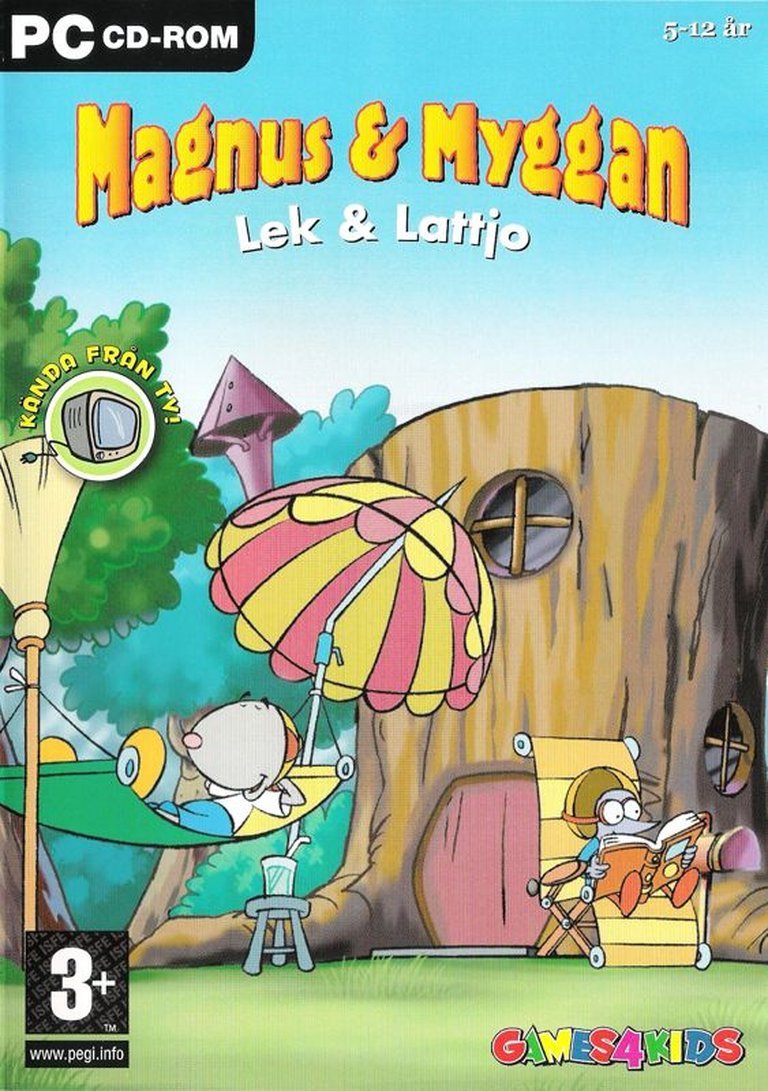
Magnus & Myggen: Hold da helt ferie is a children’s game collection featuring the adventures of a mole and a mosquito, aimed at ages five to twelve. This seventh installment in the edutainment franchise offers three separate programs with a total of seven mini-games, focusing on fun rather than educational content. The games include memory challenges, puzzles, and action-packed levels where players collect items and avoid obstacles.
Magnus & Myggen: Hold da helt ferie Reviews & Reception
sockscap64.com (80/100): Magnus & Myggen: Hold da helt ferie is a collection of games aimed at children ages five to twelve. It’s the 7th game in the edutainment franchise about the two characters, a mole and a mosquito, who in English are called Skipper & Skeeto.
Magnus & Myggen: Hold da helt ferie – A Playground of Danish Delights, Lost in Translation
Introduction
In the pantheon of late-’90s European edutainment franchises, few series carved out as distinct a niche as Magnus & Myggen (known internationally as Skipper & Skeeto). A Danish multimedia empire birthed by Ole Ivanoff’s Ivanoff Interactive, the franchise blended environmentalist themes, anthropomorphic charm, and a surprisingly rich cast of characters. Hold da helt ferie (“Take a Break” in English), released in April 2000, marks an oddball entry in the series: a pivot away from narrative-driven edutainment into pure mini-game compilation. This review dissects whether this detour captures the series’ magic or dilutes its legacy.
Development History & Context
Studio & Vision
Ivanoff Interactive, founded in the mid-’90s, specialized in children’s edutainment that balanced Scandinavian whimsy with gentle pedagogy. By 2000, the studio had established Magnus & Myggen as Denmark’s answer to Sesame Street gaming, with titles like The Revenge of Mr. Shade (1998) blending point-and-click adventuring with ecological themes.
Hold da helt ferie emerged during a transitional period. The game’s shift from education to recreation likely reflected market pressures to capitalize on the franchise’s popularity through accessible, replayable content. Developed in Macromedia Director 7—a tool better suited for interactive CDs than complex gameplay—the project was helmed by Pop Kleberg (art/design) and Ultimatum (programming). This cobbled-together production, credited to 17 developers, prioritized simplicity over innovation.
Technological Constraints
The late ’90s CD-ROM era demanded lightweight software for underpowered home PCs. Hold da helt ferie’s reliance on Macromedia limited its audiovisual ambition, resulting in rudimentary animations and static backgrounds. The decision to split the game into three separate executables (Fis & Ballade, Myrekryb, Superbat) further underscored technical limitations, as loading times and disjointed navigation frustrated young players.
Gaming Landscape
In 2000, mini-game compilations like Mario Party (1998) dominated multiplayer fun, while edutainment stalwarts like JumpStart leaned into curriculum-aligned design. Hold da helt ferie straddled both worlds awkwardly—neither sufficiently educational nor as polished as Nintendo’s offerings. Its lack of a cohesive vision left it eclipsed by contemporaries.
Narrative & Thematic Deep Dive
Plot & Characters
Unlike previous entries, Hold da helt ferie jettisons narrative almost entirely. The game’s menu features series stalwarts—brawny mole Magnus (Skipper) and bookish mosquito Myggen (Skeeto)—alongside Suzy Molson, a martial arts-prone mole introduced in Skumlesens Hævn. Yet these characters serve as mere mascots, devoid of the personality that defined earlier games.
Thematic Undercurrents
Earlier Magnus & Myggen titles wove environmentalism and anti-capitalist themes through villain Mr. Shade’s schemes. Here, only Myrekryb—a ladybug-collecting escapade—hints at ecological messaging, tasking players with rescuing numbered insects from pests. The other mini-games (Fis & Ballade’s fruit-catching, Superbat’s brick-breaking) lack thematic coherence, reducing Paradise Park to a generic playground.
Gameplay Mechanics & Systems
Core Mini-Games
-
Fis & Ballade
- Memory Match: A barebones card-flipping exercise.
- Sliding Puzzle: Requires reassembling character portraits—a tedious test of patience for children.
- Apple Catch: A Kaboom! clone where lateral bucket movement catches falling fruit. Functional but shallow.
- River Crossing: A Frogger homage with item collection. Clunky controls undermine its potential.
- Tower of Hanoi: A character-stacking puzzle. The least child-friendly of the set, likely to confuse its target audience.
-
Myrekryb (“Ant Crawl”)
The standout. Players navigate a top-down grid, collecting numbered ladybugs while avoiding spiders and ants. Power-ups like speed-boosting sugar cubes and health-restoring raindrops add strategic depth. However, erratic enemy AI and a lack of progressive difficulty curb replayability. -
Superbat
A two-player Breakout variant with racing elements. Hitting bricks with dots advances a vertical progress bar; the first to the top wins. While chaotic fun, floaty physics and uninspired level design make it a pale imitation of Arkanoid.
UI & Progression
The UI is functional but dated. Menu navigation feels disjointed, with no unifying hub. Progression is nonexistent—no unlockables, difficulty settings, or feedback beyond high scores. For a game targeting ages 5–12, the absence of rewards feels like a critical oversight.
World-Building, Art & Sound
Visual Design
Pop Kleberg’s art retains the franchise’s charming caricatures: rotund moles, spindly mosquitoes, and cartoonish bugs. Yet the environments are static and barren, lacking the lush detail of earlier titles. Myrekryb’s top-down view reduces Paradise Park to a grid, stripping it of personality.
Sound Design
The soundtrack oscillates between jaunty MIDI tunes and grating loops. Sound effects—squishy splats for enemies, twinkles for collectibles—are serviceable but forgettable. Notably absent are voice lines from Jesper Klein (Skeeto’s Danish VA), a franchise mainstay.
Reception & Legacy
Critical & Commercial Reception
No formal reviews exist—an ominous sign. The game’s MobyScore remains “n/a,” with only five user registrations on MobyGames. Sales data is scarce, but its absence from retrospective discussions suggests commercial obscurity.
Legacy
Hold da helt ferie is a footnote in the Magnus & Myggen saga. Later entries like Midnatsmysteriet (2002) returned to narrative-driven design, while this experiment faded into irrelevance. It exemplifies the risks of diluting a franchise’s identity for quick monetization.
Conclusion
Magnus & Myggen: Hold da helt ferie is neither a disaster nor a triumph. Its mini-games are mechanically sound but lack the creativity and polish to stand out in a crowded market. For completionists, it offers a curious glimpse into a franchise’s identity crisis; for others, it’s a relic best left in the CD-ROM bargain bin.
Final Verdict
A well-intentioned but uneven detour, Hold da helt ferie fails to capture the heart of its predecessors. Its legacy lies not in innovation but as a cautionary tale: even beloved franchises stumble when they lose sight of their core vision.
Score: 5/10 – A middling mini-game collection that forgets to bring the magic of Paradise Park along for the ride.