
- Release Year: 1998
- Platforms: Macintosh, Windows
- Publisher: DK Multimedia, Norstedts Rabén Multimedia
- Developer: DK Multimedia
- Genre: Educational, History
- Perspective: 1st-person
- Game Mode: Single-player
- Gameplay: Collectibles, Educational Quizzes, Interactive Maps, Time travel
- Setting: Fantasy, Historical
- Average Score: 89/100
Description
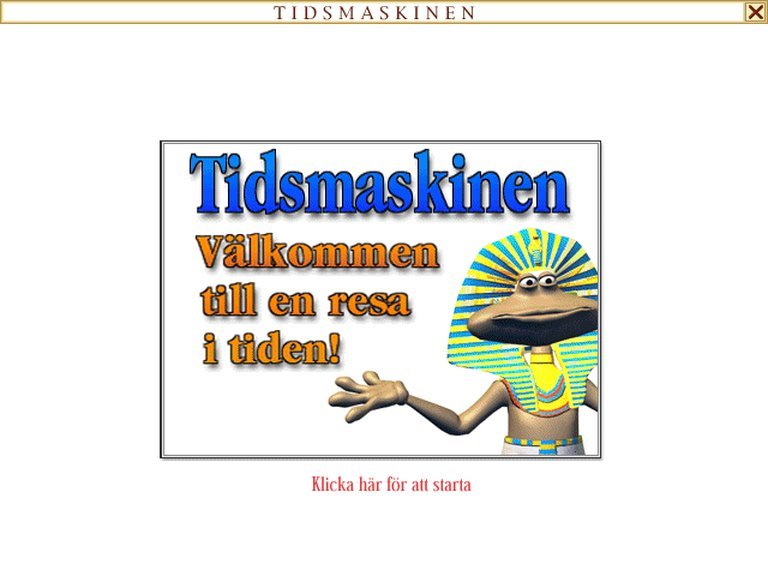
My First Amazing History Explorer is an educational adventure game where players embark on a time-traveling quest to rescue Professor Timestein, who has been trapped in history by the enigmatic Time Fugitive. Using a time machine, players explore eight historical periods—from Ancient Egypt to a 1920s city—interacting with maps, solving quizzes, and collecting clues to piece together a time trail map. Along the way, they engage in activities like designing coats of arms and writing in hieroglyphs while learning about each era’s culture and landmarks.
Gameplay Videos
My First Amazing History Explorer Reviews & Reception
myabandonware.com (89/100): I downloaded this on my windows, but the file wouldn’t play because windows don’t support 16 bit games.
My First Amazing History Explorer: A Time-Traveling Edutainment Portal to the Past
Introduction
Like a digital time capsule unearthed from the golden age of CD-ROM edutainment, My First Amazing History Explorer (1998) stands as a charming artifact of late-90s pedagogical ambition. Developed by DK Multimedia—the interactive arm of Dorling Kindersley’s renowned reference books—this whimsical adventure dared to answer a tantalizing question: Could a children’s game make Julius Caesar as thrilling as Mario? Framed as a rescue mission across millennia, the title fused encyclopedia-grade history with playful interactivity, creating a gateway drug for young armchair historians. Though scarcely remembered today, its DNA persists in modern edu-gaming hybrids. This review unearths its triumphs, limitations, and quiet legacy as a bridge between dusty textbooks and digital worlds.
Development History & Context
The DK Multimedia Vision
Emerging alongside titans like The Magic School Bus and Where in the World Is Carmen Sandiego?, My First Amazing History Explorer was part of DK Multimedia’s push to digitize their signature visual reference style. The studio’s pedigree—boasting 256 credited contributors, including producer Christian Sévigny and Senior Editor Elise Bradbury—reflected a “digital book” ethos. With historian Dr. Anne Millard consulting, the goal was clear: transform static knowledge into explorable spaces.
Technological Constraints of 1998
Built for Windows and Macintosh at the twilight of 16-bit computing, the game wrestled with era-specific limitations:
– CD-ROM Dependency: Assets were constrained by 650MB storage, demanding compressed audio/video and modest 3D renders (handled by Alternative View Studios).
– Input Simplicity: Mouse-only controls catered to young users but limited interactivity depth.
– Hardware Fragility: Modern players report compatibility issues (e.g., 16-bit installer errors on 64-bit Windows), underscoring its vulnerability to tech obsolescence.
The Edutainment Landscape
1998 was a boom year for learning games—Reader Rabbit and JumpStart dominated shelves—but DK Multimedia carved a niche with museum-like depth. Unlike competitors’ abstract mini-games, History Explorer offered location-based learning, mirroring contemporaneous CD-ROM “virtual tours” like Microsoft Encarta. The title’s focus on historical empathy (e.g., designing medieval coats of arms) aligned with progressive pedagogical trends.
Narrative & Thematic Deep Dive
Plot as Pedagogical Vehicle
The game’s MacGuffin-driven premise—rescuing Professor Timestein from the villainous Time Fugitive—is pure Saturday morning cartoon, yet ingeniously scaffolding its educational aims. Each of the eight eras (Ancient Egypt, Imperial China, 1920s cities, etc.) houses a Time Trail Map fragment, incentivizing exploration through narrative urgency. The Time Fugitive’s mischief—disrupting history—subtly frames learning as reparative, positioning the player as both detective and conservator.
Characters & Dialogue
Characterization is minimal but strategic:
– Professor Timestein: A distant paternal figure (voiced by Corey Johnson), embodying scholarly authority.
– The Time Fugitive: A puckish antagonist echoing Carmen Sandiego’s globe-trotting thieves, albeit less charismatic.
– NPCs: Era-specific guides (e.g., Roman senators, Inca artisans) deliver bite-sized facts, blending tutorial prompts with cultural immersion.
Dialogue leans functional (“Can you help restore the timeline?”), prioritizing clarity over flair—a deliberate choice for its 8–11-year-old audience.
Themes: Time as Tangible Space
Beneath its adventure veneer, the game explores history as a malleable artifact. By letting players “photograph” themselves at the Pyramids or scribe hieroglyphs, it transmutes abstract dates into hands-on experiences. The sticker journal mechanic—rewarding correct quiz answers—further literalizes learning as collectible treasure.
Gameplay Mechanics & Systems
Core Loop: Click-and-Learn Tourism
The gameplay hinges on a hub-and-spoke model:
1. Attic Hub: Navigate a 3D-rendered lab (designed by Mark Timson) to access the time machine.
2. Era Selection: Choose destinations via a stylized globe interface.
3. Exploration Phase:
– Hotspot Clicking: Investigate labeled points (e.g., “Egyptian Sphinx”) for narrated vignettes.
– Quiz Challenges: Answer multiple-choice questions (e.g., “What did Romans build to transport water?”) to earn journal stickers.
– Map Fragment Hunt: Locate hidden era-specific puzzle pieces.
Innovations & Flaws
- Strengths:
- Multimedia Depth: Seamlessly integrates illustrations by Tess Roberts/Colin Bunner with VO narration.
- Non-Linear Progression: Players can explore eras freely, respecting individual curiosity.
- Creative Activities: Designing coats of arms/writing hieroglyphs foster artistic engagement.
- Weaknesses:
- Shallow Interactivity: Hotspots trigger canned animations, lacking environmental puzzles.
- Repetition: Quiz formats rarely evolve, risking monotony.
- Save System Absence: Lacking manual saves—a frustration for young players with limited sessions.
UI/UX: Functional but Dated
The 640×480 interface—a grid of icons and text boxes—prioritizes legibility over aesthetics. The journal (a digital scrapbook) is charming but cumbersome; flipping pages feels slower than DK’s print counterparts.
World-Building, Art & Sound
Visual Design: A Living Encyclopedia
DK’s print heritage shines through:
– Era Maps: Hand-painted backdrops (see Ryan Weaver’s Inca vistas) evoke DK book plates, peppered with clickable “Did You Know?” callouts.
– 3D Elements: Characters, rendered in blocky voxel-style models by Darren Poore/Andy Moss, clash awkwardly with 2D art—a tech compromise of the era.
– UX Aesthetics: Primary-colored buttons and bold fonts scream “kid-friendly,” though lack Zoombinis’ whimsy.
Sound Design: Ambient Pedagogy
- Music: Looping era-appropriate tracks (lyre melodies in Greece, industrial clangs in Age of Industry) subtly reinforce setting.
- Voice Acting: Crisp, encouraging narration (e.g., Gavin Temple’s writing) avoids condescension, though secondary characters lack depth.
- Sound Effects: Cartoonish clicks/pops punctuate interactions, satisfying young users’ tactile expectations.
Reception & Legacy
1998 Launch: Quiet Impact
No major critic reviews survive—a testament to gaming media’s then-skepticism toward edutainment—but sales were respectable enough to spawn spiritual sequels (My First Amazing British Isles Explorer, 1999). User testimonials from platforms like MyAbandonware (4.46/5 avg.) highlight nostalgic warmth: “Omg thankyou so much I’ve been looking for it since forever” (user comment, 2023).
Long-Term Influence
While not a genre-redefining titan, History Explorer’s legacy echoes in:
– Modern Edu-Explorers: Assassin’s Creed Discovery Tour modes owe debt to its location-based learning.
– Narrative Framing: Games like Timelie (2020) replicate its “fix history” motivational hook.
– DK’s Trajectory: Paved the way for deeper interactive references (e.g., Eyewitness Encyclopedia of Science).
Its greatest triumph? Humanizing history—proving that learning could be a quest, not a chore.
Conclusion
Beneath its pixelated veneer, My First Amazing History Explorer remains a poignant time capsule of 90s edutainment idealism. It stumbled—shallow systems, rigid quizzes—but dared to envision history as a playground, not a graveyard. For Gen Z/Millennial historians, its attic hub may have been their first brush with Caesar, Confucius, and the Industrial Revolution, rendered not as bullet points but clickable worlds. While technologically eclipsed, its core thesis endures: Education Need Not Be Boring.
In the pantheon of great games, it’s no Civilization—but as a gateway drug for curious minds, it earns its “Amazing” prefix. ★★★½ (3.5/5)