
- Release Year: 2012
- Platforms: Linux, Windows
- Genre: Strategy, Tactics
- Perspective: Diagonal-down
- Game Mode: MMO, Online PVP
- Gameplay: Base building, Deformable terrain, FPS Mode, Multiplayer, Real-time strategy, Resource Management, Scenario Maker
- Setting: Futuristic, Sci-fi
- Average Score: 90/100
Description
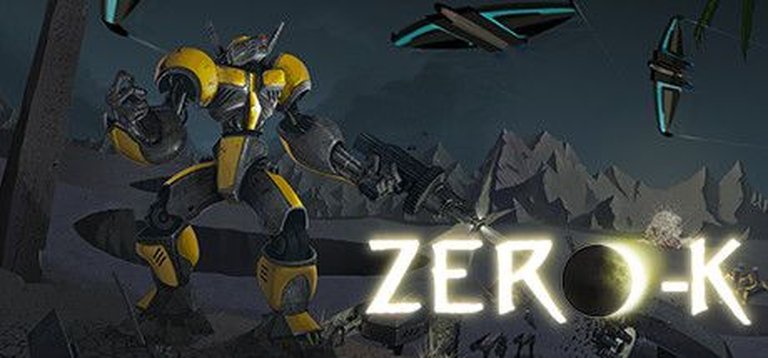
Zero-K is a free, open-source real-time strategy (RTS) game built on the Spring Engine, set in a futuristic sci-fi war where players command armies of mechs, tanks, and advanced vehicles. Featuring massive battles with up to 64 players, deformable terrain, physics-driven projectiles, and underwater combat, the game introduces unique mechanics like persistent RPG-style upgrades for commanders and Planet Wars—an MMO-inspired meta-game where clans compete to control galactic territories. Unlike traditional RTS titles, Zero-K uses a single-faction design with a flat tech tree to eliminate turtling and tier-based progression, focusing on strategic resource management and large-scale tactical warfare.
Gameplay Videos
Where to Buy Zero-K
PC
Zero-K Cracks & Fixes
Zero-K Mods
Zero-K Guides & Walkthroughs
Zero-K Reviews & Reception
techwombat.com (91/100): Zero-K is a fast-paced, space-themed RTS that takes its core inspiration from an even older game, Total Annihilation (1997), from which it has adapted most of its essential gameplay, buildings, and units.
metacritic.com (85/100): Zero-k is faithfully balanced, extremely polished and you can tell that it truly was built from the ground up with multiplayer in mind.
Zero-K Cheats & Codes
Zero-K (PC)
Enable cheat mode by typing `/cheat` in the console in singleplayer, or `!cheats` in multiplayer (requires admin or room boss status). After enabling, other cheat commands can be used.
| Code | Effect |
|---|---|
| /cheat | Enables cheat mode for use of other cheat commands. |
| !cheats | Enables cheat mode for use of other cheat commands in multiplayer (requires admin or room boss status). |
| /atm | Gives 1,000 metal and energy to the entering player’s team. |
| /destroy | Instantly destroys currently selected units. |
| /give [optional number] |
Spawns a given number of units at the location of the mouse cursor (or given coordinates). Can also be used to spawn features, e.g. wreckage. |
| /luarules give | Spawns one of each multiplayer unit and building (sorted by factory) in the top-left corner. |
| /globallos [optional team number] | Enables/disables full map view for that team (no team specified means it applies to everyone). |
| /godmode | When enabled, any player (including spectators) can give commands to units on any team. |
| /nocost | Enables/disables building everything for free and near-instantly. |
| /team |
Switches control to the selected playerteam (multiple playerteams make up an allyteam, typically two in a game). |
Zero-K: Review
Zero-K, a free, open-source real-time strategy (RTS) game, has carved out a niche for itself in the competitive gaming landscape since its inception in 2010. Built on the Spring Engine, Zero-K offers a dynamic and action-packed experience that has captivated strategy enthusiasts for over a decade. This review delves into the game’s development history, narrative, gameplay mechanics, world-building, reception, and legacy, providing a comprehensive analysis of its place in video game history.
Development History & Context
Zero-K’s development began as a fork of the open-source game Total Annihilation, a seminal RTS title from 1997. The game’s creators aimed to build on the foundational elements of Total Annihilation while introducing unique features and improvements. The Spring Engine, an open-source 3D RTS engine, provided the technological backbone for Zero-K, enabling developers to focus on gameplay mechanics and content creation.
The gaming landscape in 2010 was dominated by titles like StarCraft II and Supreme Commander, which set high standards for RTS games. Zero-K’s developers sought to differentiate their game by emphasizing a flat technology tree, allowing players to build any unit from the start without the need for research. This design choice aimed to streamline the gameplay experience and encourage creative strategies.
Narrative & Thematic Deep Dive
Zero-K’s narrative is minimalistic, focusing more on gameplay mechanics than a deep storyline. The game is set in a futuristic, sci-fi universe where players command a variety of units, from mechs and tanks to airplanes and ships. The single-player campaign takes players on a journey through a galaxy of ruined planets, each mission introducing new units and strategies.
The thematic focus of Zero-K revolves around strategic depth and tactical innovation. Players are encouraged to experiment with different unit combinations and strategies, with the game’s flat technology tree allowing for a high degree of flexibility. The narrative serves as a backdrop to the core gameplay experience, providing context without overshadowing the strategic elements.
Gameplay Mechanics & Systems
Zero-K’s gameplay is built around high-octane micromanagement and macromanaging the economy and base-building. The game features a flat technology tree, meaning all units and buildings are available from the start. This design choice encourages players to experiment with different strategies and unit combinations.
The economy in Zero-K is based on two resources: metal and energy. Metal is mined from extractors distributed around the map, while energy is collected from various buildings and used to power units and structures. The game’s interface allows for precise control over unit behavior, including queuing up units, ordering constructors to build multiple buildings, and setting patrol routes.
One of Zero-K’s standout features is its terraforming capability, which allows players to manipulate the terrain to their advantage. This adds a layer of strategic depth, as players can create defensive positions, block enemy movements, or gain height advantages.
World-Building, Art & Sound
Zero-K’s world-building is characterized by its futuristic, sci-fi setting. The game features a variety of units, from mechs and tanks to airplanes and ships, each with unique abilities and roles. The art style is cartoonish yet detailed, with units and structures designed to be both functional and visually appealing.
The sound design in Zero-K is immersive, with realistic unit and projectile physics adding to the gameplay experience. The game’s soundtrack complements the futuristic setting, providing an atmospheric backdrop to the strategic action.
Reception & Legacy
Zero-K has received critical acclaim for its innovative gameplay mechanics and strategic depth. PC Gamer named it one of the best free games of 2017, praising its dynamic and action-packed experience. The game’s open-source nature has fostered a dedicated community of developers and players, contributing to its continuous evolution and improvement.
Zero-K’s legacy lies in its influence on subsequent RTS games and the industry as a whole. Its emphasis on a flat technology tree and terraforming capabilities has inspired other developers to explore similar design choices, pushing the boundaries of the RTS genre.
Conclusion
Zero-K stands as a testament to the enduring appeal of real-time strategy games. Its innovative gameplay mechanics, strategic depth, and immersive world-building have captivated players for over a decade. The game’s open-source nature and dedicated community have ensured its continuous evolution, making it a staple in the RTS genre. Zero-K’s place in video game history is secure, and its influence will be felt for years to come.