
- Release Year: 2017
- Platforms: Windows
- Publisher: W+K Lodge
- Developer: W+K Lodge
- Genre: Educational, Simulation
- Perspective: 1st-person
- Game Mode: Single-player
- Gameplay: Escape room, Immersive control, Instruction-based
- Setting: Horror, Prison
- VR Support: Yes
Description
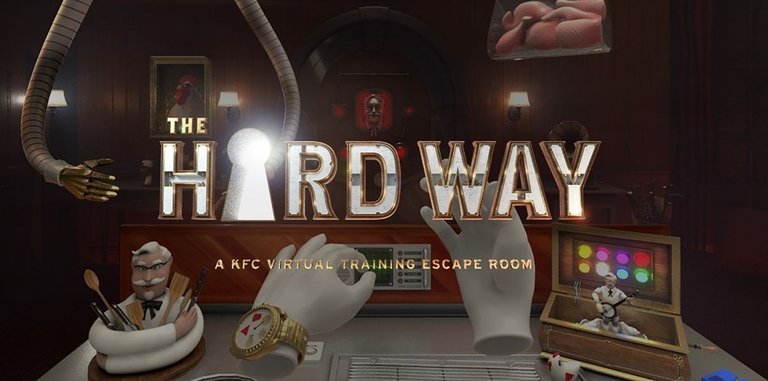
KFC The Hard Way is a VR escape room simulation developed for the Oculus Rift, blending horror-themed gameplay with a branded training experience for Kentucky Fried Chicken. Players are imprisoned by a supernatural Colonel Sanders—equipped with laser eyes and a robot companion—and must correctly follow KFC’s five-step chicken preparation process (inspecting, rinsing, breading, racking, and pressure frying) to escape. Originally designed as a supplemental employee training tool, this 10-minute Oculus Touch-controlled experience challenges users to master the authentic ‘Hard Way’ method while navigating mini-games and immersive escape room mechanics.
Gameplay Videos
KFC The Hard Way Reviews & Reception
dailyar.news : It’s too easy and short, so I don’t think it may be really considered a game.
KFC The Hard Way: A Surreal Blend of VR Training and Branded Horror
Introduction
In the annals of bizarre video game marketing experiments, KFC The Hard Way stands out as a surreal collision of corporate training, escape-room mechanics, and horror-infused absurdity. Released in 2017 by Wieden+Kennedy’s creative tech group, W+K Lodge, this Oculus Rift VR experience masqueraded as both a KFC employee training tool and a publicly available “game” starring a laser-eyed, robot-accompanied Colonel Sanders. This review dissects its legacy as a flawed but fascinating artifact of branded entertainment, asking: Can a 10-minute VR chicken-frying simulator be more than a corporate gimmick?
Development History & Context
The Studio and Vision
W+K Lodge, the experimental arm of advertising giant Wieden+Kennedy, pitched KFC The Hard Way as a “supplemental training program” for KFC employees. Jonathan Minori, W+K Lodge’s design director, framed VR as the ideal medium to “teach trainees how to make KFC’s Original Recipe” while leaning into the escape-room trend for entertainment value. The project’s dual mandate—utility and marketing—reflected KFC’s desire to modernize its image while preserving Colonel Sanders’ folksy mystique.
Technological Constraints and Ambitions
Built exclusively for Oculus Rift with Touch controllers, the game targeted mid-2010s VR hardware limitations. With just 10 minutes of gameplay, it prioritized accessibility over depth, banking on novelty rather than complexity. KFC’s US marketing director, George Felix, touted it as a bridge between the Colonel’s “handcrafted” 1940s process and modern tech—though critics later questioned its efficacy as a training tool.
The 2017 Gaming Landscape
Released amidst VR’s early consumer boom, KFC The Hard Way capitalized on the medium’s hype while competing with genre-defining titles like Robo Recall. Its blend of horror and simulation defied categorization, straddling the line between corporate propaganda and experimental indie game.
Narrative & Thematic Deep Dive
Plot: Colonel Sanders’ Sadistic Kitchen
Players are imprisoned by a cyborg-esque Colonel Sanders, who tasks them with preparing KFC chicken to escape. The Colonel, sporting laser eyes and a robotic sidekick, oscillates between comedic and sinister—a far cry from his wholesome public persona. The narrative frames chicken preparation as a life-or-death trial, weaponizing KFC’s “11 herbs and spices” lore into a dystopian gauntlet.
Themes: Corporate Control and Absurdity
Beneath its campy surface, the game explores themes of corporate indoctrination. The Colonel’s authoritarian presence—monitoring players via cameras and issuing terse commands—mirrors real-world workplace surveillance. Yet the surreal tone (laser eyes, robot companions) undercuts any serious critique, reducing the experience to a self-aware parody of brand mythology.
Gameplay Mechanics & Systems
Core Loop: Fry or Die
The gameplay revolves around five steps: inspecting, rinsing, breading, racking, and frying chicken. Using Oculus Touch, players manipulate tools like flour dredgers and pressure fryers, guided by the Colonel’s vague directives. Failures—like undercooked chicken—trigger his wrath, but penalties are minimal, reducing stakes.
Innovation vs. Frustration
While VR immersion enhances the tactile novelty of breading chicken, the puzzles lack challenge. DailyAR’s review noted that solutions often rely on trial-and-error (“licking” virtual meat to inspect quality) rather than skill, undermining its training premise. The 10-minute runtime exacerbates these issues, leaving no room for progression or mastery.
UI and Accessibility
The UI is minimalist, relying on diegetic interfaces like kitchen timers. However, the small play area and limited interactivity (objects outside reach are purely decorative) highlight the game’s constrained scope.
World-Building, Art & Sound
Visual Design: Industrial Horror Meets Fast-Food Kitsch
The setting—a dimly lit, metallic kitchen—evokes a sci-fi prison, with KFC branding lurking in the shadows. The Colonel’s exaggerated design (glowing eyes, mechanical voice) leans into horror-camp, while the hyper-realistic chicken models contrast grotesquely with the absurd tone.
Sound Design: Clucking Dread
The soundtrack amplifies tension with ominous drones and clattering kitchen noises. The Colonel’s voice—distorted and patronizing—heightens the unease, though his quips (“You call that breading?”) occasionally veer into dark comedy.
Reception & Legacy
Critical Response: Lukewarm Wings
Critics dismissed KFC The Hard Way as a middling marketing stunt. DailyAR called it “too confused about what it wants to be,” lambasting its shallow puzzles and lack of educational value. Others praised its atmosphere but questioned its $0 price tag: Was this a game, an ad, or a failed training tool?
Commercial Impact and Influence
Despite minimal player engagement (MobyGames lists just one collector), the game succeeded as a viral curiosity. Its escape-room template influenced later branded VR experiences, demonstrating how corporations could gamify training—or at least generate headlines.
Conclusion
KFC The Hard Way is neither a great game nor an effective training program, but as a cultural artifact, it epitomizes the 2010s’ VR gold rush and the absurd lengths brands will go to stay relevant. Its blend of horror, humor, and corporate didacticism remains unforgettable—if only for its sheer audacity. While it won’t be remembered alongside VR classics, it earns a place in gaming history as a deliciously weird experiment in fast-food storytelling. Colonel Sanders would be proud. Or maybe he’d just laser-eye you for undercooking the chicken.